Fingerprint scanners, which were once reserved for biometric logging systems and attendance systems, are now part of regular smartphones and much more. Fingerprints have been a trusted method of personal identity. Combined with face id or other biometric identification systems like retina scanning, fingerprints offer an impeccable way to recognize any person. With a blast of mobile applications and wearables, the use of fingerprint scanning has quite moved from ‘identification’ to ‘authentication’. Soon, it may not remain confined to unlocking your mobile phones and their applications. Many IoT applications like smart home automation, IIoT, and digital security applications are already using fingerprint scanners wherever user identification, authentication, or recognition is required.
As the use cases show, the electronics behind fingerprint scanners are equally interesting. In this article, we will explore different types of fingerprint scanners based on their underlying electronics.
Fingerprints are unique markers
The pattern of tiny ridges and valleys on the skin of fingers is called a fingerprint. A surprise of nature, human fingerprints are unique markers. Probably, in the course of human evolution, fingerprints were an adaptation to firmly grip and hold things, just like tires have tread patterns to hold a grip of the road.
Interestingly, fingerprints are formed by the seventh month of fetus development. The pattern formed by fingerprints is dictated by the genetic code as well as several environmental factors. Apart from the genetic code that decides how fetus’s position influences skin forms on the developing fetus, the development of every ridge of the fingerprint in the womb, composition and density of the surrounding amniotic fluid, and several other fetal development factors. All these events and factors are so random that there is never any chance of two human beings, even if they are twins, have the same fingerprints ever.
Even more interesting is that the fingerprints set in the womb remain unchanged for a lifetime. No doubt, fingerprints are unique identifiers of humans.
How fingerprint scanners work
Any fingerprint scanner, irrespective of its underlying electronics, scans a digital image of the fingerprint. The sample image is stored in memory and used for comparison with future scans.
The comparative analysis of the entire fingerprint image is often too processor-intensive. That is why most of the scanning systems look for unique patterns in a fingerprint image. These unique features of a fingerprint are called minutiae. The scanner looks for points where ridges end or split into two ridges. These distinct features are called typical. The scanning software records the absolute positions of minutiae in the scanned image and maps them to find their relative position with respect to each other. This results in unique shapes and dimensions between various minutiae.
Like the fingerprint, the resulting shapes and dimensions are always unique. By identifying a sufficient number of minutiae, their absolute positions in the scan, and relative pattern, a scanner can identify a particular fingerprint uniquely. All of this involves complex image processing algorithms.
Many fingerprint scanners have additional sensors like pulse sensors or heat sensors to determine if the scanned image is from a live finger or not. A fingerprint scanner relies on the digital image of the scanned fingerprint. Sometimes it is possible to forge fingerprints using a print image, finger mold, or cloning from residual fingerprints. The use of additional sensors helps detect forging misadventures.
Types of fingerprint scanners
Based on electronics, there are four types of fingerprint scanners –
- Optical scanners
- Capacitive scanners
- Ultrasonic scanners
- In-display scanners
In embedded applications, optical and capacitive scanners are most common. Mobile devices and wearables mostly have capacitive or in-display scanners.
Optical scanners
Optical scanners are the earliest models of fingerprint scanners. As the name suggests, these scanners capture the fingerprint’s optical image using CCD or CMOS image sensors. These are similar to camera sensors, though they are designed to take high-contrast images compared to any regular camera. The sensor consists of an array of LEDs that the CCD/CMOS sensors capture light up the finger’s areas and the reflected light waves. The sensor is packed with a high density of diodes to get a detailed image of the fingerprint. The captured image is a 2D picture of the scanned fingerprint. The latest models are as small as 1mm in dimensions and can even scan wet fingers. As the costs are gradually falling, optical-capacitive hybrid scanners capable of detecting live finger are trending.
The optical scanners, despite all current advancements, are still easy to fool. The fingerprints can be forged using a fingerprint’s high-resolution image, a prosthetic, or an artificial finger.
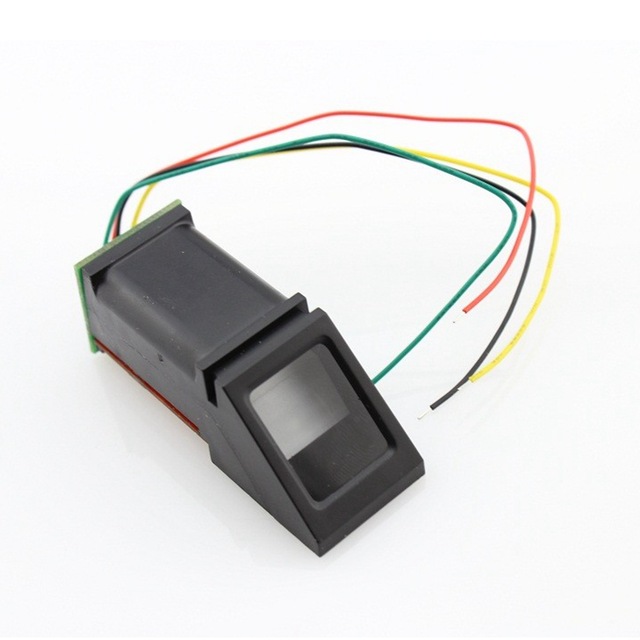
Example of optical fingerprint scanner
Capacitive scanners
Capacitive scanners use entirely different technology to read a fingerprint. It uses an array of hundreds of small capacitors to detect capacitance between finger ridges and valleys for capacitor plates. Wherever there’s a ridge, its distance with the capacitor plate is small, resulting in slightly less capacitance. Wherever there’s a valley, its distance with the capacitor plate is greater with an air gap in-between. This results in larger capacitance. The capacitance from each capacitor in the array is passed to the operational amplifier and recorded with analog-to-digital converters’ help. This produces a digital scan of the fingerprint according to the capacitive touch sensing.
The capacitive scanners are not easy to fool and can even detect a live finger. The only way to forge a fingerprint with the capacitive scanner is to hack the controller hardware or software. Otherwise, these scanners can neither be fooled by a print image or a prosthetics by the principle of operation. A print image will have consequential capacitive effects, and a prosthetic can not exactly mimic a live finger’s touch capacitance.
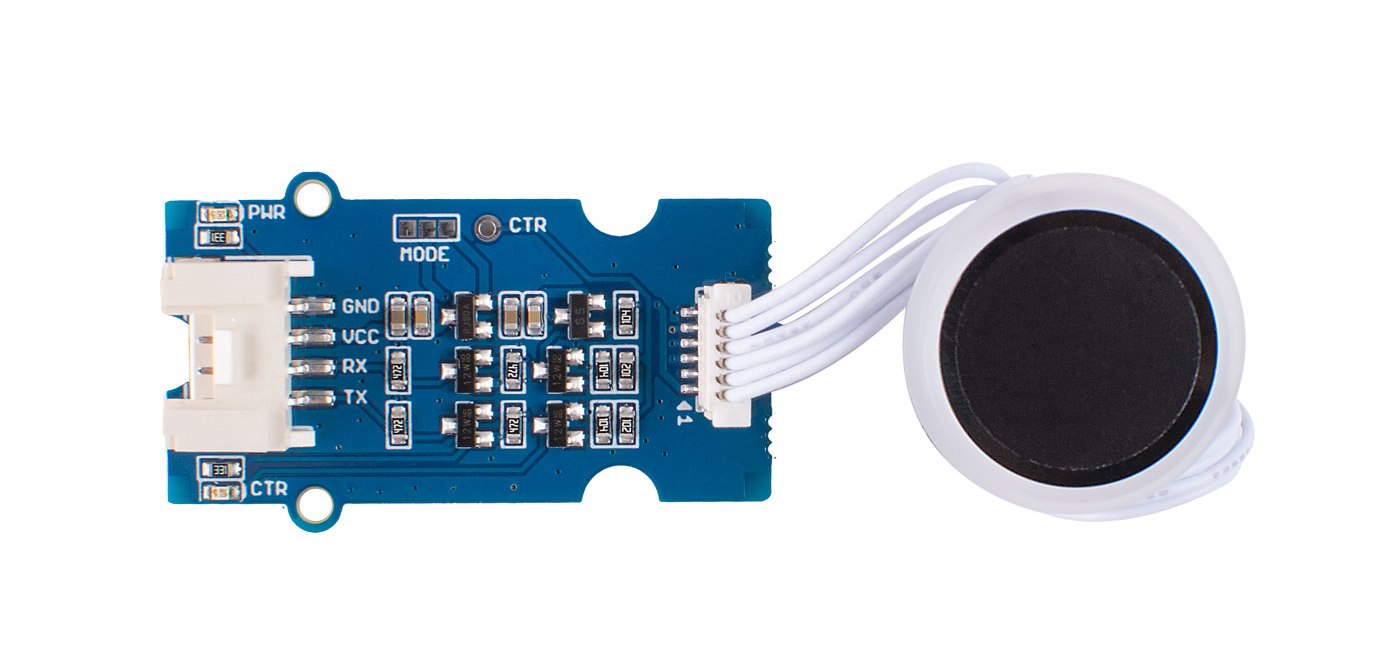
Example of an optical fingerprint scanner.
Ultrasonic scanners
The ultrasonic scanners are the latest and most sophisticated fingerprint scanners capable of producing 3D scans of fingerprints. At present, this technology is only in use in some high-end smartphones. In an ultrasonic scanner, there is an array of ultrasonic transmitters and receivers. The transmitters emit ultrasonic pulses reflected in the ridges, valleys, and pores of the fingerprint. An array of receivers senses the reflected pulses. The receivers are actually sensors that measure mechanical stress due to the intensity of reflected ultrasonic pulses at different points. This results in a 3D map of the fingerprint scan, which is must be detailed compared to the 2D scan of any capacitive scanner.
Ultrasonic scanners require some time to effectively capture the 3D map of a fingerprint. Ultrasonic scanners are easy to implement. They are often used for in-display scanners in smartphones. It is almost impossible to forge ultrasonic scanners like capacitive scanners. The 3D feature of the scanned fingerprint makes the technology even more robust. Like capacitive scanners, ultrasonic scanners can also be forged only by hacking the hardware or the software. By the principle of operation, ultrasonic scanners are almost impeccable.
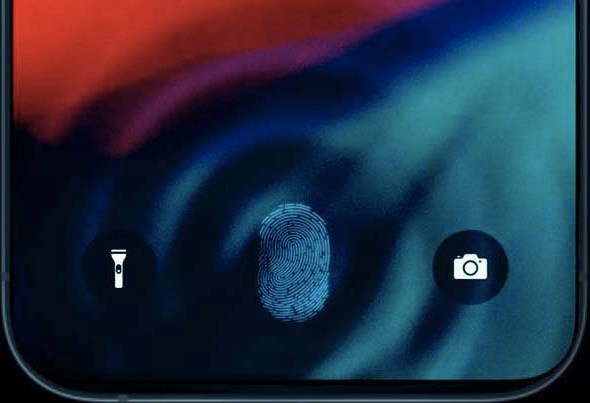
Example of ultrasonic fingerprint scanner in a smartphone.
In-display scanners
A lot of smartphones now come with in-display fingerprint scanners. These are either ultrasonic or optical-capacitive scanners. Smartphones and other wearables using OLED screens prefer to use optical-capacitive scanners. In contrast, ultrasonic scanners are widely used in medium-range smartphones and products because they are easy and cost-effective to implement.
Fingerprint scanners for Arduino, Raspberry Pi, and other embedded prototyping platforms –
The optical and capacitive scanners are quite commonly used for embedded applications. A good example of an optical scanner is the R305 model. It has been quite popular among electronics hobbyists for years. R303 is a popular capacitive scanner good to start with. These scanners usually communicate data with a microcontroller or microcomputer over the UART interface. It is easy to interface and operate them as they come with instructions to record, scan and compare fingerprints. All these instructions can be easily communicated with the scanner over UART protocol.
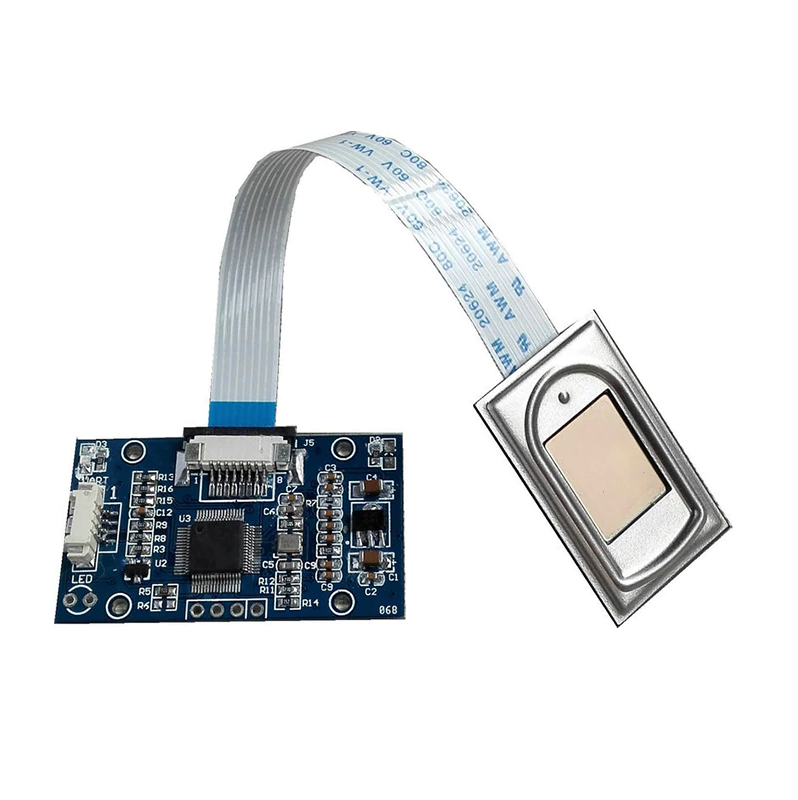
Example of capacitive fingerprint scanner R303.
Conclusion
Fingerprint scanners are handy devices. These must be combined with other biometric or authentication methods to implement a foolproof person identification system. This may involve incorporating other ‘who-you-are’ systems like retina scanning or iris scanning, ‘what-you-know’ systems like PIN codes, or ‘what-you-have’ systems like RFID tags or smart cards. Biometric identification systems like fingerprint scanners are useful in designing IIoT, logging and attendance applications, smart homes, and security applications.
Fingerprint scanners, types of fingerprint scanners, optical fingerprint scanner, capacitive fingerprint scanner, ultrasonic fingerprint scanner, in-display fingerprint scanner, R305 fingerprint scanners, R303 fingerprint scanner, fingerprint scanner Arduino, fingerprint module Arduino, fingerprint scanner raspberry pi, fingerprint module raspberry pi,
You may also like:


Filed Under: Featured, What Is
Questions related to this article?
👉Ask and discuss on Electro-Tech-Online.com and EDAboard.com forums.
Tell Us What You Think!!
You must be logged in to post a comment.