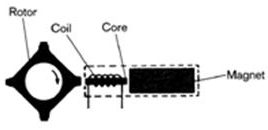
SPEED – a buzz word in today’s scenario, is a measure of “how fast”. Everybody is in a rat race and wants to run at the fastest speed. ‘Speed’ is used in variety of contexts and is measured using variety of methods in their own contexts.According to physics, speed is related to motion. Distance travelled by a moving body in a given time is called speed. Other related terms are angular speed, velocity, and angular velocity. Angular speed is the angular distance per unit time. (Linear) Velocity and angular velocity are vector quantities and are defined as displacement (linear/angular) per unit time.Speed is measured using different kinds of sensors operating on different principles. Subsequent sections will discuss various kinds of sensors used for measurement of speed (and related vector quantity, velocity).
CISC & RISC Architecture

Instruction Set Architecture(ISA) is important from user’s/ compilers perspective. Instruction Set Architecture is a ‘functional appearance to its immediate user/programmer’. ISA involves details like addressing modes, opcodes, registers, etc. Microarchitecture is important from the perspective of processor designer. Microarchitecture defines the logical structure or organisation that implements ISA. It involves details of pipelining stages, caches, physical registers, functional units, etc.Realization of hardware is important from the perspective of chip designer. Hardware is the actual “physical structure that embodies the implementation.” It involves micro-details of gates, transistors, wires, etc.Processors having identical ISA may be very different in organization. Processors with identical ISA and nearly identical organization are still not nearly identical.
Ethernet
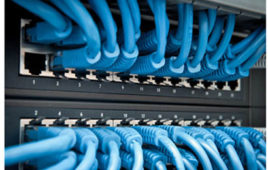
Networking is playing vital role in current IT era where data distribution and access is critically As the use of communication between important. two or more entities increases the networking technologies need to be improved and refurbished over time. Similarly the transmission media, the heart of a network, has been changed with the time improving on the previous one. If you know a little bit about networking you surely have heard the term Ethernet which is currently the dominant network technology.Wide spread of the Ethernet technology made most of the offices, universities and buildings use the technology for establishment of local area networks (LANs).To understand what actually Ethernet is, we need to know about IEEE first which is a short of Institute of Electrical and Electronics Engineers. IEEE is a part of International Organization for Standardization (ISO) whose standard IEEE 802.3 is defined for Local Area Network.
Magnetometers
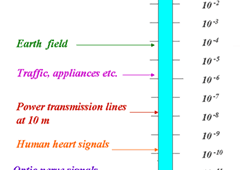
All of us probably are aware about the fact that the magnets create magnetic fields; earth has a magnetic field; current flowing in a wire also generate magnetic field. But have we ever realized that the fields are generated also by our heart and brain. However, what differs between the magnetic field generated by a magnet and that generated by brain and heart is the magnitude of magnetic field. Following figure shows the magnitude of magnetic fields generated by various sources. We all are surrounded by magnetic fields. Magnetic fields are generated by flowing electrical current in various electrical/electronic appliances; TV, computers, power transmission lines, etc. Earth also has its own magnetic field, though relatively small. Earth magnetic field is largest at the poles (~ 60 000 nT) and smallest as the equator (~ 30 000 nT). The earth’s magnetic field strength is proportional to 1/r3 (until the influence from the solar wind gets noticeable).
Current Sensors

Measuring a voltage in any system is a “passive” activity as it can be done easily at any point in the system without affecting the system performance. However, current measurement is “intrusive” as it demands insertion of some type of sensor which introduces a risk of affecting system performance. Current measurement is of vital importance in many power and instrumentation systems. Traditionally, current sensing was primarily for circuit protection and control. However, with the advancement in technology, current sensing has emerged as a method to monitor and enhance performance. Knowing the amount of current being delivered to the load can be useful for wide variety of applications. Current sensing is used in wide range of electronic systems, viz., Battery life indicators and chargers, 4-20 mA systems, over-current protection and supervising circuits, current and voltage regulators, DC/DC converters, ground fault detectors, programmable current sources, linear and switch-mode power supplies, communications devices , automotive power electronics, motor speed controls and overload protection, etc.
Humidity Sensor

Humidity is the presence of water in air. The amount of water vapor in air can affect human comfort as well as many manufacturing processes in industries. The presence of water vapor also influences various physical, chemical, and biological processes. Humidity measurement in industries is critical because it may affect the business cost of the product and the health and safety of the personnel. Hence, humidity sensing is very important, especially in the control systems for industrial processes and human comfort. Controlling or monitoring humidity is of paramount importance in many industrial & domestic applications. In semiconductor industry, humidity or moisture levels needs to be properly controlled & monitored during wafer processing. In medical applications, humidity control is required for respiratory equipments, sterilizers, incubators, pharmaceutical processing, and biological products. Humidity control is also necessary in chemical gas purification, dryers, ovens, film desiccation, paper and textile production, and food processing.
Load Cell
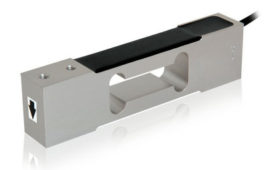
Day-in and day-out we have been using electronic scales or weighing machines. You go to any grocery store or a jewellery shop; the items are weighed using electronic weighing machines (Weighing balances are also used in situations where very high accuracy is not of paramount importance). But, have we ever given a thought on the mechanism of the electronic scales? At the heart of electronic scales or weighing machines is a sensor called load cell. These sensors sense the force (or weight) of the items and the electronic circuitry processes the sensors’ output and displays it on the indicator. Load cells are highly accurate transducers which provide the user with information not generally obtainable by other technology due to commercial factors. Usage of load cell is not limited to electronics scales; they are used load testing machines, industrial scales, flow-meters, etc., though we hardly ever come in direct contact with the load cells.
Gesture Recognition Technology
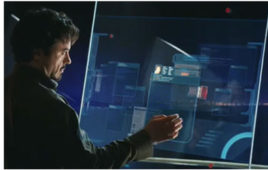
“Have you seen the remote?” “I left it on the table after watching my matinee show”. “It is not here, I will miss the news again because of you!!!” In the near future, such heated discussions over remote control won’t disturb the harmony of the house. Not because they will place it correctly but because soon remote controls will be the objects of the past. Technology has finally reached that dimension when our hands will take over the job and replace them by directly communicating with the computer or television. For instance, in order to delete a folder or file from the computer, place your palm on it, and throw it like a paper in a dustbin. Even while using the microwave oven to bake a cake, waving our hands in the air like a magician would serve as a command for the oven. While some of us might be thinking of it being a futuristic vision, some of us have already experienced it through what we call “Gesture Recognition Technology.”
CDMA Technology

Primary requirements for any wireless mode of communication include high quality of service and data secrecy. Realizing that these two factors are to be fulfilled in the most optimized ways without the costs going too high, CDMA, a spread spectrum based technology came into existence. Initially restricted to the armed forces, this technology was commercially launched in 1995 by Qualcomm Telecommunications and now, as per Q4 of the year 2011, CDMA has over 8 billion voice and data customers in the 122 countries that it operates. CDMA is regarded as an improvement over GSM technology whose need can be easily understood by taking a simple example. Consider 5 couples that have their respective partners in different rooms. The partners are permitted to communicate only to each other and each is provided with a communication instrument for the purpose.
Joysticks
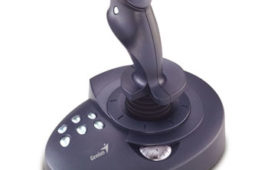
If you have ever visited a video game parlour to play a video game, you definitely would have used a JOYSTICK. Originally invented for flight controllers and motion simulators, they gained acceptance in number of systems, ranging from video games to industrial systems. Millions of video game enthusiasts, crane operators, etc. would owe a debt of gratitude to the inventor of this wonderful device, a joystick, though the inventor of this device is not quite known. The word ‘Joystick’ was used first by Robert Loraine and was cited in the Oxford English Dictionary, though he didn’t invent the device. Mr. Robert Esnault – Pelterie is also mentioned to be an originator of this buzz word. A E George along with Jobling used a stick for the first time when they flew an aircraft and this stick gained popularity as Joystick.
Escalators

In old days when modes of transportation were not there, people used to walk to the places they wanted to reach. For transportation of goods, bullock carts, camels, horses, etc. were often used. All this was meeting the mobility requirements as the settlements were not too dispersed. With the rapid advancement in the development of tall building and public facilities, it became paramount to address the need to transportation of pedestrians and also of goods. With multi-storeyed buildings or large shopping complexes or airports, it is unreasonable to expect the user to travel across the buildings/ public facilities by means of walking alone, at least not in a timely manner. Towards this end, innovations sprung up facilitating movement of pedestrians as well as goods in large shopping malls, multi-storeyed residential buildings, airports and other public facilities.
Classifications of RADAR
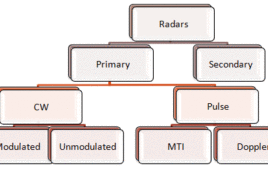
When we start reading about radar, we come across various terms which are explained differently. There are various kinds of Radar classified in different ways. This article explains the various radar types in a lucid manner. A Primary Radar transmits high-frequency signals toward the targets. The transmitted pulses are reflected by the target and then received by the same radar. The reflected energy or the echoes are further processed to extract target information. Secondary radar units work with active answer signals. In addition to primary radar, this type of radar uses a transponder on the airborne target/object. The secondary radar unit transmits and also receives high-frequency impulses, the so called interrogation. This isn’t simply reflected, but received by the target by means of a transponder which receives and processes. After this the target answers at another frequency.
RADAR (Radio Detection and Ranging)

If you have sometimes experienced the reflection of a sound due to the presence of a sound reflecting object like a canyon/ cave, etc. you have in a way experienced how radar functions. When you shout near towards a valley or a mountain, the reflection of a sound, i.e., the echo comes back. The time an echo requires to come back can be used to estimate the distance of the reflecting object, provided the speed of sound in air is known. Radar functions in a similar manner to find out the location of the reflection object using RF waves. Radar is an acronym for RAdio Detecting And Ranging. The name itself suggests that the radars are used to detect the presence of object and determine its range, i.e., distance and bearing, using radio frequency waves.
Swarm Robotics

“When everybody thinks alike, nobody is thinking much”, is so rightly said. Think out-of-the-box and you potent some innovation or maybe an invention; credits to your gamut. To speak in line with the concept here, swarming population; not always, is a bad idea. How about rescuing some disaster hit zone with swarming intelligent population or maintaining a warehouse with moving, self-operational shelves?? A great idea indeed. Everybody must have noticed the movement of ants or similar insects. It is awesomely coordinated and aligned with respect to each other. They accomplish their task collectively by keeping an eye on each other’s movement. This type of coordinated movement in insects is termed as Swarm and when this movement is performed by some group of robots then in technical terms it is called as “Swarm Robotics” inspired by colonies of ants and swarms of bees.
CMOS (Complementary Metal-Oxide Semiconductor)
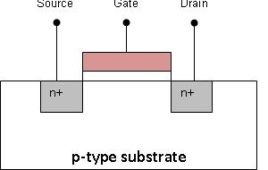
The first working point contact transistor developed by John Bardeen, Walter Brattain and William Shockley at Bell laboratories in 1947 initiated the rapid growth of the information technology industry. In 1958, J Kilby invented the first integrated circuit flip flop at Texas and soon after this; Frank Wanlass at Fairchild described the first CMOS logic…
COB ICs
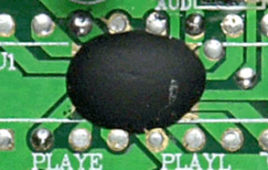
The quest to fabricate more and more devices in a minimum Silicon space has been ON since J. K and R. Noyce invented the first ICs. This quest has enabled scientific community to cross various technological frontiers. Sustained efforts to put more and more transistors on a wafer have led us to nanotechnologies. In the commonly used electronic technology, the semiconductor chips (also known as bare-dice) are individually mounted on a package, and wire-bonded to its I/O pins. This package is then mounted on a Printed Circuit Board (PCB). However, not only does packaging of single chip ICs cost more than the cost of the chips they contain, packaging of a chip take relatively large amount of physical space. Using a conventional single chip package and circuit board interconnect strategy, the package and interconnects took up over 50% of the timing budget as well.
IRIS Detection or IRIS Recognition
Day in and day out we need to prove our identity at various places, for secure access to buildings, air and rail travel, to cast a vote, etc. Security and the authentication of individuals are necessary in different spheres of life. Traditionally, we have been using photo-based identity cards to prove our identity and we have been quite accustomed to it. These identity cards were augmented/replaced by passwords in many cases. However, of late, these conventional identity proofs are being replaced by biometric identifications to overcome many of the shortfalls of these methods. One of the most dangerous security threats is the impersonation, in which somebody claims to be somebody else. Trend in the identification & authentication world is headed towards biometrics. Finger prints, face recognition, Iris Recognition, DNA pattern recognition are replacing printed identity cards.
Multi-touch Screen Technology

While we are all fascinated by the touchscreen-market gimmick cajoling us with its ‘Touch away’ tagline, are we actually only at an inch’s distance? This ‘no-distance’ de facto makes sense at the front end only. When given a hawk’s eye, there is another world inside waiting to be discovered, waiting to satiate your knowledge for technology. Well, for the smart gadgets with smart people in the smart world, it’s an uncanny missing out a discussion on Touchscreen Technology, specifically undertaking the Multitouch Technology. The multi-touch or the plural touch is an interactive technique which allows users to interact with the digital environment inside the gadget, directly or indirectly with his fingers or palm. Multi-touch devices include smart phones, touch tables, computer tables, public kiosks, walls, and ‘touchpad’. Well these inverts in touchpad bring us to a minute line of demarcation between touchscreen and touchpad.
Infrared Sensors or IR Sensors
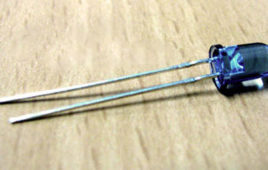
Infrared radiation is the portion of electromagnetic spectrum having wavelengths longer than visible light wavelengths, but smaller than microwaves, i.e., the region roughly from 0.75µm to 1000 µm is the infrared region. Infrared waves are invisible to human eyes. The wavelength region of 0.75µm to 3 µm is called near infrared, the region from 3 µm to 6 µm is called mid infrared and the region higher than 6 µm is called far infrared. Active infrared sensors employ both infrared source and infrared detectors. They operate by transmitting energy from either a light emitting diode (LED) or a laser diode. A LED is used for a non-imaging active IR detector, and a laser diode is used for an imaging active IR detector. In this types of IR sensors, the LED or laser diode illuminates the target, and the reflected energy is focused onto a detector. Photoelectric cells, Photodiode or phototransistors are generally used as detectors. The measured data is then processed using various signal-processing algorithms to extract the desired information.
Micro-Electro-Mechanical Systems (MEMS)

Micro-Electro-Mechanical Systems or MEMS is a precision device technology that integrates mechanical elements, sensors, actuators, and electronics on a common silicon substrate through micro fabrication technology. MEMS is also referred to as MST (Microsystems Technology in Europe) and MM (Micromachines in Japan). MEMS with optics is called MOEMS- Micro-Opto-Electro-Mechanical-Systems). ICs can be thought of as the “brains” of a system and MEMS augments it with the “Senses” and “Limbs”. While the electronics are fabricated using integrated circuit (IC) batch processing techniques, MEMS uses compatible “micromachining” processes, in addition to IC fabrication processes, that selectively etch away parts of the silicon wafer or add new structural layers to form the mechanical and electromechanical devices. These systems can sense, control and actuate on microscale, and function individually or in arrays to generate effects on macroscale.