Engineers Garage

  • Electronic Projects & Tutorials
    • Electronic Projects
      • Arduino Projects
      • AVR
      • Raspberry pi
      • ESP8266
      • BeagleBone
      • 8051 Microcontroller
      • ARM
      • PIC Microcontroller
      • STM32
    • Tutorials
      • Audio Electronics
      • Battery Management
      • Brainwave
      • Electric Vehicles
      • EMI/EMC/RFI
      • Hardware Filters
      • IoT tutorials
      • Power Tutorials
      • Python
      • Sensors
      • USB
      • VHDL
    • Circuit Design
    • Project Videos
    • Components
  • Articles
    • Tech Articles
    • Insight
    • Invention Stories
    • How to
    • What Is
  • News
    • Electronic Product News
    • Business News
    • Company/Start-up News
    • DIY Reviews
    • Guest Post
  • Forums
    • EDABoard.com
    • Electro-Tech-Online
    • EG Forum Archive
  • DigiKey Store
    • Cables, Wires
    • Connectors, Interconnect
    • Discrete
    • Electromechanical
    • Embedded Computers
    • Enclosures, Hardware, Office
    • Integrated Circuits (ICs)
    • Isolators
    • LED/Optoelectronics
    • Passive
    • Power, Circuit Protection
    • Programmers
    • RF, Wireless
    • Semiconductors
    • Sensors, Transducers
    • Test Products
    • Tools
  • Learn
    • eBooks/Tech Tips
    • Design Guides
    • Learning Center
    • Tech Toolboxes
    • Webinars & Digital Events
  • Resources
    • Digital Issues
    • EE Training Days
    • LEAP Awards
    • Podcasts
    • Webinars / Digital Events
    • White Papers
    • Engineering Diversity & Inclusion
    • DesignFast
  • Guest Post Guidelines
  • Advertise
  • Subscribe

Controlling Appliances Wirelessly using RF Technology

By Gurmeet Singh January 18, 2021


REQUIREMENTS:

1. Encoder/Decoder (HT12E/HT12D)
2. RX/TX module (433 MHz)
3. SPDT switches (4)
4. Relays (4) {to handle 220 ac voltage}
5. 7805 voltage regulator IC
6. L293d {for operating 12V relays}
Nowadays everyone needs a device which could control appliances wirelessly. This allows us to operate them on our fingertips from particular vicinity with ease.
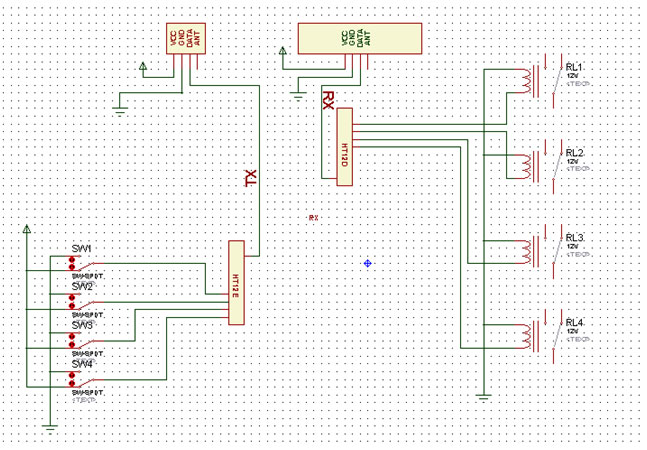
This time I have created a prototype of a device which controls 4 devices/appliances separately using RF (Radio Frequency) technology. The device comprises two sections: Transmitting (remote) and Receiving part.
The transmitting part works as a remote device to send the corresponding data to the receiver section. It further consists of 4 SPDT (single pole double throw) switch, one Encoder IC (HT12E) and a TX module (433 MHz). These 4 switches are connected to the 4 data pins of the encoder IC to generate a 4-bit data to be transmitted. The switches provide either high (+5V) or low (0V) signal levels.
At the receiver’s part, this 4-bit data is received wirelessly by the decoder IC via RX module and then corresponding output is given at the data pins of the decoder. The 4 relays are connected to these 4 data outputs which react only to the high state (+5V) i.e. for (+5V) it will remain on and for (0V) it will go off. This technique even helps to operate appliances working on 220 AC voltage.
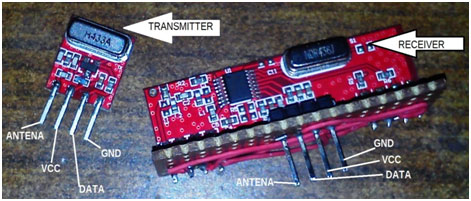
Image of 433MHz RF Transmitter and Receiver Modules
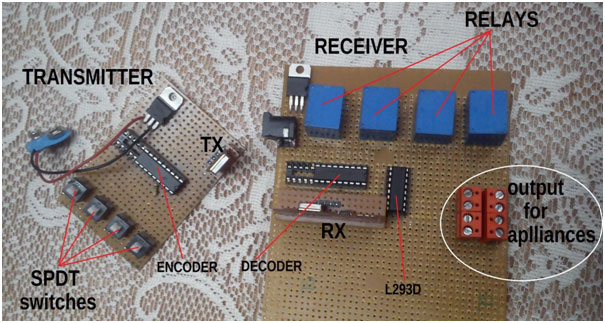
Fig. 1: 

Image of 433MHz RF Transmitter and Receiver Modules

Prototypes of 433 MHz RF Transmitter and Receiver Modules based on HT12E and HT12D ICs

Fig. 2: Prototypes of 433 MHz RF Transmitter and Receiver Modules based on HT12E and HT12D ICs


ABOUT Encoder/Decoder:

Encoders and decoders are used when we need to send our data serially. The encoder decoder pair which I have used is HT12E/HT12D respectively. These are 18 pin ICs.
 These encoders/decoders require 12 bits for communication out of which 8 are the address pins and the rest four are the 4-data pins. For a pair of these encoders/decoders to work together their address should match, only then the data will be decoded at the decoder part.
The figure bellow represents how the wave is generated for the communication to take place:
Now here first 8 (1-8) pulses correspond to the address pins and the pulses 9-12 are the data one.
Since there are only 4 bits for data communication therefore this makes them a 4 bit data encoder/decoder IC.
These encoders/decoders also require a clock pulse at pin 15&16 which can be provided by simply connecting these two pins via a specified resistance. I have used 1M Ohm for the encoder part while decoder works with 33K Ohm (these values are specified in their datasheet).
To know more about these ICs do visit the links below:

(ENCODER):http://www.engineersgarage.com/electronic-components/ht12e

(DECODER):http://www.engineersgarage.com/electronic-components/ht12d-datasheet


ABOUT RF module:

These modules are really simple to deal with. They just require a VCC (+5V), GND (0V) and the DATA connection. Some of them need ANTENA (ANT) connection as well. The module that I have used works on 433 MHz frequency to transmit data wirelessly.
Now the question which arises is that how to interface Rx/Tx with our Decoder/Encoder part. It’s really simple; just connect the data out pin of the encoder with the data pin of Tx and the data pin of Rx with the data in pin of the decoder.

You may also like:


  • What are different types of industrial robots?

  • What are LoRa gateways and what types are available?

  • How does LoRa modulation enable long-range communication?

  • How to select drone motors

  • What are the different EV charging protocols?

  • What battery chemistries are used in electric vehicles?

Circuit Diagrams

Circuit-Diagram-433-MHz-RF-Transmitter-Receiver-Modules

Project Video


Filed Under: Circuit Design, Electronic Projects
Tagged With: 8051, home automation, rf, RF module
 

Next Article

← Previous Article
Next Article →

Questions related to this article?
👉Ask and discuss on Electro-Tech-Online.com and EDAboard.com forums.


Tell Us What You Think!! Cancel reply

You must be logged in to post a comment.

EE TECH TOOLBOX

“ee
Tech Toolbox: Internet of Things
Explore practical strategies for minimizing attack surfaces, managing memory efficiently, and securing firmware. Download now to ensure your IoT implementations remain secure, efficient, and future-ready.

EE Learning Center

EE Learning Center
“engineers
EXPAND YOUR KNOWLEDGE AND STAY CONNECTED
Get the latest info on technologies, tools and strategies for EE professionals.

HAVE A QUESTION?

Have a technical question about an article or other engineering questions? Check out our engineering forums EDABoard.com and Electro-Tech-Online.com where you can get those questions asked and answered by your peers!


RSS EDABOARD.com Discussions

  • Voltage mode pushpull is a nonsense SMPS?
  • Input impedance matching network
  • High Side current sensing
  • The comparison of different Tcl script checkers
  • Reducing "shoot-through" in offline Full Bridge SMPS?

RSS Electro-Tech-Online.com Discussions

  • Is AI making embedded software developers more productive?
  • Back to the old BASIC days
  • Parts required for a personal project
  • PIC KIT 3 not able to program dsPIC
  • Failure of polypropylene motor-run capacitors

Featured – RPi Python Programming (27 Part)

  • RPi Python Programming 21: The SIM900A AT commands
  • RPi Python Programming 22: Calls & SMS using a SIM900A GSM-GPRS modem
  • RPi Python Programming 23: Interfacing a NEO-6MV2 GPS module with Raspberry Pi
  • RPi Python Programming 24: I2C explained
  • RPi Python Programming 25 – Synchronous serial communication in Raspberry Pi using I2C protocol
  • RPi Python Programming 26 – Interfacing ADXL345 accelerometer sensor with Raspberry Pi

Recent Articles

  • What is AWS IoT Core and when should you use it?
  • AC-DC power supply extends voltage range to 800 V DC
  • Infineon’s inductive sensor integrates coil system driver, signal conditioning circuits and DSP
  • Arm Cortex-M23 MCU delivers 87.5 µA/MHz active mode
  • STMicroelectronics releases automotive amplifiers with in-play open-load detection

EE ENGINEERING TRAINING DAYS

engineering

Submit a Guest Post

submit a guest post
Engineers Garage
  • Analog IC TIps
  • Connector Tips
  • Battery Power Tips
  • DesignFast
  • EDABoard Forums
  • EE World Online
  • Electro-Tech-Online Forums
  • EV Engineering
  • Microcontroller Tips
  • Power Electronic Tips
  • Sensor Tips
  • Test and Measurement Tips
  • 5G Technology World
  • Subscribe to our newsletter
  • About Us
  • Contact Us
  • Advertise

Copyright © 2025 WTWH Media LLC. All Rights Reserved. The material on this site may not be reproduced, distributed, transmitted, cached or otherwise used, except with the prior written permission of WTWH Media
Privacy Policy

Search Engineers Garage

  • Electronic Projects & Tutorials
    • Electronic Projects
      • Arduino Projects
      • AVR
      • Raspberry pi
      • ESP8266
      • BeagleBone
      • 8051 Microcontroller
      • ARM
      • PIC Microcontroller
      • STM32
    • Tutorials
      • Audio Electronics
      • Battery Management
      • Brainwave
      • Electric Vehicles
      • EMI/EMC/RFI
      • Hardware Filters
      • IoT tutorials
      • Power Tutorials
      • Python
      • Sensors
      • USB
      • VHDL
    • Circuit Design
    • Project Videos
    • Components
  • Articles
    • Tech Articles
    • Insight
    • Invention Stories
    • How to
    • What Is
  • News
    • Electronic Product News
    • Business News
    • Company/Start-up News
    • DIY Reviews
    • Guest Post
  • Forums
    • EDABoard.com
    • Electro-Tech-Online
    • EG Forum Archive
  • DigiKey Store
    • Cables, Wires
    • Connectors, Interconnect
    • Discrete
    • Electromechanical
    • Embedded Computers
    • Enclosures, Hardware, Office
    • Integrated Circuits (ICs)
    • Isolators
    • LED/Optoelectronics
    • Passive
    • Power, Circuit Protection
    • Programmers
    • RF, Wireless
    • Semiconductors
    • Sensors, Transducers
    • Test Products
    • Tools
  • Learn
    • eBooks/Tech Tips
    • Design Guides
    • Learning Center
    • Tech Toolboxes
    • Webinars & Digital Events
  • Resources
    • Digital Issues
    • EE Training Days
    • LEAP Awards
    • Podcasts
    • Webinars / Digital Events
    • White Papers
    • Engineering Diversity & Inclusion
    • DesignFast
  • Guest Post Guidelines
  • Advertise
  • Subscribe