Engineers Garage

  • Electronic Projects & Tutorials
    • Electronic Projects
      • Arduino Projects
      • AVR
      • Raspberry pi
      • ESP8266
      • BeagleBone
      • 8051 Microcontroller
      • ARM
      • PIC Microcontroller
      • STM32
    • Tutorials
      • Audio Electronics
      • Battery Management
      • Brainwave
      • Electric Vehicles
      • EMI/EMC/RFI
      • Hardware Filters
      • IoT tutorials
      • Power Tutorials
      • Python
      • Sensors
      • USB
      • VHDL
    • Circuit Design
    • Project Videos
    • Components
  • Articles
    • Tech Articles
    • Insight
    • Invention Stories
    • How to
    • What Is
  • News
    • Electronic Product News
    • Business News
    • Company/Start-up News
    • DIY Reviews
    • Guest Post
  • Forums
    • EDABoard.com
    • Electro-Tech-Online
    • EG Forum Archive
  • DigiKey Store
    • Cables, Wires
    • Connectors, Interconnect
    • Discrete
    • Electromechanical
    • Embedded Computers
    • Enclosures, Hardware, Office
    • Integrated Circuits (ICs)
    • Isolators
    • LED/Optoelectronics
    • Passive
    • Power, Circuit Protection
    • Programmers
    • RF, Wireless
    • Semiconductors
    • Sensors, Transducers
    • Test Products
    • Tools
  • Learn
    • eBooks/Tech Tips
    • Design Guides
    • Learning Center
    • Tech Toolboxes
    • Webinars & Digital Events
  • Resources
    • Digital Issues
    • EE Training Days
    • LEAP Awards
    • Podcasts
    • Webinars / Digital Events
    • White Papers
    • Engineering Diversity & Inclusion
    • DesignFast
  • Guest Post Guidelines
  • Advertise
  • Subscribe

16-Channel Data Acquisition System(DACQ)

By Gurmeet Singh January 30, 2012

 1) Introduction 

Data acquisition systems, as the name of this system implies, are processes used to assemble information to paper or analyze some phenomenon. In the simplest form, a technician logging the temperature of an oven on a piece of paper is performing data acquisition. As technology has progressed, this type of process has been simplified and made more accurate, versatile, and reliable through electronic equipment. Equipment ranges from simple recorders to intricate computer systems. Data acquisition products serve as a focal point in a system, tying together a wide variety of products, such as sensors that are a sign of temperature, pressure, flow, or level, some common data acquisition terms are shown below.
 
Analog to digital converter (A/D) -this electronic device is used to converts analog signals to an equivalent digital form. The analog-to-digital converter is the heart of most data acquisition systems.
Digital-to-Analog Converter (D/A)-this electronic component found in many data acquisition devices that produce an analog output signal.
Digital Input/output (DIO)-this device Refers to a type of data acquisition signal. Digital I/O is discrete signals which are either one of two states. These states may be on/off, high/low, 1/0, etc. Digital I/O is also referred to as binary I/O.
Differential Input-Refers to the way a signal is wired to a data acquisition device. Differential inputs have a unique high and unique low connection for each channel. Data acquisition devices have either single-ended or differential inputs, many devices support both configurations.
RS232-A standard for serial communications found in many data acquisition systems. RS232 is the most common serial communication; however, it is somewhat limited in that it only supports communication to one device connected to the bus at a time.
Sample Rate -The speed at which this system collects data. The speed is normally expressed in samples per second. For multi-channel data acquisition devices the sample rate is typically given as the speed of the analog-to-digital converter (A/D). To obtain individual channel sample rate, need to divide the speed of the A/D by the number of channels being sampled.
 
1.1) Aim
This report presents the work out of how with the use of advanced pressure sensors qualify under production purpose o deal with the various tasks.
 
1.2) Overview of ADC0816, ADC0817
The ADC0816/ADC0817 data acquisition component is a Monolithic CMOS device with an 8-bit analog-to-digital converter, 16-channel multiplexer and microprocessor compatible control logic. These two devices are similar to ADC0808/ADC0809 except these have 16 analog input signals instead of 8.and the multiplexer output and A/D comparator inputs are externally available but in ADC0808/09 its connected internally. This feature is useful when connecting signal connecting circuitry to the A/D. ADC0816/17 also have an expansion control pin to allow the addition of more multiplexers. That’s why more input channels. The ADC0816 is identical to ADC0817 except accuracy point of view the ADC0816 having the more accuracy part with the total adjusted error of ±1/2 LSB and in the same way the ADC0817 have ±1 LSB. So in many applications where the slightly low accuracy is needed the ADC0817 represents a more economical solution.
 
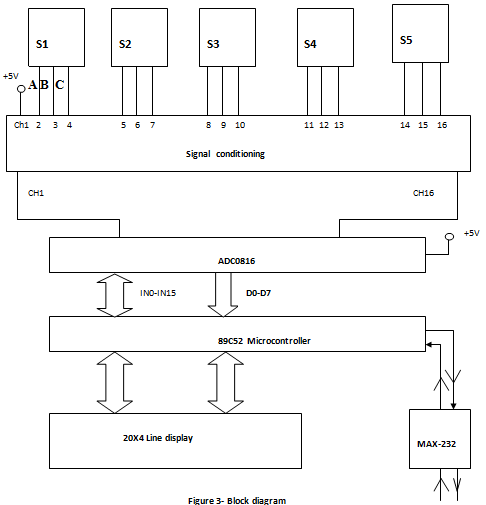
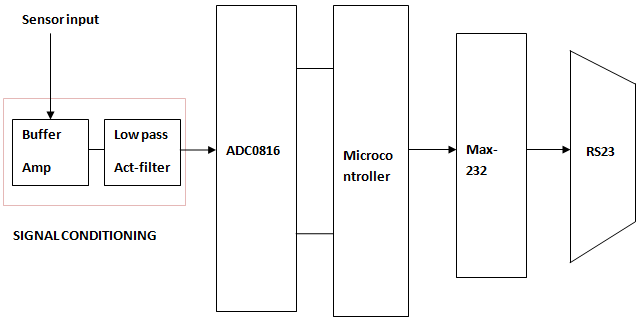
Block diagram of Data acquisition system
 

Block diagram of Data acquisition system


Requirement Analysis

2) Requirement analysis
2.1) Problem description
Following were the procedures to be followed for designing the proposed circuit onto the printed circuit board:
Create the schematic diagram on by the use of ISIS software from circuit diagram
Converting the schematic diagram to PCB layout
Designing the PCB layout for the schematic capture
Get the fabrication done from PCB Lab,
Populating and soldering the components.
Write the program and transfer it to flash onto controller then
Test the functionality
 
2.2) Components required
The following components were required the finalized the design:
Software to draw the schematic diagram and to PCB Layout
Drilling machines
Fabricated board
Circuit components
Soldering tools
DC Power supply unit
Voltmeter
Pair of cords
Tektronix oscilloscope
 
3) Possible Solution
MEMS type Pressure sensor under the final validation
 
Figure shows the possible solution diagram to solve this problem that was needed for this task
 

Components Required

The major components that were used in this particular design are MEMS Pressure Sensors, Signal conditioning, ADC0816, 89C52 controller, LCD 20×4 display, MAX 232
 
MICROCONTROLLER- AT89C52:
The 8952 microcontroller is upgraded version of 8051 family of microcontrollers. The 8051 microcontroller was introduced by Intel Corporation in the year 1981. It is an 8-bit microcontroller with Harvard Architecture manufactured by advanced CMOS processes. It has 128 bytes of on chip RAM, 4k bytes of on chip ROM, two 16-bit timers/counters, four 8-bit ports of which one is a serial port, etc. There are 6 interrupt sources also. Since this is an 8-bit micro controller, the CPU can work on only 8 bits of data at a time. Data larger than 8 bits has to be broken down to 8 bit pieces. Though it has an addressing capability of 64 Kbytes, only 4k bytes have been provided on chip.
 
MAX-232
IC is used to convert the TTL/CMOS logic levels to RS232 logic levels during serial communication of microcontrollers with PC. The controller operates at TTL logic level (0-5V) whereas the serial communication in PC works on RS232 standards (-25 V to + 25V). This makes it difficult to establish a direct link between them to communicate with each other.
 
Micro-Electro-Mechanical Systems (MEMS)
Micro-Electro-Mechanical Systems or MEMS is a precision device technology that integrates mechanical elements, sensors, actuators, and electronics on a common silicon substrate through micro fabrication technology. MEMS are also referred to as MST (Microsystems Technology in Europe) and MM (Micro machines in Japan). MEMS with optics are called MOEMS- Micro-Opto-Electro-Mechanical-Systems).
 

Signal Conditioning Process

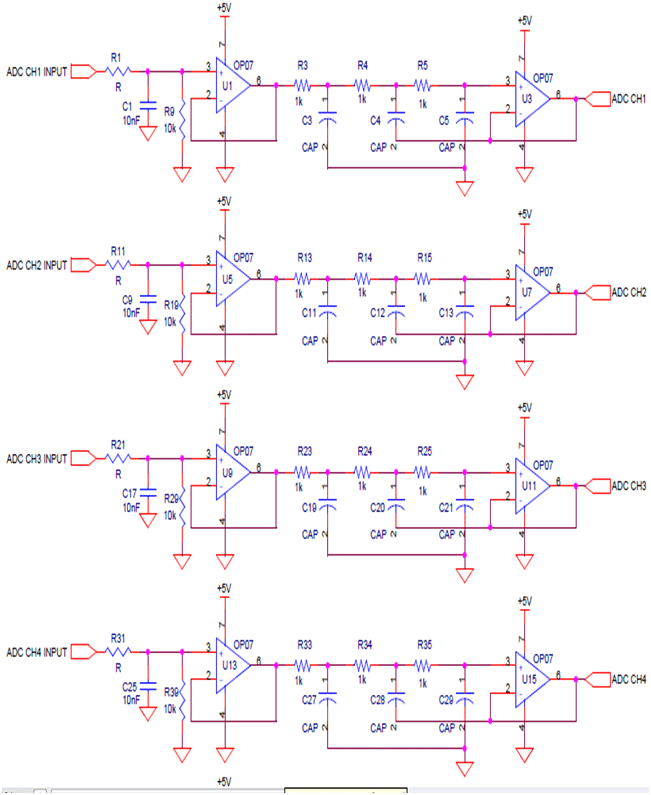
Signal conditioning process
Signal conditioning Means manipulating an analog signal in such a way that it meets the requirements of the next stage for further processing. Most common use is in analog-to-digital converters.
 
The process of signal conditioning
Signal conditioning process including Buffering, amplification, filtering converting, range matching etc.
 
Buffering
Is a process to buffer the input signal and keep this signal as usual for the next?
 
Filtering
This is the most common signal conditioning function, as usually not all the signal frequency spectrum contains valid data. The common example is 50Hz AC power lines, present in most environments, which will produce noise if amplified. So this step of signal conditioning removed the noise and other distortions from the input signals
 
Amplifying
Signal amplification performs two important functions: increases the resolution of the given input signal, and increases its signal-to-noise ratio. For example, the output of an electronic temperature sensor   which is most likely in the mill volts range so possibly it is too low for an ADC to process directly. So in this case it is very necessary to bring the voltage level up to the level that is required by ADC.
 
Commonly used amplifiers on signal conditioning process include Sample and hold amplifiers, Peak Detectors, Log amplifiers, Antilog amplifiers, Instrumentation amplifiers or programmable gain amplifiers.
 
Isolation
This process of Signal isolation is required to use in order to pass the signal from the source to the measurement device without a physical connection. It is frequently used to isolate or separate possible sources of signal disorder. Also prominent is that’s it is important to separate the potentially expensive equipment after completing the process of conditioning.


Project Source Code


Project Source Code

###


#include<reg51.h>

sbit ale=P2^1;  //address latch enable

sbit oe=P2^0;  //output enable

sbit sc=P2^2;  //start conversion

sbit eoc=P2^7;  //end of conversion

sbit ADD_A=P1^1;  // Address pins for selecting input channels.

sbit ADD_B=P1^2;

sbit ADD_C=P1^3;


sfr addr_port=0x90;  //p1 por

sfr data_port=0x80;  //p0 port


unsigned char k, data_buffer;


void transmit();

void delay(unsigned int count);


void transmit()  //serial port transmission

{

            SBUF=k;

            while(TI==0);

            TI=0;


            SBUF=data_buffer;

            while(TI==0);

            TI=0;

}


void delay(unsigned int count)  // Function to provide time delay in msec.

{

            int i,j;

            for(i=0;i<count;i++)

            { 

                        for(j=0;j<1275;j++);

            }

}


void main()

{

            data_port=0xFF;

            delay(2);

            ale=0;

            oe=0;

            sc=0;

            TMOD=0x20;

            TH1=0xFD;  //timer1 setting for serial communication

            SCON=0x50;

            TR1=1;


            while(1)

            {

                        for(k=0; k<=15; k++)

                        {

                                    addr_port=k;

                                    delay(2);

                                    ale=1;

                                    delay(2);

                                    sc=1;

                                    delay(1);

                                    ale=0;

                                    delay(1);

                                    sc=0;

                                    while(eoc==1);

                                    while(eoc==0);

                                    oe=1;

                                    data_buffer=data_port;

                                    transmit();

                                    delay(2);

                                    oe=0;

                        }

                        if (k==15)

                        {

                                    k=0;

                        }

            }

}


###


Circuit Diagrams
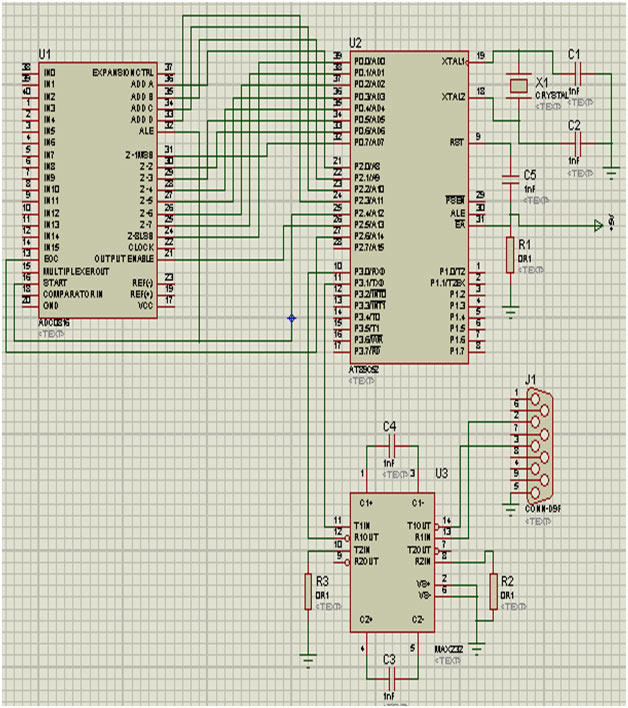
16-Channel-data-acquisition
Signal-conditioning-part


Filed Under: Electronic Projects
Tagged With: adc0816, adc8017, data acquisition, rs 232
 

Next Article

← Previous Article
Next Article →

Questions related to this article?
👉Ask and discuss on EDAboard.com and Electro-Tech-Online.com forums.


Tell Us What You Think!! Cancel reply

You must be logged in to post a comment.

EE TECH TOOLBOX

“ee
Tech Toolbox: Internet of Things
Explore practical strategies for minimizing attack surfaces, managing memory efficiently, and securing firmware. Download now to ensure your IoT implementations remain secure, efficient, and future-ready.

EE Learning Center

EE Learning Center
“engineers
EXPAND YOUR KNOWLEDGE AND STAY CONNECTED
Get the latest info on technologies, tools and strategies for EE professionals.

HAVE A QUESTION?

Have a technical question about an article or other engineering questions? Check out our engineering forums EDABoard.com and Electro-Tech-Online.com where you can get those questions asked and answered by your peers!


RSS EDABOARD.com Discussions

  • Voltage mode pushpull is a nonsense SMPS?
  • Input impedance matching network
  • High Side current sensing
  • The comparison of different Tcl script checkers
  • Reducing "shoot-through" in offline Full Bridge SMPS?

RSS Electro-Tech-Online.com Discussions

  • Is AI making embedded software developers more productive?
  • Back to the old BASIC days
  • Parts required for a personal project
  • PIC KIT 3 not able to program dsPIC
  • Failure of polypropylene motor-run capacitors

Featured – RPi Python Programming (27 Part)

  • RPi Python Programming 21: The SIM900A AT commands
  • RPi Python Programming 22: Calls & SMS using a SIM900A GSM-GPRS modem
  • RPi Python Programming 23: Interfacing a NEO-6MV2 GPS module with Raspberry Pi
  • RPi Python Programming 24: I2C explained
  • RPi Python Programming 25 – Synchronous serial communication in Raspberry Pi using I2C protocol
  • RPi Python Programming 26 – Interfacing ADXL345 accelerometer sensor with Raspberry Pi

Recent Articles

  • What is AWS IoT Core and when should you use it?
  • AC-DC power supply extends voltage range to 800 V DC
  • Infineon’s inductive sensor integrates coil system driver, signal conditioning circuits and DSP
  • Arm Cortex-M23 MCU delivers 87.5 µA/MHz active mode
  • STMicroelectronics releases automotive amplifiers with in-play open-load detection

EE ENGINEERING TRAINING DAYS

engineering

Submit a Guest Post

submit a guest post
Engineers Garage
  • Analog IC TIps
  • Connector Tips
  • Battery Power Tips
  • DesignFast
  • EDABoard Forums
  • EE World Online
  • Electro-Tech-Online Forums
  • EV Engineering
  • Microcontroller Tips
  • Power Electronic Tips
  • Sensor Tips
  • Test and Measurement Tips
  • 5G Technology World
  • Subscribe to our newsletter
  • About Us
  • Contact Us
  • Advertise

Copyright © 2025 WTWH Media LLC. All Rights Reserved. The material on this site may not be reproduced, distributed, transmitted, cached or otherwise used, except with the prior written permission of WTWH Media
Privacy Policy

Search Engineers Garage

  • Electronic Projects & Tutorials
    • Electronic Projects
      • Arduino Projects
      • AVR
      • Raspberry pi
      • ESP8266
      • BeagleBone
      • 8051 Microcontroller
      • ARM
      • PIC Microcontroller
      • STM32
    • Tutorials
      • Audio Electronics
      • Battery Management
      • Brainwave
      • Electric Vehicles
      • EMI/EMC/RFI
      • Hardware Filters
      • IoT tutorials
      • Power Tutorials
      • Python
      • Sensors
      • USB
      • VHDL
    • Circuit Design
    • Project Videos
    • Components
  • Articles
    • Tech Articles
    • Insight
    • Invention Stories
    • How to
    • What Is
  • News
    • Electronic Product News
    • Business News
    • Company/Start-up News
    • DIY Reviews
    • Guest Post
  • Forums
    • EDABoard.com
    • Electro-Tech-Online
    • EG Forum Archive
  • DigiKey Store
    • Cables, Wires
    • Connectors, Interconnect
    • Discrete
    • Electromechanical
    • Embedded Computers
    • Enclosures, Hardware, Office
    • Integrated Circuits (ICs)
    • Isolators
    • LED/Optoelectronics
    • Passive
    • Power, Circuit Protection
    • Programmers
    • RF, Wireless
    • Semiconductors
    • Sensors, Transducers
    • Test Products
    • Tools
  • Learn
    • eBooks/Tech Tips
    • Design Guides
    • Learning Center
    • Tech Toolboxes
    • Webinars & Digital Events
  • Resources
    • Digital Issues
    • EE Training Days
    • LEAP Awards
    • Podcasts
    • Webinars / Digital Events
    • White Papers
    • Engineering Diversity & Inclusion
    • DesignFast
  • Guest Post Guidelines
  • Advertise
  • Subscribe