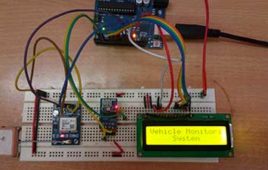
The vehicle tracking systems are designed for tracking the movement of a vehicle from a location at any time. Such system is equipped with a GPS receiver which maintains the GPS location of the device. The GPS location of the device traced by the GPS sensor is sent to a cloud server or cloud service with the help of a controller. This project is a simple implementation of such system on one of the most popular prototyping boards – Arduino UNO.
Arduino Vs Raspberry Pi: How to select between the two?

This is a common dilemma among electronics community of engineers whether they are DIY hobbyists or professionals working on a prototype. There may be a case that one might have worked on some microcontrollers and now willing to propel the academic excellence by working on development boards or do one needs to choose a development board for a do-it-yourself engineering project. Let’s have a fundamental understanding of both the boards to make clear which to select.First thing is that both Arduino and Raspberry Pi offer a range of development boards with different specifications and features.
How to Make First Python Program with Beaglebone Black
Beaglebone black supports various high level languages such as a C, C++ and scripting languages like java, python. Programming of application is mostly written in C language for controller or processor. Python is an interpreted language and great library source available for BBB. At low level, programming in python is efficient and responds quicker than C language.This tutorial talks about making first python program with Beaglebone Black. So in case you are not aware of basic python programming then I suggest you to go through the same before proceeding.
Web Controlled LCD Display- (Part 9/12)
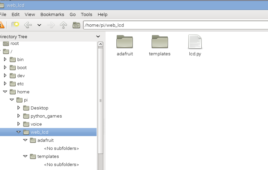
We will make a straightforward web application with a frame that permit a client to send a message to the Raspberry Pi utilizing Flask in a web browser. This will permit us to control the Raspberry Pi from a PC, tablet or smart phone. At the point when the form is submitted, it will send the message to the LCD by means of the Raspberry Pi’s GPIO ports. All the code, including the web application, is in Python and HTML.
Web controlled Home Automation- (Part 11/12)
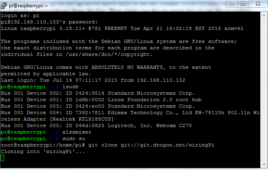
The Wiring Pi project is used here to switch the GPIO pins high and low. Run the following commands for downloading Wiring Pi and install.
Web Server using Python- (Part 8/12)
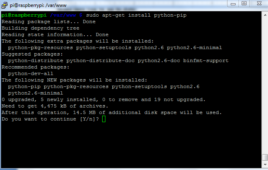
In this project the Raspberrypi board is booted with the Ubuntu OS and is connected to the Ethernet port of a Windows7 PC. The board is connected to the internet connection as explained in the project Connecting the Raspberrypi to the internet. The IP address of the Raspberrypi board has been obtained to remote login in the TUI using the PUTTY and is remotely accessed using VNC.In this tutorial we use a Python web framework called Flask to create a dynamic web server in Raspberry Pi. While there’s a lot you can do with Flask “out of the box,” it also supports many different extensions for doing different operations such as user authentication, generating forms, and using databases.
Snake game- (Part 6/12)
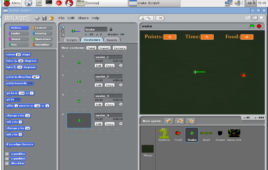
In this project a Raspberry Pi board is booted with Ubuntu OS and is connected to the Ethernet port of a Windows7 PC. The board is connected to the internet as explained in the project how to connect the Raspberry Pi to the internet. The IP address of the Raspberrypi board has been obtained to remote login in the TUI using PUTTY and is remotely accessed using VNC.
How to run a python code on boot- (Part 7/12)
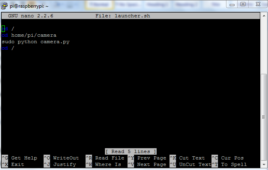
This article is to provide step by step instructions to run a Python code in the boot of Raspberry Pi automatically. Sometimes we may want to run a Python script when Raspberry Pi boots up, like Webserver applications need an auto start of the server so that remote access is possible. There are a number of different techniques to do this, one of those is crontab. A crontab is a job scheduler that allows the system to perform tasks at defined time or intervals. It is a very powerful tool and useful in lots of situations. You can use it to run commands in the boot or a python script in this case.
How to Use Raspberry Pi as a Game Server- (Part 35/38)
In this particular project Ubuntu is installed on Raspberry pi board and is loaded on the Raspberry pi board and is connected to a router using a cross-over LAN cable. Hence the only additional hardware required with the Raspberry pi for this project is a LAN cable only.Once connected to the router with Ubuntu OS on it, it can be accessed remotely from other systems connected in same LAN network. The board can be accessed from a Linux PC using the secure shell which is enabled in the Ubuntu of Raspberry pi board.This article focus on how to configure the Raspberry pi board as a web server and the technique to make it serve a graphical game for those who type the IP or address of the Raspberry pi board from the address tab of their web browser. The Raspberry pi web server is available in the same LAN network or it can be made available to anyone who has the internet connectivity using the technique of port forwarding.
How to Add Sound to Raspberry Pi Game Pad- (Part 37/38)
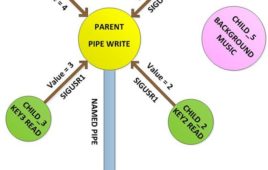
The gamepad is a simple circuit built on a breadboard with few buttons, LEDs and a resistor array. There are eight general purpose IO pins on the 13*2 pin connectors of the Raspberrypi board and among them four pins has been selected as input and then remaining four pins as output. The input pins are connected to push button and are pulled down using 1K resistors. The output pins are connected to the LEDs through another set of 1K resistors. For this project the Raspberry pi board is loaded with Ubuntu and is remotely accessed using VNC. To access the pins that coming out of the Broadcom controller the C library “bcm2835” has been downloaded and installed. This article focuses on how to add sound to a game that is coded to be played with a Raspberry pi gamepad.
Simple Raspberry Pi Game Pad for Ball Catching Game – (Part 36/38)
Raspberry Pi is provided with a RCA connector which can be used to connect it directly to a TV screen which is based on PAL and NTSC standard. The board also has a HDMI connector output which can be used to connect the board to a HD TV. One can also use remote login to access the Raspberry pi and view the GUI (Text User Interface) on the PC screen. The Raspberry pi board is also very easy to interface with external devices or circuits through its pin outs. This makes the Raspberry pi a suitable platform for playing and developing interesting games.This article discusses how to develop a simple graphical game using the HTML5 and JavaScript language and to interface it with an external custom made game pad hardware connected to the pins of Raspberry pi board.
Playing Snake Game using Raspberry Pi Game Pad- (Part 38/38)
This article discusses about how to develop simple game pad hardware and interface it with the Raspberrypi board and also about the technique of interfacing a game code written in HTML5 with the game pad. Here a Snake game written in HTML5 and JavaScript is modified in such a way that it can be played with the new game pad having four push buttons. In this project the techniques of signals, pipe, fork etc. are used get the game running. The Snake game running on a browser window forms the GUI or front end of the entire system. In a Linux operating system each hardware device is represented as a file. In this project there is game pad which is the hardware and there is a process which reads from the game pad and there is also a Pipe file or FIFO in-between the game and the game pad reading process.
Controlling Hardware using GUI in Raspberry Pi -(Part 32/38)
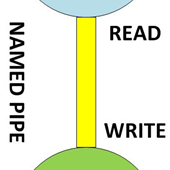
The Graphical User Interface (GUI) helps the user to communicate with the system effortlessly. The GUI is considered as the front end of an application. In a Linux operating system each hardware device is represented as a file. The device can be controlled by simply reading and writing into that file. The hardware of an operating system is on the one side and the user trying to access the hardware is on the other side, and in between them there might be several layers of process running which communicates each other using inter process communication methods. The GUI is the process which the user can use to communicate with all these process layers and finally communicate with the Hardware. This project demonstrates how to create a GUI using the QT which can control the LEDs connected to the Raspberrypi board.
How to Control Hardware using Named Pipe – (Part 34/38)
In a Linux operating system all each hardware device is represented as a file. The device can be controlled by simply reading and writing into that file. The hardware of an operating system is on the one side and the user trying to access the hardware is on the other side, and in between them there might be several layers of applications running which communicates each other using inter process communication methods. This project demonstrates how to control a process which can turn on and off the LEDs of the Raspberrypi with the help of another process by writing into a pipe file. The Raspberrypi is a mini computer which can be used to learn and experiment the concept and working of an Operating System. The Raspberry pi is a device which uses the Broadcom controller chip which is a SoC (System on Chip). This SoC has the ARM11 processor which runs on 700 MHz at its core.
How to Get GUI on Raspberry Pi – (Part 04/38)
The Raspberry pi is a single board minicomputer which comes without input and output units, but with connectors for them. The board is designed to be easy to use and available at the least possible price. The main intention of releasing such a board is to provide computer education to the remote schools where the PCs are not very commonly used. The idea is to use the TV screen as the display unit for the Raspberry pi board and hence converting the TV into a computer. The board is hence provided with a RCA connector which can be used to connect it directly to a TV screen which is based on PAL and NTSC standard. The board also has a HDMI connector output which can be used to connect the board to a HD TV, but there is no VGA connector.
Named Pipe Example Using Raspberry Pi – (Part 33/38)
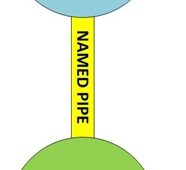
Multi-tasking Operating Systems can run several processes at a time creating and effect of parallel processing with the help of the high speed processor. There are different kinds of Inter Process Communication (IPC) system and the Named Pipe is one of the simplest of them. The Named Pipe is actually a temporary file having a particular name and stored at a particular directory whose name and location are known to the processes which needs to communicate with each other. The Named Pipe is also called First In First Out (FIFO).This project demonstrates how two programs communicate each other using named pipe. In this project a simple program is written which creates a pipe and continuously checks for any data on the pipe. The data is written to the pipe by simply using terminal commands. As soon data appears on the pipe, the program reads it and prints back on the terminal.
How to Create Buttons in Qt- (Part 31/38)
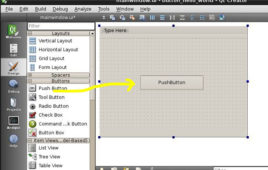
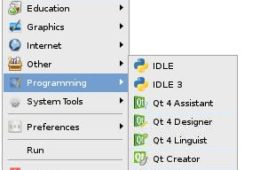
In this project the Raspberrypi board is loaded with Ubuntu and is remotely accessed using VNC. The Raspberrypi board is also connected to the internet. Downloading and installing the fourth version, QT4 using commands are already discussed in a previous article. There is another article which discusses about how to start with programming in QT, a hello world program using QT. Once the installation is complete the user can find them listed under the installed programs for ‘Programming’. The list includes “Qt 4 Assistant”, “Qt 4 Designer”, “Qt 4 Linguist” and “Qt Creator”. The “Qt 4 Assistant” is basically provides help in the form of documentations related to the topics in QT. “Qt 4 Designer” is where the user can create a design and save it as a ‘.ui’ file which can then be used in QT projects. The “Qt 4 Linguist” provides a language view of the design created.
Hello World Program using Qt in Raspberry Pi- (Part 30/38)
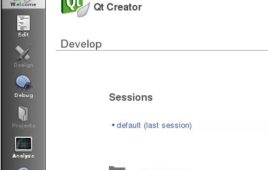
The Raspberrypi board is powerful enough to run large operating systems like Linux, Mac and Windows. Linux operating systems especially Ubuntu is preferred for all kind of programming and development.The board is provided with a RCA connector which can be used to connect it directly to a TV screen which is based on PAL and NTSC standard. The board also has a HDMI connector output which can be used to connect the board to a HD TV. A board capable of generating graphics on standard display screen needs a perfect application using which the programmers can exploit that capability. The ‘QT’ is a widely used platform for creating GUIs in Linux environment.Qt is an application which helps indeveloping the UI framework using the Qt IDE. Qt uses standard C++ but it also supports support many compilers, including the GCC C++ compiler and the Visual Studio suite.
How to Install Qt in Raspberry Pi- (Part 29/38)
The Raspberry pi is a device which uses the Broadcom controller chip which is a SoC (System on Chip). Raspberrypi is provided with a RCA connector which can be used to connect it directly to a TV screen which is based on PAL and NTSC standard. The board also has a HDMI connector output which can be used to connect the board to a HD TV. A board capable of generating graphics on standard display screen needs a perfect application using which the programmers can exploit that capability. The ‘QT’ is a widely used platform for creating GUIs in Linux environment. Qt is an application which helps indeveloping the UI framework using the Qt IDE. Qt uses standard C++ but it also supports support many compilers, including the GCC C++ compiler and the Visual Studio suite.This article explains how to install the QT in Raspberrypi.
How to Use Signal Values and Messages to Read Multiple Inputs- (Part 27/38)
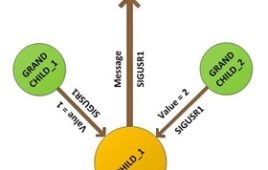
In this particular project a Parent creates only one Childs process which will then create its own Child Processes. The Grand Child Processes of the Parent processes are then used to read the status of the four input pins independently. The Child processes are made to send a signal ‘SIGUSR1’ to their own Parent process whenever the status of the input pin changes. Each Child process sends a different value along with the signals they sent. As soon as their Parent process receives a signal, it reads the value from the signal and sends the status in the form of a message along with a signal to the original Parent process. This forms a Process System made up of 4 Grand Child process, a Child Process and a Parent process where the Parent is free to do its work, but the Child can get the attention of the Parent by sending signal.