Engineers Garage

  • Electronic Projects & Tutorials
    • Electronic Projects
      • Arduino Projects
      • AVR
      • Raspberry pi
      • ESP8266
      • BeagleBone
      • 8051 Microcontroller
      • ARM
      • PIC Microcontroller
      • STM32
    • Tutorials
      • Audio Electronics
      • Battery Management
      • Brainwave
      • Electric Vehicles
      • EMI/EMC/RFI
      • Hardware Filters
      • IoT tutorials
      • Power Tutorials
      • Python
      • Sensors
      • USB
      • VHDL
    • Circuit Design
    • Project Videos
    • Components
  • Articles
    • Tech Articles
    • Insight
    • Invention Stories
    • How to
    • What Is
  • News
    • Electronic Product News
    • Business News
    • Company/Start-up News
    • DIY Reviews
    • Guest Post
  • Forums
    • EDABoard.com
    • Electro-Tech-Online
    • EG Forum Archive
  • DigiKey Store
    • Cables, Wires
    • Connectors, Interconnect
    • Discrete
    • Electromechanical
    • Embedded Computers
    • Enclosures, Hardware, Office
    • Integrated Circuits (ICs)
    • Isolators
    • LED/Optoelectronics
    • Passive
    • Power, Circuit Protection
    • Programmers
    • RF, Wireless
    • Semiconductors
    • Sensors, Transducers
    • Test Products
    • Tools
  • Learn
    • eBooks/Tech Tips
    • Design Guides
    • Learning Center
    • Tech Toolboxes
    • Webinars & Digital Events
  • Resources
    • Digital Issues
    • EE Training Days
    • LEAP Awards
    • Podcasts
    • Webinars / Digital Events
    • White Papers
    • Engineering Diversity & Inclusion
    • DesignFast
  • Guest Post Guidelines
  • Advertise
  • Subscribe

DATA ACQUISITION ROBOT

By Prabakaran P.M September 8, 2024

Summary:

This Project aims in the building of one application of robots in the automation of Collecting environmental aspects. The robot supports remote performance monitoring and maintenance of various factors of the environment in any given area. The details of the design, setup and the use of the robot in Data Acquisition (DAQ) system are given here. The sensors provide accurate and reliable real time data needed for autonomous monitoring and control of any type of area or industry. Data Acquired by the proposed system can be remotely accessed, plotted and analyzed. This provides a fully automated solution for the monitoring and control of remote locations.
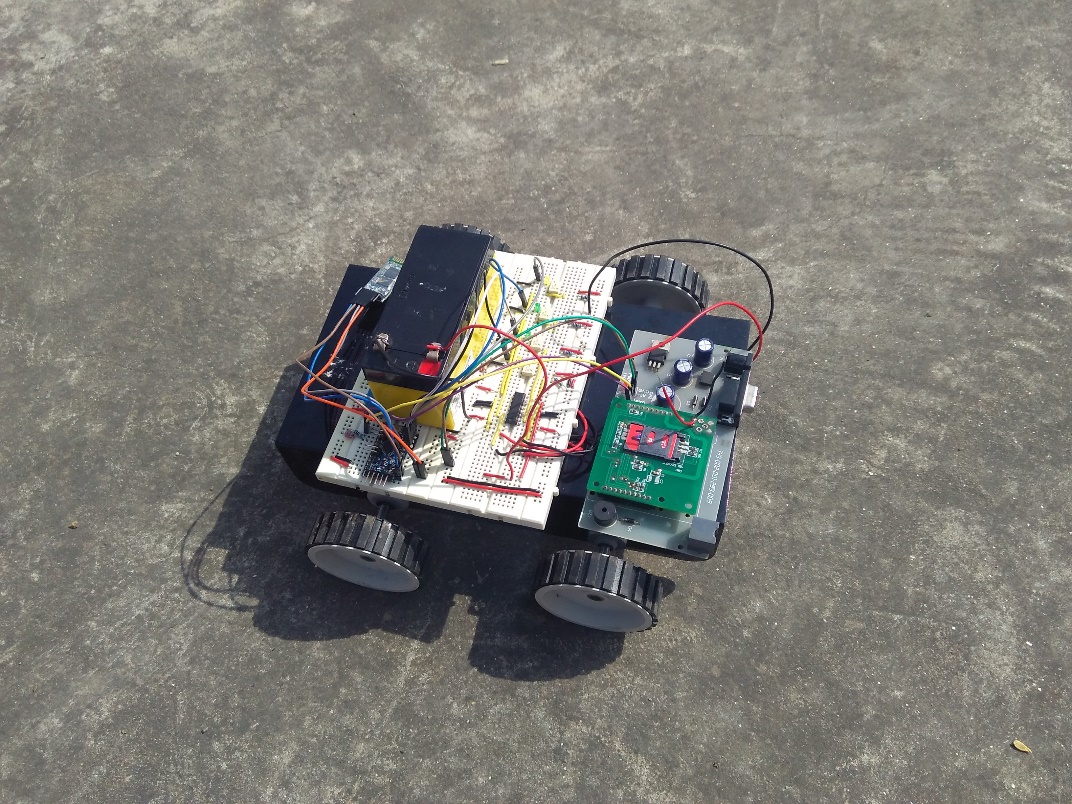
Prototype of Arduino based Land Rover Robot used for Sensor Data Acquisition

Fig. 1: Prototype of Arduino based Land Rover Robot used for Sensor Data Acquisition

Description:

Prerequisites & Equipment:

You are going to need the following:

  1. An Arduino Board or Arduino clone(Here is a guide if you need)

  2. Two DC Motors.

  3. A 5v TTL -UART Bluetooth module.

  4. Robot chassis and wheels which suit your chassis size and motor size.

  5. Arduino IDE for the programming.

Block Diagram:
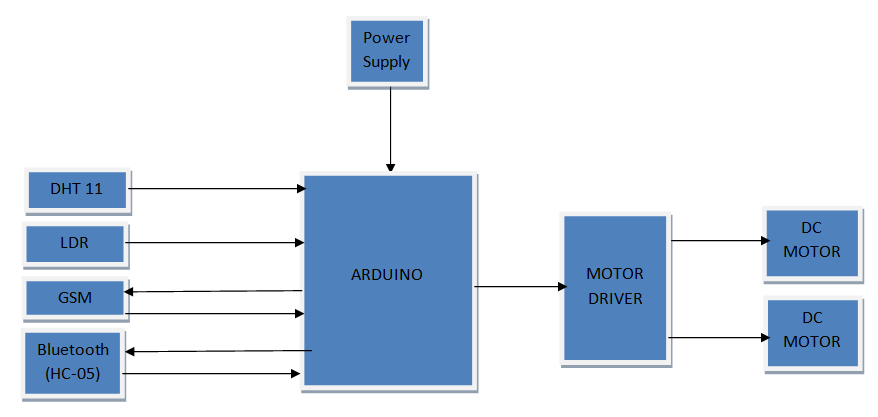
Block Diagram of Arduino based Sensor Data Acquisition Robot

 Fig. 2: Block Diagram of Arduino based Sensor Data Acquisition Robot

Our aim of this project is to collect the sensor data and to store it for the future analysis. There are many techniques used for Data acquisition such as EEPROM, SD card. Here we are going to use internet based storage, which is a reliable and efficient way for analysis of any sensor data.

Hardware assembly:

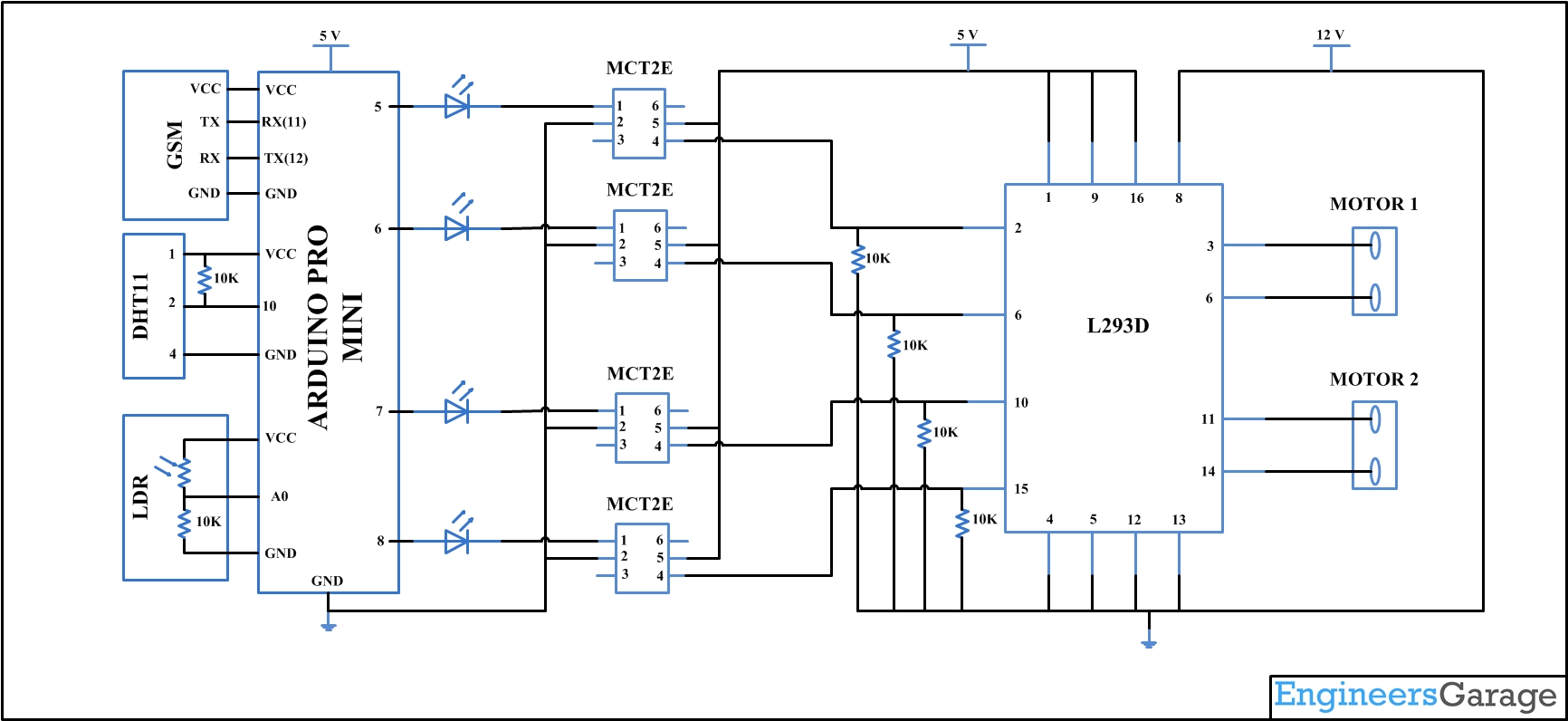
Make the Robot connections as are given by the circuit diagram. Make the robot assembly with your selected parts and connect the motors to the circuit. Optocouplers are used to safeguard the Arduino from High voltage risks. Note: RX of Arduino should be connected to TX of Bluetooth module and TX of Arduino should be connected to RX of Bluetooth module.

Working:

In this Robot we add internet functionality by using a GSM modem which provide GPRS connection. The section below will explain how to send the sensor readings via an HTTP command to a website. We use the ThingSpeak website which provides a simple and free API for logging data from a variety of sensors.
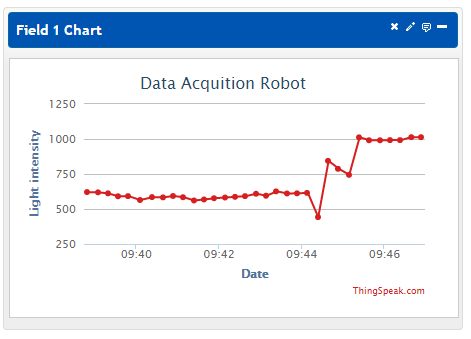
Graph showing Light Intensity variations sensed by LDR on Data Acquisition Arduino Robot
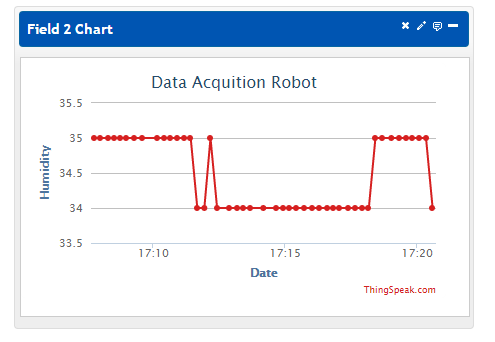
Fig. 3: Graph showing Light Intensity variations sensed by LDR on Data Acquisition Arduino Robot

Graph showing Humidity variations recorded by DHT11 sensor on Data Acquisition Arduino Robot

Fig. 4: Graph showing Humidity variations recorded by DHT11 sensor on Data Acquisition Arduino Robot
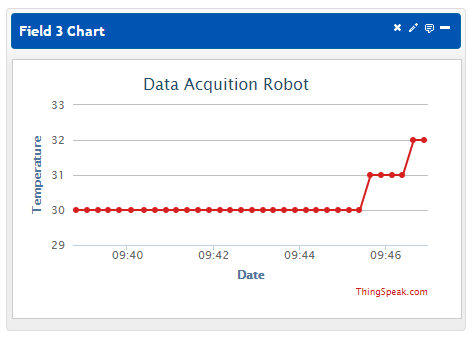
Graph showing Temperature variations recorded by DHT11 sensor on Data Acquisition Arduino Robot

Fig. 5: Graph showing Temperature variations recorded by DHT11 sensor on Data Acquisition Arduino Robot

These are some example charts which were generated from sensor data sent from robot to channel on the ThingSpeak website:

Thing Speak Setup

Here are the steps required in order to get this example working with the ThingSpeak website:

  1. Create an account with ThingSpeak (Sign-up).

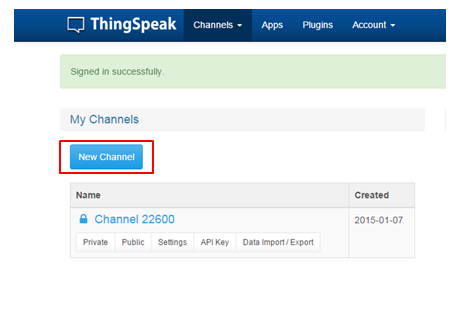
  2. Create a New Channel

Screenshot of Thingspeak Website showing Creation of Channel for Data Acquisition

Fig. 6: Screenshot of Thingspeak Website showing Creation of Channel for Data Acquisition

  1. Copy the WRITE API KEY from the APIKEYS tab for your new channel.

  2. Configure your new channel (see the Channel Settings tab).

    • Add three fields to your channel.

    • Name the channel and each of the fields.

    • Save the new channel settings.

    • Note: The channel and field names are used for labelling the data in the charts these names have no effect on the API and can be changed at any time.

Here are the settings of the channel used for this Robot:
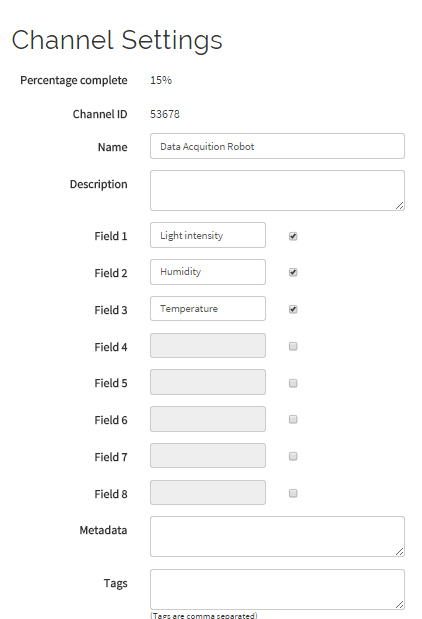
Screenshot of Thingspeak website showing addition of Light Intensity,Temperature and Humidity Fields in created channel for dis

Fig. 7: Screenshot of Thingspeak website showing addition of Light Intensity, Temperature and Humidity Fields in created channel for displaying sensor data

Libarary Includes

In addition to the existing libraries, we must now also include the Timerone, Soft serial and DHT libraries in the sketch using the #include compiler directive.

#include <TimerOne.h>

#include <SoftwareSerial.h>

#include <DHT.h>

The ThingSpeak API limits the data upload to a maximum of once every 15 seconds. Also, it takes some time to establish the GPRS connection before any data can be sent. For this reason, we adjust the Timer1.initialize(4000000); // set a timer of 4 second. And make a variable to 5 called tick_count so that the readings are taken once per 20 seconds. (the units are microseconds)

Setup:

In addition to the existing setup code for robotic controls, we should make some initializations to GSM.

GPRS.write(“AT+CGATT=1”); //Attach a GPRS Service

GPRS.write(“AT+CGDCONT=1,”IP”,”airtelgprs.com””); //Define PDP Context

GPRS.write(“AT+CSTT=”airtelgprs.com”,””,”””); //Set Access point, User ID, and password

GPRS.write(“AT+CIICR”); //Bring up wireless connection with GPRS Time consuming

GPRS.write(“AT+CIFSR”); // Get Local IP address. No actually needed though.

GPRS.write(“AT+CIPSTATUS”); // Get Connection Status P.S. It should be ‘IP STATUS’. // This can be used as a check point.

GPRS.write(“AT+CIPHEAD=1”); // Add headers to the HTTP request.

GPRS.write(“AT+CDNSORIP=1”); //Indicates whether connection request will be using IP address (0), or domain name (1)

GPRS.write(“AT+CIPSTART=”TCP”,”api.thingspeak.com”,”80″”); //Start up TCP connection (mode, IP address/name, port) P.S. if returns ‘CONNECT OK’ then you’re lucky

GPRS.write(“AT+CIPSEND”);//Telling the GSM module that we’re going to send the data

Collection of Data:

Light = analogRead(A0); // Reading Light intensity

Reading temperature or humidity takes about 250 milliseconds! Sensor readings may also be up to 2 seconds ‘old’ (its a very slow sensor)

h = dht.readHumidity(); // Read temperature as Celsius (the default)

t = dht.readTemperature();

Data sending to Thing Speak:

itoa (Light,LIGHT_data,10);

itoa (h,HUMID_data,10);

itoa (t,TEMP_data,10); //Function for converting integer to string.

GPRS.write(“AT+CIPSEND”); //Telling the GSM module that we’re going to send the data

GPRS.write(“GET /update?key=XXXXXXXXXXXXXXXXXXXXXXX= “); // Change to your API KEY.

GPRS.write(LIGHT_data);

GPRS.write(“&field2= “);

GPRS.write(HUMID_data);

GPRS.write(“&field3= “);

GPRS.write(TEMP_data);

GPRS.write(” HTTP/1.1″); //And finally here comes the actual HTTP request //The following are the headers that must be set.

GPRS.write(“Host: api.thingspeak.com”);

GPRS.write(“Connection: keep-alive”);

GPRS.write(“Accept: */”);

GPRS.write(“*”);

GPRS.write(“Accept-Language: en-us”);

GPRS.write(0x1A);//It tells the GSM module that we’re not going to send data anymore

// char ctrlZ = 0x1A;

You may also like:

  • What are the top development boards for AI and ML?

  • What are different types of industrial robots?

  • What are LoRa gateways and what types are available?

  • What battery chemistries are used in electric vehicles?

  • What are the different types of EV charging connectors?

  • What are the components of robotic arms and industrial robots?

Circuit Diagrams

Circuit-Diagram-Arduino-Based-Control-Circuitry-Used-Data-Acquisition-Robot

Project Video


Filed Under: Electronic Projects, PIC Microcontroller


Next Article

← Previous Article
Next Article →

Questions related to this article?
👉Ask and discuss on Electro-Tech-Online.com and EDAboard.com forums.


Tell Us What You Think!! Cancel reply

You must be logged in to post a comment.

EE TECH TOOLBOX

“ee
Tech Toolbox: Internet of Things
Explore practical strategies for minimizing attack surfaces, managing memory efficiently, and securing firmware. Download now to ensure your IoT implementations remain secure, efficient, and future-ready.

EE Learning Center

EE Learning Center
“engineers
EXPAND YOUR KNOWLEDGE AND STAY CONNECTED
Get the latest info on technologies, tools and strategies for EE professionals.

HAVE A QUESTION?

Have a technical question about an article or other engineering questions? Check out our engineering forums EDABoard.com and Electro-Tech-Online.com where you can get those questions asked and answered by your peers!


RSS EDABOARD.com Discussions

  • Reducing "shoot-through" in offline Full Bridge SMPS?
  • High Side current sensing
  • How to simulate power electronics converter in PSpice?
  • Voltage mode pushpull is a nonsense SMPS?
  • Layout IRN reduction in Comparator

RSS Electro-Tech-Online.com Discussions

  • Back to the old BASIC days
  • Parts required for a personal project
  • PIC KIT 3 not able to program dsPIC
  • Failure of polypropylene motor-run capacitors
  • Siemens large industrial PLC parts

Featured – RPi Python Programming (27 Part)

  • RPi Python Programming 21: The SIM900A AT commands
  • RPi Python Programming 22: Calls & SMS using a SIM900A GSM-GPRS modem
  • RPi Python Programming 23: Interfacing a NEO-6MV2 GPS module with Raspberry Pi
  • RPi Python Programming 24: I2C explained
  • RPi Python Programming 25 – Synchronous serial communication in Raspberry Pi using I2C protocol
  • RPi Python Programming 26 – Interfacing ADXL345 accelerometer sensor with Raspberry Pi

Recent Articles

  • What is AWS IoT Core and when should you use it?
  • AC-DC power supply extends voltage range to 800 V DC
  • Infineon’s inductive sensor integrates coil system driver, signal conditioning circuits and DSP
  • Arm Cortex-M23 MCU delivers 87.5 µA/MHz active mode
  • STMicroelectronics releases automotive amplifiers with in-play open-load detection

EE ENGINEERING TRAINING DAYS

engineering

Submit a Guest Post

submit a guest post
Engineers Garage
  • Analog IC TIps
  • Connector Tips
  • Battery Power Tips
  • DesignFast
  • EDABoard Forums
  • EE World Online
  • Electro-Tech-Online Forums
  • EV Engineering
  • Microcontroller Tips
  • Power Electronic Tips
  • Sensor Tips
  • Test and Measurement Tips
  • 5G Technology World
  • Subscribe to our newsletter
  • About Us
  • Contact Us
  • Advertise

Copyright © 2025 WTWH Media LLC. All Rights Reserved. The material on this site may not be reproduced, distributed, transmitted, cached or otherwise used, except with the prior written permission of WTWH Media
Privacy Policy

Search Engineers Garage

  • Electronic Projects & Tutorials
    • Electronic Projects
      • Arduino Projects
      • AVR
      • Raspberry pi
      • ESP8266
      • BeagleBone
      • 8051 Microcontroller
      • ARM
      • PIC Microcontroller
      • STM32
    • Tutorials
      • Audio Electronics
      • Battery Management
      • Brainwave
      • Electric Vehicles
      • EMI/EMC/RFI
      • Hardware Filters
      • IoT tutorials
      • Power Tutorials
      • Python
      • Sensors
      • USB
      • VHDL
    • Circuit Design
    • Project Videos
    • Components
  • Articles
    • Tech Articles
    • Insight
    • Invention Stories
    • How to
    • What Is
  • News
    • Electronic Product News
    • Business News
    • Company/Start-up News
    • DIY Reviews
    • Guest Post
  • Forums
    • EDABoard.com
    • Electro-Tech-Online
    • EG Forum Archive
  • DigiKey Store
    • Cables, Wires
    • Connectors, Interconnect
    • Discrete
    • Electromechanical
    • Embedded Computers
    • Enclosures, Hardware, Office
    • Integrated Circuits (ICs)
    • Isolators
    • LED/Optoelectronics
    • Passive
    • Power, Circuit Protection
    • Programmers
    • RF, Wireless
    • Semiconductors
    • Sensors, Transducers
    • Test Products
    • Tools
  • Learn
    • eBooks/Tech Tips
    • Design Guides
    • Learning Center
    • Tech Toolboxes
    • Webinars & Digital Events
  • Resources
    • Digital Issues
    • EE Training Days
    • LEAP Awards
    • Podcasts
    • Webinars / Digital Events
    • White Papers
    • Engineering Diversity & Inclusion
    • DesignFast
  • Guest Post Guidelines
  • Advertise
  • Subscribe