Engineers Garage

  • Electronic Projects & Tutorials
    • Electronic Projects
      • Arduino Projects
      • AVR
      • Raspberry pi
      • ESP8266
      • BeagleBone
      • 8051 Microcontroller
      • ARM
      • PIC Microcontroller
      • STM32
    • Tutorials
      • Audio Electronics
      • Battery Management
      • Brainwave
      • Electric Vehicles
      • EMI/EMC/RFI
      • Hardware Filters
      • IoT tutorials
      • Power Tutorials
      • Python
      • Sensors
      • USB
      • VHDL
    • Circuit Design
    • Project Videos
    • Components
  • Articles
    • Tech Articles
    • Insight
    • Invention Stories
    • How to
    • What Is
  • News
    • Electronic Product News
    • Business News
    • Company/Start-up News
    • DIY Reviews
    • Guest Post
  • Forums
    • EDABoard.com
    • Electro-Tech-Online
    • EG Forum Archive
  • DigiKey Store
    • Cables, Wires
    • Connectors, Interconnect
    • Discrete
    • Electromechanical
    • Embedded Computers
    • Enclosures, Hardware, Office
    • Integrated Circuits (ICs)
    • Isolators
    • LED/Optoelectronics
    • Passive
    • Power, Circuit Protection
    • Programmers
    • RF, Wireless
    • Semiconductors
    • Sensors, Transducers
    • Test Products
    • Tools
  • Learn
    • eBooks/Tech Tips
    • Design Guides
    • Learning Center
    • Tech Toolboxes
    • Webinars & Digital Events
  • Resources
    • Digital Issues
    • EE Training Days
    • LEAP Awards
    • Podcasts
    • Webinars / Digital Events
    • White Papers
    • Engineering Diversity & Inclusion
    • DesignFast
  • Guest Post Guidelines
  • Advertise
  • Subscribe

What is EMC?

By Ayush Jain February 2, 2025

EMC stands for Electromagnetic compatibility, which means that a device is compatible with (i.e., no interference is caused by) its electromagnetic (EM) environment. It does not emit levels of EM energy that generate electromagnetic interference (EMI) in other devices in the vicinity.

Electromagnetic interference (EMI) is the interference caused by one electrical or electronic device to another by the electromagnetic fields set up by its operation.

Sometimes we notice that the tube light is flickering when a water pump or motor device is on. This is because the motor draws more current, which causes a voltage drop. The change of electrical current and voltage generates electromagnetic interference (EMI). This interference must be within specific limits to avoid interference in the other devices present within the range.

An EMC test identifies this electromagnetic interference generated by a device. EMC tests also determine how the device reacts to electromagnetic interference caused by another device.
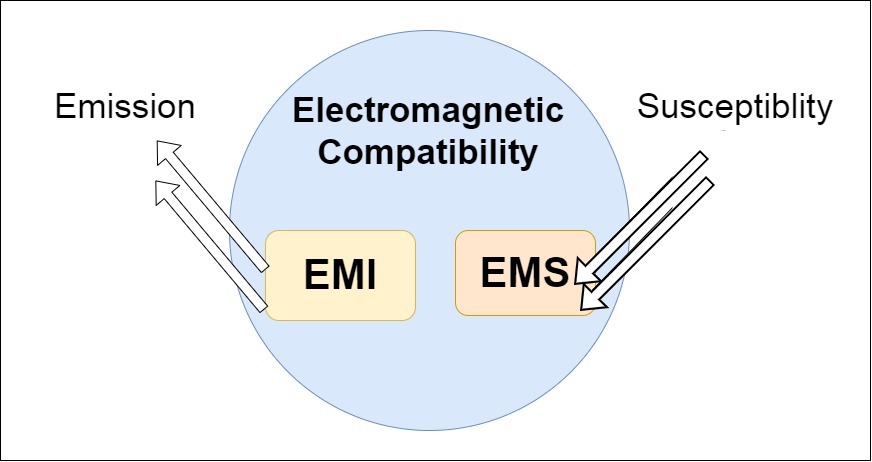
Types of EMC

All devices have the potential to emit electromagnetic fields. The devices used in our daily lives such as TVs, mobile phones, washing machines, ATMs, RFID tags, etc., all generate electromagnetic interference or can be damaged by interference generated by another device. To ensure the proper functioning of devices, an EMC test performs several sub-tests on the equipment under test ( EUT) to test the immunity of the victim device to survive in an environment of electromagnetic emission. Also, the EMI generated by the EUT should be within the limit of interference regulated by the country.

Types of EMC tests
The basic block diagram of EMC tests is given below. Not all of these are not applicable for each product, and another test will likely be added according to the product’s application.

EMC tests are comprised of two tests—one is EMI (Electromagnetic Interference), and another is EMS (Electromagnetic Susceptibility).
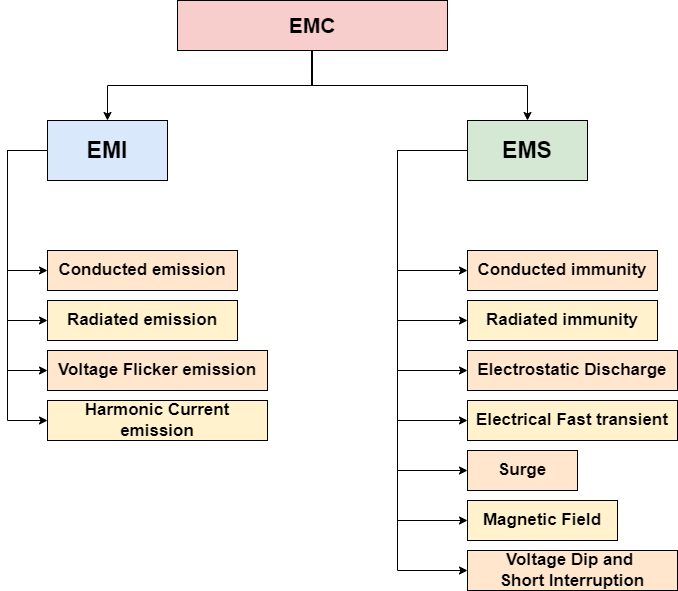
Block diagram of types of EMC tests

Electromagnetic Interference (EMI)
An electronic device will generate current and voltage fluctuations, which produce electromagnetic interference (EMI). Therefore, EMI generated by a particular device needs to be limited by the proper electronic design and shielding so as not to affect neighboring devices.

For example, a drill machine running in the house can cause TV flickering in the neighborhood house because they are connected with the same supply line.
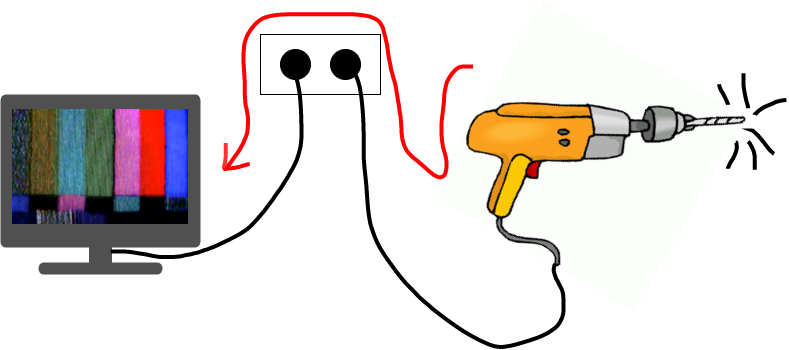
EMI effect on other devices

Types of Electromagnetic Interference (EMI) 

  • Conducted Emission

When the device emits an electromagnetic field and transmits it from the conductor of a wire, it is called conducted emission. It can potentially cause problems in the entire power distribution network, affecting other devices.
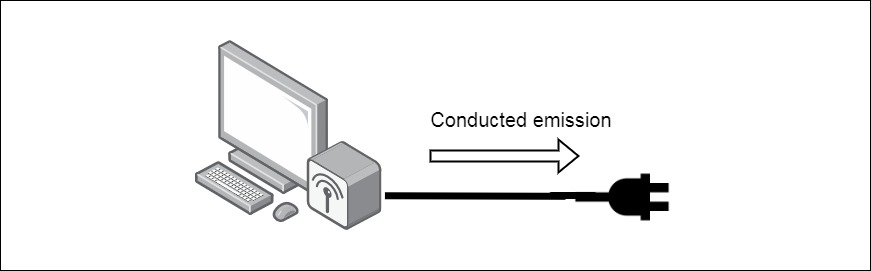
Conducted emission

  • Radiated Emission

When the device emits electromagnetic energy, it is released as electromagnetic fields that propagate through the air and can also interfere with other nearby devices.
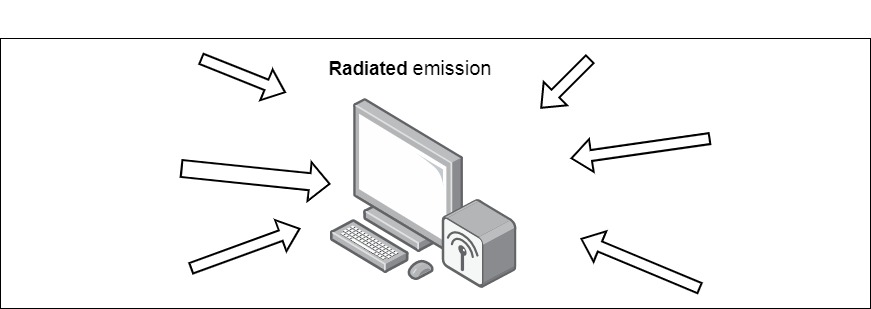
Radiated emission

  • Voltage Flicker Emission

Voltage Flicker occurs by changing load current, which flickers both frequency and amplitude. This can be illustrated by the change of a light bulb’s brightness or changing the speed of the motor or fan.
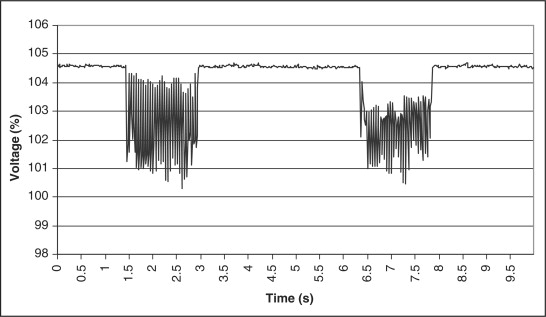
Voltage flickering in DC (Image: Science Direct)

  • Harmonic Current Emission

When the device emits any harmonics and distorts the mains supply, it is called harmonic current emission. It is associated with switch mode power converters and other non-linear loads such as motor, transformer, and lamp dimmers.
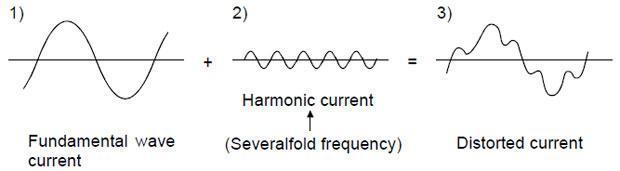
Harmonics from the device(Image: Science Direct)

Electromagnetic Susceptibility (EMS)
Electromagnetic Susceptibility (EMI) means the device is capable or has immunity to survive or works as expected in an environment where other devices generate electromagnetic interference. Every device tends to emit electromagnetic interference, so the victim device should not misbehave in these environments; these are all noted in the EMS test standards of the country.

Let’s take a real-life example to understand why is EMS test is required. If a user hears any noise in their mobile while another mobile or any home appliance is in use, it is because of the low immunity of the device.
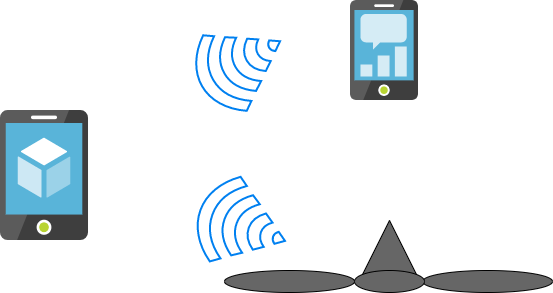
Effect of other devices on the user device

Types of Electromagnetic Susceptibility (EMS)

  • Conducted immunity

In the conducted immunity test, the disturbance in cable or power supply is created by an RF amplifier, and the device’s function should not be affected by that distortion or interference in the power supply.
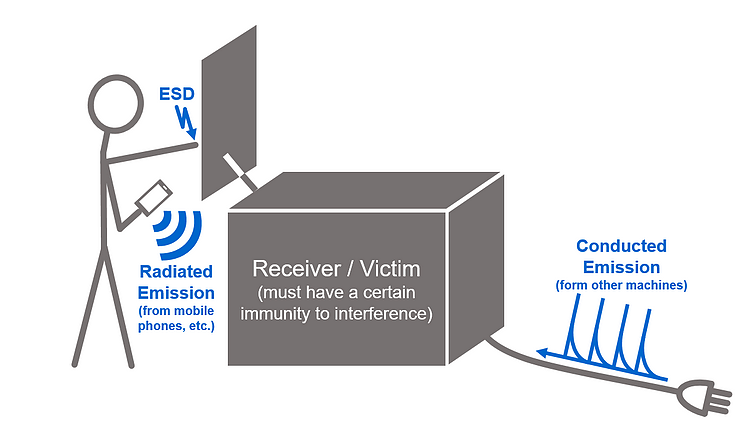
Radiated and conducted emission (Image: Academy of EMC)

  • Radiated immunity

In a radiated immunity test, the device creates an electric field disturbance, noise, or magnetic field interference through the air. In this scenario, the device should perform as expected.
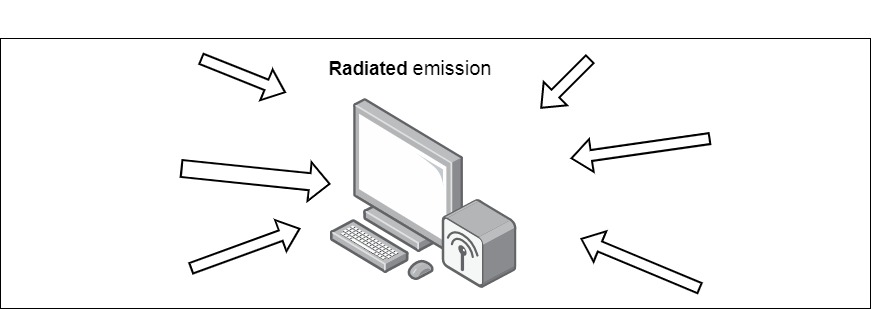
Radiated emission

  • Electrostatic Discharge (ESD)

Electrostatic Discharge is the Discharge of the human body in the metallic part of the device; whenever the human body touches the device, they will get a shock. It could permanently damage the device, so that this test will check the protection and immunity against ESD.

ESD symbol (image: Incompliance Magazine)

  • Electrical Fast Transient (EFT)

The EFT immunity test simulates the switching of inductive loads in the real world. The inductive load switching creates a small spark, which is a bursting of pulses. The device must be able to handle those pulses.
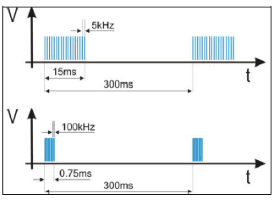
Bursting by EFT (Image: EMCfastpass)

  • Surge

ESD and EFT have similar rise times, pulse width, and energy levels. With a surge, the pulse’s rise time is just 1.2us, and the duration is longer. The pulse width is 50us so there should be protection in the circuit to handle the surge.

  • Magnetic Field

The magnetic field is everywhere; a current passing through a wire can generate a magnetic field around the wire. In this test magnetic field is created to test the device’s behavior and the functionality of the device should not be affected.
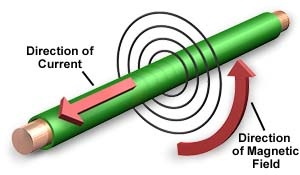
The magnetic field generated in wire (Image: source)

  • Voltage Dip and Short Interruption

In this test, the power supply fluctuations are created in either AC or DC, and then the device is observed under these conditions.
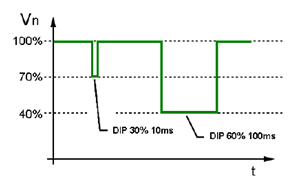
Voltage dip and short interruption (Image: EMC fastpass)

Global rules and regulations
The EMC standard is different for every country. The Federal Communication Commission (FCC) has some regulations and standards for EMC certification in the USA. In Canada, Industry Canada is equivalent to FCC. In Europe, the CE mark is equivalent to  FCC.

Some of the Marks provided by these regulatory bodies are as follows:

EMS Regulatory bodies for the USA.
EMC Regulatory bodies for Europe
EMC Regulatory bodies for Canada
EMC Regulatory bodies for Australia
EMC Regulatory bodies for Japan
EMC Regulatory bodies for China


You may also like:


  • What are EMS/EMC immunity lab tests?

  • What are some common EMI/EMC tests?

  • How to perform an EMI/EMC pre-compliance test

  • What is Wireless Electric Vehicle Charging System (WEVCS)?

  • What is an SoC?

  • EMI Detector using Arduino

Filed Under: EMI/EMC/RFI, Tutorials
Tagged With: conducted emissions, electromagnetic, electromagnetic compatability, electromagnetic interference, EMC, emi, harmonics, radiated emissions
 

Next Article

← Previous Article
Next Article →

EE TECH TOOLBOX

“ee
Tech Toolbox: Internet of Things
Explore practical strategies for minimizing attack surfaces, managing memory efficiently, and securing firmware. Download now to ensure your IoT implementations remain secure, efficient, and future-ready.

EE Learning Center

EE Learning Center
“engineers
EXPAND YOUR KNOWLEDGE AND STAY CONNECTED
Get the latest info on technologies, tools and strategies for EE professionals.

HAVE A QUESTION?

Have a technical question about an article or other engineering questions? Check out our engineering forums EDABoard.com and Electro-Tech-Online.com where you can get those questions asked and answered by your peers!


RSS EDABOARD.com Discussions

  • Reducing "shoot-through" in offline Full Bridge SMPS?
  • High Side current sensing
  • How to simulate power electronics converter in PSpice?
  • Voltage mode pushpull is a nonsense SMPS?
  • Layout IRN reduction in Comparator

RSS Electro-Tech-Online.com Discussions

  • Back to the old BASIC days
  • Parts required for a personal project
  • PIC KIT 3 not able to program dsPIC
  • Failure of polypropylene motor-run capacitors
  • Siemens large industrial PLC parts

Featured – RPi Python Programming (27 Part)

  • RPi Python Programming 21: The SIM900A AT commands
  • RPi Python Programming 22: Calls & SMS using a SIM900A GSM-GPRS modem
  • RPi Python Programming 23: Interfacing a NEO-6MV2 GPS module with Raspberry Pi
  • RPi Python Programming 24: I2C explained
  • RPi Python Programming 25 – Synchronous serial communication in Raspberry Pi using I2C protocol
  • RPi Python Programming 26 – Interfacing ADXL345 accelerometer sensor with Raspberry Pi

Recent Articles

  • What is AWS IoT Core and when should you use it?
  • AC-DC power supply extends voltage range to 800 V DC
  • Infineon’s inductive sensor integrates coil system driver, signal conditioning circuits and DSP
  • Arm Cortex-M23 MCU delivers 87.5 µA/MHz active mode
  • STMicroelectronics releases automotive amplifiers with in-play open-load detection

EE ENGINEERING TRAINING DAYS

engineering

Submit a Guest Post

submit a guest post
Engineers Garage
  • Analog IC TIps
  • Connector Tips
  • Battery Power Tips
  • DesignFast
  • EDABoard Forums
  • EE World Online
  • Electro-Tech-Online Forums
  • EV Engineering
  • Microcontroller Tips
  • Power Electronic Tips
  • Sensor Tips
  • Test and Measurement Tips
  • 5G Technology World
  • Subscribe to our newsletter
  • About Us
  • Contact Us
  • Advertise

Copyright © 2025 WTWH Media LLC. All Rights Reserved. The material on this site may not be reproduced, distributed, transmitted, cached or otherwise used, except with the prior written permission of WTWH Media
Privacy Policy

Search Engineers Garage

  • Electronic Projects & Tutorials
    • Electronic Projects
      • Arduino Projects
      • AVR
      • Raspberry pi
      • ESP8266
      • BeagleBone
      • 8051 Microcontroller
      • ARM
      • PIC Microcontroller
      • STM32
    • Tutorials
      • Audio Electronics
      • Battery Management
      • Brainwave
      • Electric Vehicles
      • EMI/EMC/RFI
      • Hardware Filters
      • IoT tutorials
      • Power Tutorials
      • Python
      • Sensors
      • USB
      • VHDL
    • Circuit Design
    • Project Videos
    • Components
  • Articles
    • Tech Articles
    • Insight
    • Invention Stories
    • How to
    • What Is
  • News
    • Electronic Product News
    • Business News
    • Company/Start-up News
    • DIY Reviews
    • Guest Post
  • Forums
    • EDABoard.com
    • Electro-Tech-Online
    • EG Forum Archive
  • DigiKey Store
    • Cables, Wires
    • Connectors, Interconnect
    • Discrete
    • Electromechanical
    • Embedded Computers
    • Enclosures, Hardware, Office
    • Integrated Circuits (ICs)
    • Isolators
    • LED/Optoelectronics
    • Passive
    • Power, Circuit Protection
    • Programmers
    • RF, Wireless
    • Semiconductors
    • Sensors, Transducers
    • Test Products
    • Tools
  • Learn
    • eBooks/Tech Tips
    • Design Guides
    • Learning Center
    • Tech Toolboxes
    • Webinars & Digital Events
  • Resources
    • Digital Issues
    • EE Training Days
    • LEAP Awards
    • Podcasts
    • Webinars / Digital Events
    • White Papers
    • Engineering Diversity & Inclusion
    • DesignFast
  • Guest Post Guidelines
  • Advertise
  • Subscribe