Engineers Garage

  • Electronic Projects & Tutorials
    • Electronic Projects
      • Arduino Projects
      • AVR
      • Raspberry pi
      • ESP8266
      • BeagleBone
      • 8051 Microcontroller
      • ARM
      • PIC Microcontroller
      • STM32
    • Tutorials
      • Audio Electronics
      • Battery Management
      • Brainwave
      • Electric Vehicles
      • EMI/EMC/RFI
      • Hardware Filters
      • IoT tutorials
      • Power Tutorials
      • Python
      • Sensors
      • USB
      • VHDL
    • Circuit Design
    • Project Videos
    • Components
  • Articles
    • Tech Articles
    • Insight
    • Invention Stories
    • How to
    • What Is
  • News
    • Electronic Product News
    • Business News
    • Company/Start-up News
    • DIY Reviews
    • Guest Post
  • Forums
    • EDABoard.com
    • Electro-Tech-Online
    • EG Forum Archive
  • DigiKey Store
    • Cables, Wires
    • Connectors, Interconnect
    • Discrete
    • Electromechanical
    • Embedded Computers
    • Enclosures, Hardware, Office
    • Integrated Circuits (ICs)
    • Isolators
    • LED/Optoelectronics
    • Passive
    • Power, Circuit Protection
    • Programmers
    • RF, Wireless
    • Semiconductors
    • Sensors, Transducers
    • Test Products
    • Tools
  • Learn
    • eBooks/Tech Tips
    • Design Guides
    • Learning Center
    • Tech Toolboxes
    • Webinars & Digital Events
  • Resources
    • Digital Issues
    • EE Training Days
    • LEAP Awards
    • Podcasts
    • Webinars / Digital Events
    • White Papers
    • Engineering Diversity & Inclusion
    • DesignFast
  • Guest Post Guidelines
  • Advertise
  • Subscribe

Basics of Li-ion Battery Charging (Part- 3/17)

By Diksha July 6, 2024

Lithium-ion batteries are another popular type of batteries that are used in the Uninterruptible Power Supply (UPS) designs. These batteries are commonly used in portable electronic devices. These are low maintenance batteries having high energy density, small size and light weight which makes them suitable for use in most of the portable devices.

But, due to high energy density in comparison to the weight and volume of the Li-ion Battery, there are also some safety concerns while charging the Li-ion batteries. Before designing a charger circuit for these batteries, let us first understand charging methods and topologies involved in charging Li-ion batteries. Also, precautions required in handling, storing and disposing of these batteries are must to know.
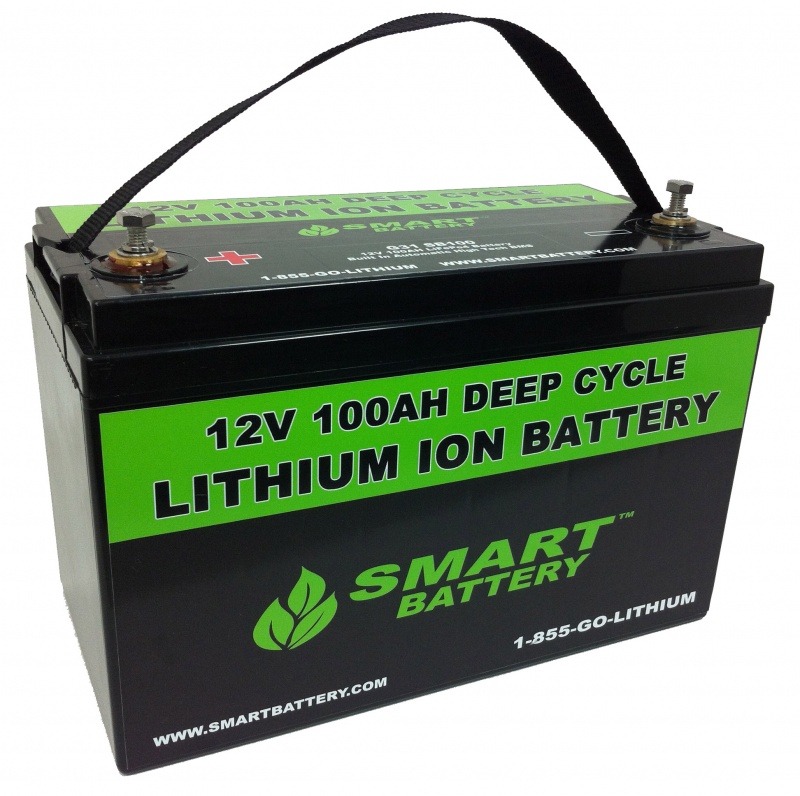
Representational Image of a 12V Lithium Ion Battery

Fig. 1: Representational Image of a 12V Lithium Ion Battery

Charging Li-ion Batteries
There are different charging methods for charging any battery –
1. Constant current charging (abbreviated as CC charging )
2. Constant voltage charging (abbreviated as CV charging )
3. Constant current-Constant voltage charging (CC-CV Charging)
The manufacturers of Li-ion Battery recommend strict standards for charging the Li-ion batteries. The Li-ion batteries must be charged by Constant Current-Constant Voltage Charging method. So designing a Li-ion battery charger needs an intelligent circuitry which can switch the battery charging in between CC and CV charging modes.
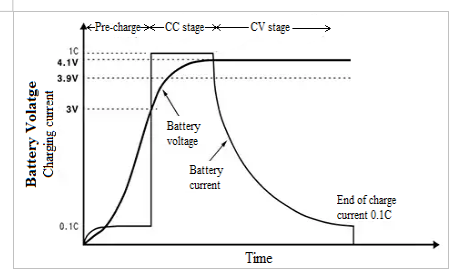
There are three states in Li-ion battery charging as shown in the graph below –
1. Trickle charge state
2. Constant current state (CC state)
3. Constant voltage state (CV state)
Graphical Presentation Showing Charging of Lithium IOn Battery

Fig. 2: Graphical Presentation Showing Charging of Lithium IOn Battery

• Trickle state –

A Li-ion battery cannot be discharged below its discharging limit. Most of the Li-ion batteries have discharge limit of 2.8V to 3V. Below 3V the battery is said to be in the dead state. To overcome the dead state the battery needs to be charged by 0.1C or 0.3C charge rate or 10% of the maximum battery capacity.
The charge rate here refers to the charge and discharge rate of the Li-ion Battery. It is defined by the charge and discharge current relative to the battery capacity. This is expressed in ‘C’ units. The use of rates instead of current values allows easy comparison of the capacity of batteries when comparing different battery technologies or different battery sizes for the same technology.
So in trickle charge state, the battery charging current can be expressed in ‘C’. In trickle charge state when the battery voltage reaches to 3V, then the battery comes out of dead state and then it can be charged with CC and CV charging circuit.
If in a trickle charge state, the voltage of the dead battery does not charge up to 3V level after a sufficient period of time then, that means the battery is permanently damaged. Generally, the time taken by a Li-ion battery for trickle charge state is 10 minutes.

• Constant Current State (CC state) –

After completion of trickle charge state, the battery should be charged by the constant current method. In Constant Current State, the battery is charged by a constant current keeping the voltage equal to the peak terminal voltage of the battery. The constant current required for charging the battery is decided by its C. Generally, the batteries are charged by a rate 0.5C to 0.8C in this charging mode. The battery charges very fast in this state. That is why this state is also called Fast Charging State. In this state, the battery is 80% charged and the remaining 20% is charged by Constant Voltage (CV) mode.

• Constant voltage State (CV state) –

When the terminal voltage of the battery reaches to 4.2V then the battery needs to be charged with a Constant Voltage Source. Now the CC state should be cut off and the charging current should start decreasing. The constant voltage should be equal to the maximum voltage of the battery to fully charge it. However, it is recommended to charge the battery at a bit less voltage than its maximum rated voltage.
This increases the lifespan of the battery. The current in this mode slowly starts dropping down by maintaining a constant voltage. In this state charging rate of the battery is very less. So it takes more time to charge the remaining 20% of the battery and due to this, some chargers are designed to skip this charging state.
Charging Topologies for Li-ion Batteries
There are basically two types of topologies used for charging the Li-ion batteries –
1. Linear Regulator
2. Switching Regulators

1. Linear Regulator –

A Linear regulator is used for maintaining a constant voltage at the output. The regulator act like a variable resistor which maintains the steady voltage at the output by continuously dissipating the heat. This decreases the overall efficiency of the system. So in this topology, a linear regulator is used for charging the battery. The efficiency of this charger is comparatively less but it is simple to design and have low cost.

2. Switching regulators –

The Switching Regulators step-up and step-down the input supply voltage to the desired voltage level. The switching regulators (like transistors) continuously switches between their ON and OFF state. So they spend quite less time in high dissipation state which reduces power dissipation of the system. This improves the efficiency of the switching regulator as compared to a linear regulator. Therefore, designing the charger by this topology increases the system efficiency. But this topology requires comparatively costlier electronic components as well as have a complex circuitry involved in the system design.

Maintenance of Li-ion Batteries and charging and discharging standards of Li-ion Batteries 

The Li-ion batteries are low maintenance batteries. They have a very slow self-discharge rate compared to other rechargeable batteries. The technology involved in the design and development of lithium ion batteries is still under development and it has far to go in the future. These batteries have an aging problem associated with both time onwards from their manufacturing as well as the number of charging and discharging cycles these batteries undergo. There are also safety issues with these batteries and even at some places, these batteries are not allowed to be carried on aircrafts. Due to immature technology and safety issues, these batteries need to be used with care. That is why it is important to take care of certain precautionary measures while designing a charger for Lithium Ion batteries.
For a better life of these batteries, these should be charged at a charging rate of 0.5 C to 0.8 C in Constant Current (CC) state. The battery must be charged slightly less than its maximum rated voltage in Constant Voltage state. The Li-ion batteries can perform well at elevated temperature but long time exposure can reduce their life. These batteries can have fast charging in the temperature range of 0 to 45 degree Celsius. That is why the charging should be done in this temperature range if possible. Even at lower temperatures than these, charging is possible but it increases the internal resistance of the battery resulting in slow charging and therefore longer charging time.
At a high temperature greater than 45 degree Celsius the battery life may degrade. These batteries are not much robust and can easily get damaged by over charging and over discharging. So, completely discharging of the battery should be best avoided. Also charging of deeply discharged Li-ion batteries should also be avoided if they have been left in that condition for several months. The overcharging of these batteries can result in metallic lithium build up on the anode, which can lead to short circuiting and cell venting ( bursting cells and flames).
Storage of Li-Ion Batteries 
These batteries when not used should be stored in a cool place. Before storage, they must be charged or discharged to 50% charge level to avoid over charge or over discharge condition. As these batteries have an aging problem and may though get self-discharge if left unused and unattended for a longer time, they must be charged at least once every six months. They must be charged to 50 percent level in each cycle. These batteries must be stored in a cool place where the temperature may be in the range from 5 to 20 degree Celsius.
Precautions required while using Li-ion Batteries 
These batteries can catch fire on short circuiting so, their terminals should never be shorted by mistake. Even when attached to a circuit, it should be taken care that their terminals are not shorted by accident. Due to fluids used in their design, these batteries are not robust to vibrations or shocks. That is why these batteries are not recommended for use in transportation. Even there are restrictions in carrying these batteries in aircraft at many places.
Disposing Li-Ion Batteries 
These batteries should not be disposed of in fire or water. For destroying them, these should never be crushed as these contain fluids that can be harmful to humans and the environment. If a Li-ion battery starts leaking fluids, the fluid should not be touched and the battery must be removed with utmost care. These batteries should be best disposed of by handling to a waste facility. If there is no such facility nearby, they can be thrown in a regular trash in a separate bag so that they can be easily collected by the waste management facility.


You may also like:


  • How does LoRa modulation enable long-range communication?

  • What battery chemistries are used in electric vehicles?

  • What are the different types of EV charging connectors?

  • What types of motors are used in electric vehicles?

  • What is Wireless Electric Vehicle Charging System (WEVCS)?

  • What is the role of embedded software in electric vehicles?

Filed Under: Power, Tutorials


Next Article

← Previous Article
Next Article →

Questions related to this article?
👉Ask and discuss on Electro-Tech-Online.com and EDAboard.com forums.


Tell Us What You Think!! Cancel reply

You must be logged in to post a comment.

EE TECH TOOLBOX

“ee
Tech Toolbox: Internet of Things
Explore practical strategies for minimizing attack surfaces, managing memory efficiently, and securing firmware. Download now to ensure your IoT implementations remain secure, efficient, and future-ready.

EE Learning Center

EE Learning Center
“engineers
EXPAND YOUR KNOWLEDGE AND STAY CONNECTED
Get the latest info on technologies, tools and strategies for EE professionals.

HAVE A QUESTION?

Have a technical question about an article or other engineering questions? Check out our engineering forums EDABoard.com and Electro-Tech-Online.com where you can get those questions asked and answered by your peers!


RSS EDABOARD.com Discussions

  • Reducing "shoot-through" in offline Full Bridge SMPS?
  • High Side current sensing
  • How to simulate power electronics converter in PSpice?
  • Voltage mode pushpull is a nonsense SMPS?
  • Layout IRN reduction in Comparator

RSS Electro-Tech-Online.com Discussions

  • Back to the old BASIC days
  • Parts required for a personal project
  • PIC KIT 3 not able to program dsPIC
  • Failure of polypropylene motor-run capacitors
  • Siemens large industrial PLC parts

Featured – RPi Python Programming (27 Part)

  • RPi Python Programming 21: The SIM900A AT commands
  • RPi Python Programming 22: Calls & SMS using a SIM900A GSM-GPRS modem
  • RPi Python Programming 23: Interfacing a NEO-6MV2 GPS module with Raspberry Pi
  • RPi Python Programming 24: I2C explained
  • RPi Python Programming 25 – Synchronous serial communication in Raspberry Pi using I2C protocol
  • RPi Python Programming 26 – Interfacing ADXL345 accelerometer sensor with Raspberry Pi

Recent Articles

  • What is AWS IoT Core and when should you use it?
  • AC-DC power supply extends voltage range to 800 V DC
  • Infineon’s inductive sensor integrates coil system driver, signal conditioning circuits and DSP
  • Arm Cortex-M23 MCU delivers 87.5 µA/MHz active mode
  • STMicroelectronics releases automotive amplifiers with in-play open-load detection

EE ENGINEERING TRAINING DAYS

engineering

Submit a Guest Post

submit a guest post
Engineers Garage
  • Analog IC TIps
  • Connector Tips
  • Battery Power Tips
  • DesignFast
  • EDABoard Forums
  • EE World Online
  • Electro-Tech-Online Forums
  • EV Engineering
  • Microcontroller Tips
  • Power Electronic Tips
  • Sensor Tips
  • Test and Measurement Tips
  • 5G Technology World
  • Subscribe to our newsletter
  • About Us
  • Contact Us
  • Advertise

Copyright © 2025 WTWH Media LLC. All Rights Reserved. The material on this site may not be reproduced, distributed, transmitted, cached or otherwise used, except with the prior written permission of WTWH Media
Privacy Policy

Search Engineers Garage

  • Electronic Projects & Tutorials
    • Electronic Projects
      • Arduino Projects
      • AVR
      • Raspberry pi
      • ESP8266
      • BeagleBone
      • 8051 Microcontroller
      • ARM
      • PIC Microcontroller
      • STM32
    • Tutorials
      • Audio Electronics
      • Battery Management
      • Brainwave
      • Electric Vehicles
      • EMI/EMC/RFI
      • Hardware Filters
      • IoT tutorials
      • Power Tutorials
      • Python
      • Sensors
      • USB
      • VHDL
    • Circuit Design
    • Project Videos
    • Components
  • Articles
    • Tech Articles
    • Insight
    • Invention Stories
    • How to
    • What Is
  • News
    • Electronic Product News
    • Business News
    • Company/Start-up News
    • DIY Reviews
    • Guest Post
  • Forums
    • EDABoard.com
    • Electro-Tech-Online
    • EG Forum Archive
  • DigiKey Store
    • Cables, Wires
    • Connectors, Interconnect
    • Discrete
    • Electromechanical
    • Embedded Computers
    • Enclosures, Hardware, Office
    • Integrated Circuits (ICs)
    • Isolators
    • LED/Optoelectronics
    • Passive
    • Power, Circuit Protection
    • Programmers
    • RF, Wireless
    • Semiconductors
    • Sensors, Transducers
    • Test Products
    • Tools
  • Learn
    • eBooks/Tech Tips
    • Design Guides
    • Learning Center
    • Tech Toolboxes
    • Webinars & Digital Events
  • Resources
    • Digital Issues
    • EE Training Days
    • LEAP Awards
    • Podcasts
    • Webinars / Digital Events
    • White Papers
    • Engineering Diversity & Inclusion
    • DesignFast
  • Guest Post Guidelines
  • Advertise
  • Subscribe