Engineers Garage

  • Electronic Projects & Tutorials
    • Electronic Projects
      • Arduino Projects
      • AVR
      • Raspberry pi
      • ESP8266
      • BeagleBone
      • 8051 Microcontroller
      • ARM
      • PIC Microcontroller
      • STM32
    • Tutorials
      • Audio Electronics
      • Battery Management
      • Brainwave
      • Electric Vehicles
      • EMI/EMC/RFI
      • Hardware Filters
      • IoT tutorials
      • Power Tutorials
      • Python
      • Sensors
      • USB
      • VHDL
    • Circuit Design
    • Project Videos
    • Components
  • Articles
    • Tech Articles
    • Insight
    • Invention Stories
    • How to
    • What Is
  • News
    • Electronic Product News
    • Business News
    • Company/Start-up News
    • DIY Reviews
    • Guest Post
  • Forums
    • EDABoard.com
    • Electro-Tech-Online
    • EG Forum Archive
  • DigiKey Store
    • Cables, Wires
    • Connectors, Interconnect
    • Discrete
    • Electromechanical
    • Embedded Computers
    • Enclosures, Hardware, Office
    • Integrated Circuits (ICs)
    • Isolators
    • LED/Optoelectronics
    • Passive
    • Power, Circuit Protection
    • Programmers
    • RF, Wireless
    • Semiconductors
    • Sensors, Transducers
    • Test Products
    • Tools
  • Learn
    • eBooks/Tech Tips
    • Design Guides
    • Learning Center
    • Tech Toolboxes
    • Webinars & Digital Events
  • Resources
    • Digital Issues
    • EE Training Days
    • LEAP Awards
    • Podcasts
    • Webinars / Digital Events
    • White Papers
    • Engineering Diversity & Inclusion
    • DesignFast
  • Guest Post Guidelines
  • Advertise
  • Subscribe

Home-made digital clock keeps time after 45 years

By Martin Rowe March 5, 2024

Look inside this one-chip clock built from surplus parts. With the case open, replacing parts waiting to fail seemed like a good idea.
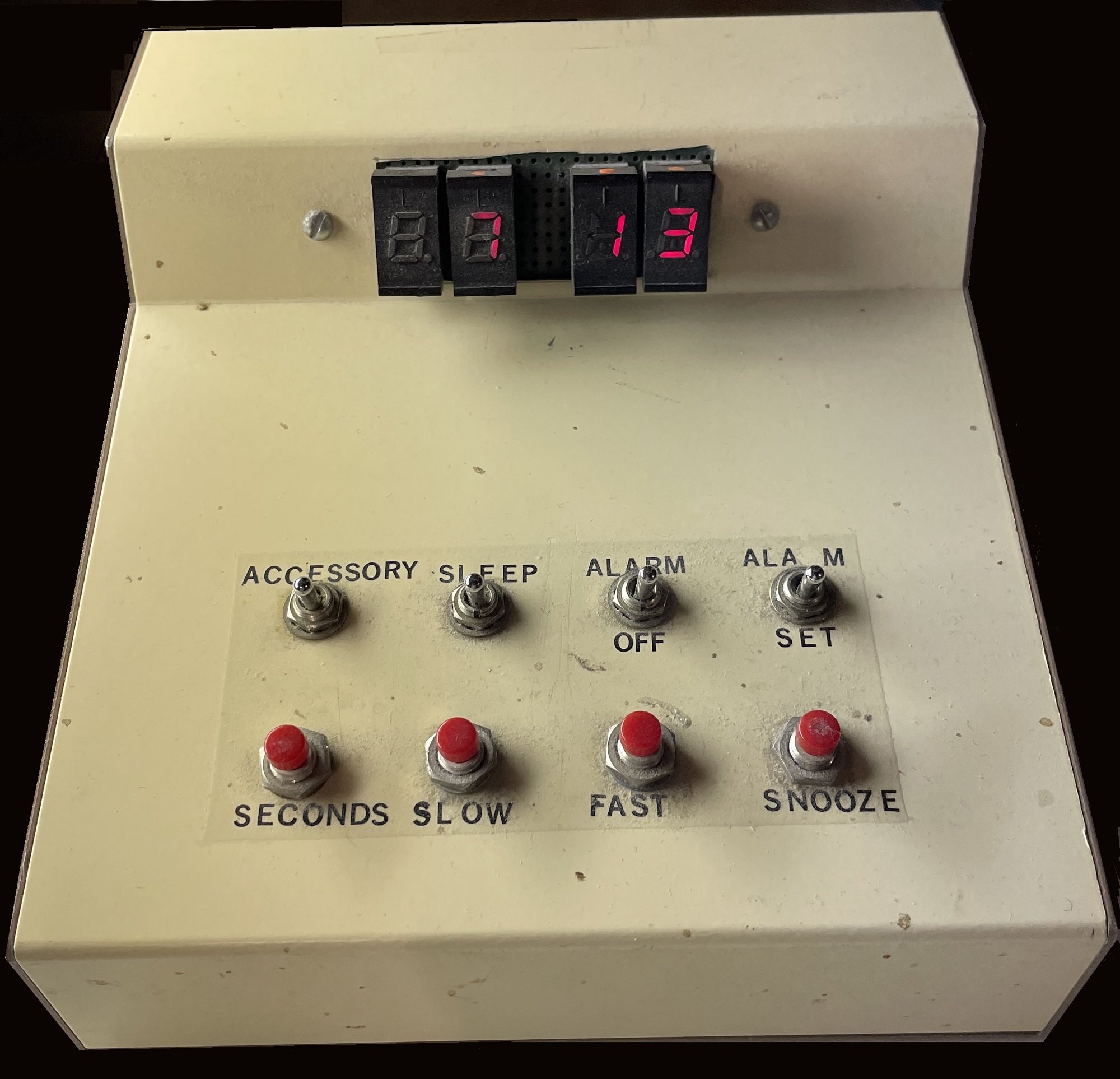
MM5316 clock

Figure 1. This clock, based on an MM5316 clock chip and originally built in 1978, still keeps time.

In my second year at WPI, I found myself in “B term” where I had a scheduling problem. Being as WPI operates on a four-term academic year, I couldn’t find a one-term course for the second term that didn’t require a prerequisite. Faced with taking just two classes (but having paid for three), I convinced a professor to sponsor me for an independent study building a digital clock (Figure 1).

The previous summer, I stopped into a surplus electronics store called Verada 214 in Lowell, Mass. Figure 2 shows portion of an ad from the January 1975 issue of 73 Magazine. There among the unorganized piles of parts, I found some National Semiconductor MM5316 clock chips in 40-pin dual-inline packages (DIPs) along with a datasheet. This seemed like a way to fill the unused academic slot.

Verada 214

Figure 2. Verada 214, a surplus electronics store in Lowell, Mass. This image was originally published in 1975 by 73 Magazine.

Having registered for the project, I again went to Verada 214. That’s when I bought the socket, switches, LEDs, transistors, original wooden box, and other components.

Wooden box?

That’s because when I started building the clock using a plastic case, my roommates took pleasure in annoying me by pushing the buttons. To make that harder, I used a wooden box and installed the pushbuttons flush with the box surface. That made it just difficult enough for my roommates to stop because they needed something to push the buttons. After leaving school and my roommates, I rebuilt the clock into the current metal box.

The video provides an overall tour of the clock with the case open. There, you’ll see wire-wrapped connections and a few soldered connections. Figure 3 shows some of the wire wrapping.
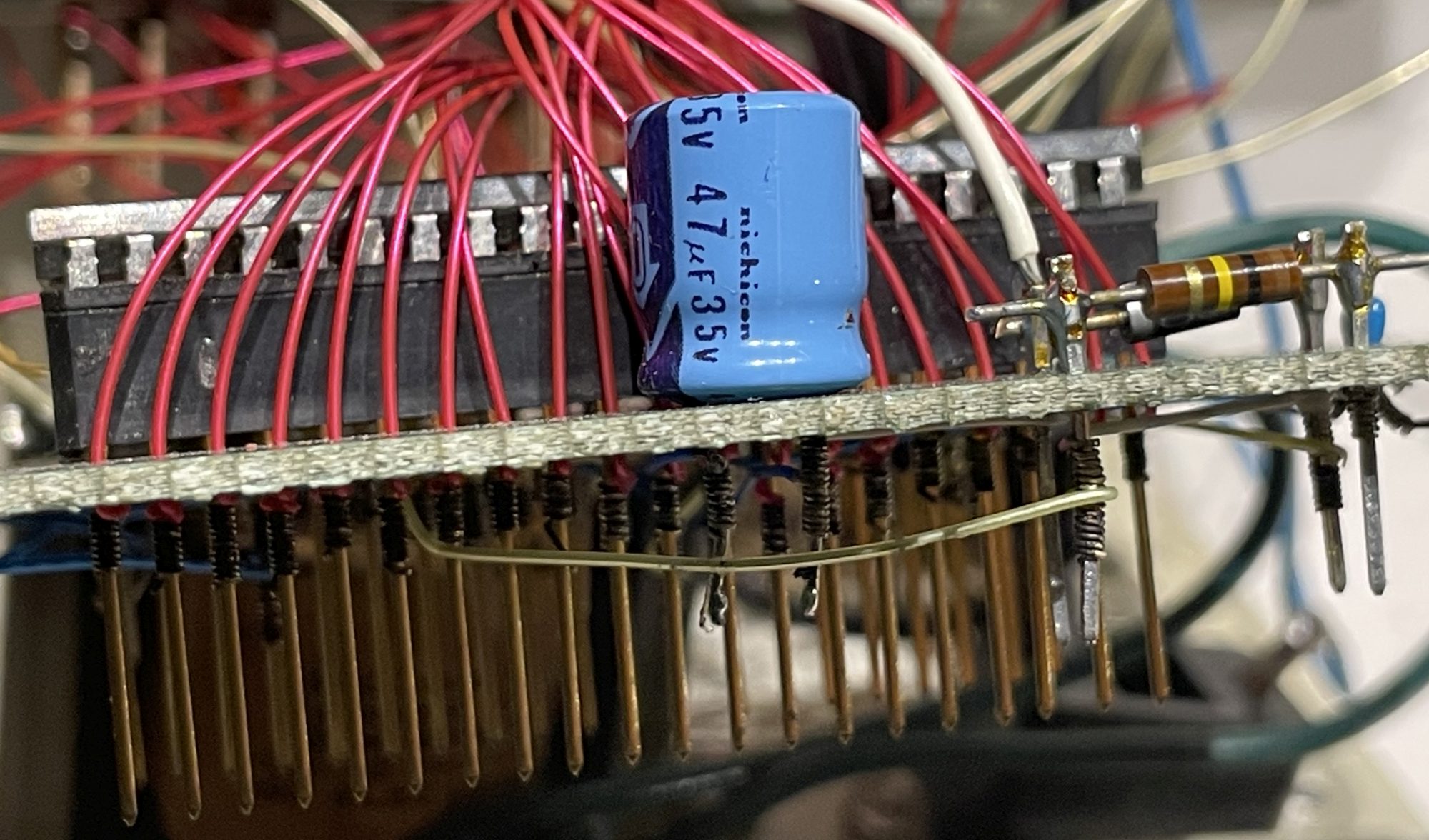
wire wrap

Figure 3. Many wiring connections in the digital clock were wire wrapped.

Replacement parts

One soldered connection made me wonder what I was thinking all those years ago. Figure 4 shows a connection from the transformer primary AC mains (black wire) that goes through the white wire to a toggle switch that, when closed, bypasses a relay. The relay provided power to an AC outlet on the back, where I once connected a radio. Because I no longer use the AC outlet, it seemed best to disconnect it from the circuit. Insulating a bare AC mains connection with tape, and not even electrical tape? What was I thinking?
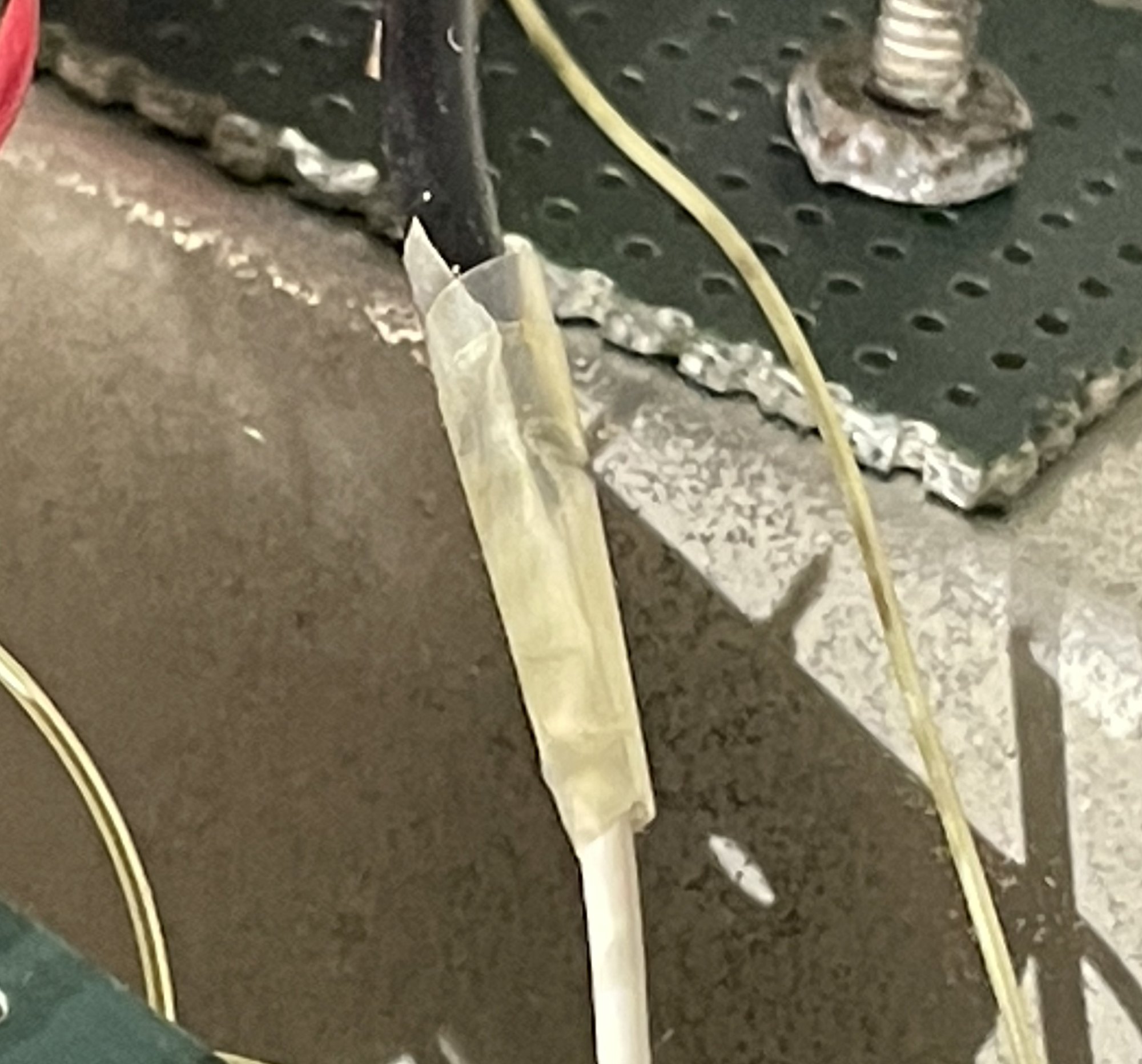
Figure 4. This original AC mains wire connections used everyday tape for it’s insulation.

In addition to feeling the need to make a better AC mains connection, I found the transformer had leaked (Figure 5) and needed replacing even though it still worked. After searching several distributor sites, I ordered a Hammond Manufacturing 166F12B 12 V CT transformer from Arrow ($0.99 + $6.99 for shipping). Mouser and Digi-Key charge $14 and $15, respectively, plus shipping.
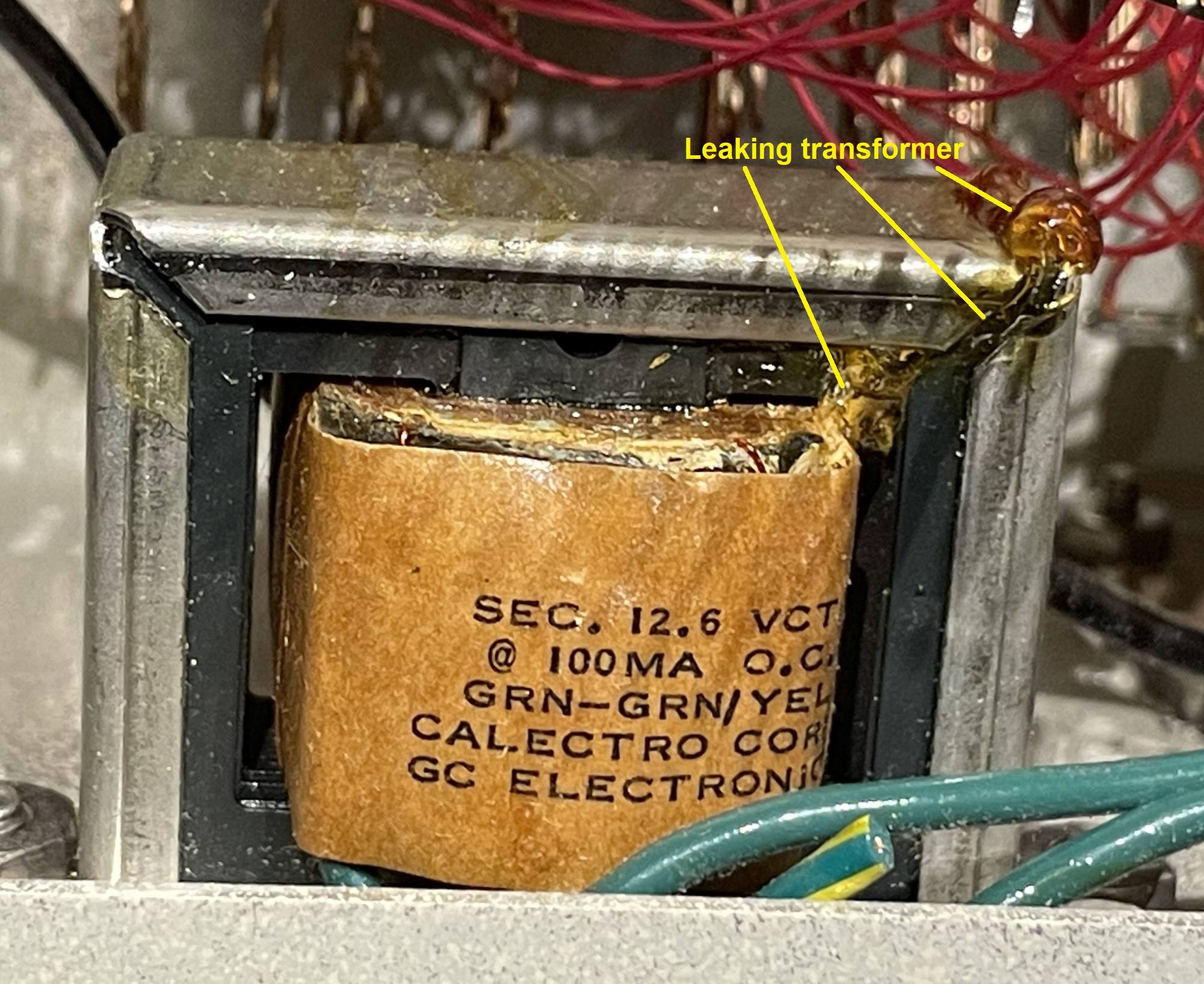
Leaking AC transformer

Figure 5. The transformer leaked over time, but was still working.

Expect capacitors to fail

You’ve probably replaced a few failed electrolytic capacitors. I have. To my surprise, the blue 47 µF, 35 V capacitor in the power circuit (Figure 3) has never failed, even after so many years. Nevertheless, I felt the need to replace it. Not wanting to pay another $6.99 for a $0.99 part, I bought a 100 V electrolytic capacitor from You-Do-It Electronics (no lower voltage in stock at the time). Will it last 40 years or fail in ten?

Figure 6 shows the new transformer with the primary connected to AC mains through a twist-on wire connector. The figure also shows the new capacitor (black). Now came the moment of truth. Would the clock work as before or go up in flames? I’m happy to report that it’s working.
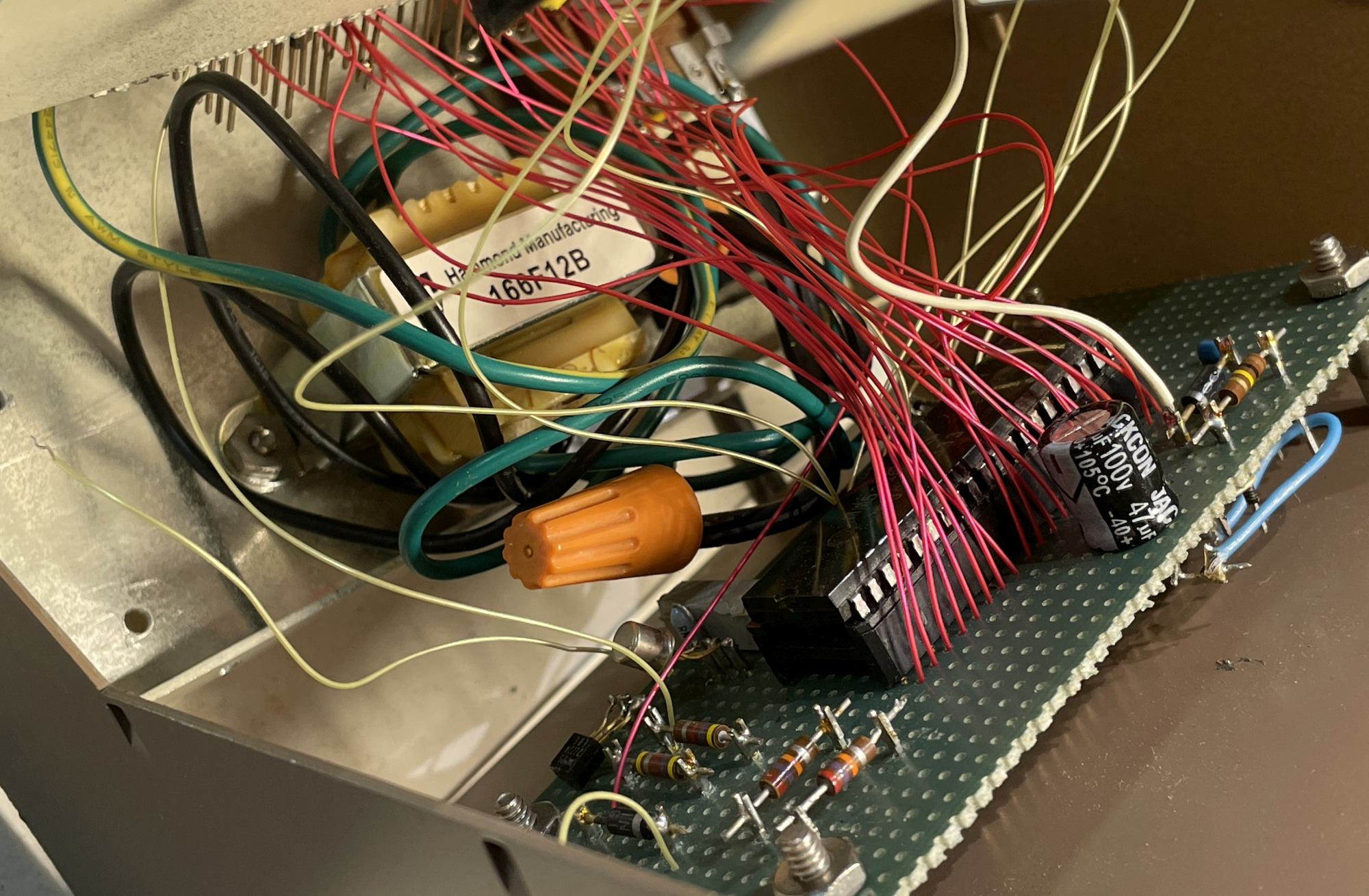
Figure 6. The new transformer now uses capped AC mains connections. The new capacitor filters the AC ripple.

Look carefully at Figure 6. You’ll see a 2N2222A transistor in a metal can package. Next to it is a potentiometer that’s a brightness control for the LEDs. Sometime around 2013, the LEDs mysteriously dimmed. To compensate, I placed a carboard box around the LEDs to block ambient light. I attributed that to aging LEDs. A few years later, the LEDs just as mysteriously regained their original brightness. I can easily read them, though perhaps I should open the case and try adjusting the pot and see if the LEDs brighten.

Or I could leave things alone for another 40 years.

Figure 7 is a portion of “The National Anthem” published in September 1973 highlighting the MM5316. Today, the “MM” designation is used by Menlo Micro. Fortunately, the people there are smart enough not to use the MM53xx designation.
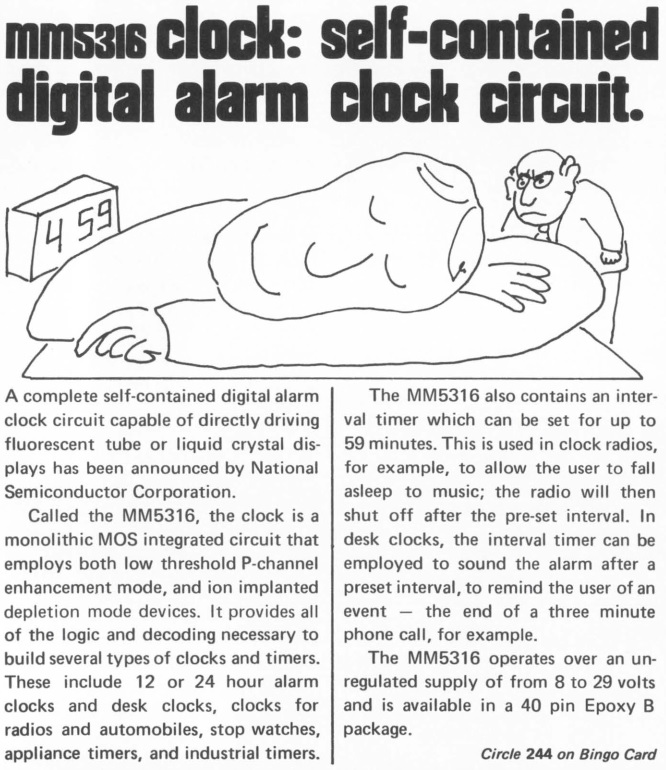
Figure 7. National Semiconductor published an ad in 1973 that included this description of the MM5316.


Filed Under: Circuit Design, Electronic Projects, Featured, Home Automation, Video
Tagged With: menlomicro, NationalSemiconductor
 

Next Article

← Previous Article
Next Article →

Questions related to this article?
👉Ask and discuss on EDAboard.com and Electro-Tech-Online.com forums.


Tell Us What You Think!! Cancel reply

You must be logged in to post a comment.

EE TECH TOOLBOX

“ee
Tech Toolbox: Internet of Things
Explore practical strategies for minimizing attack surfaces, managing memory efficiently, and securing firmware. Download now to ensure your IoT implementations remain secure, efficient, and future-ready.

EE Learning Center

EE Learning Center
“engineers
EXPAND YOUR KNOWLEDGE AND STAY CONNECTED
Get the latest info on technologies, tools and strategies for EE professionals.

HAVE A QUESTION?

Have a technical question about an article or other engineering questions? Check out our engineering forums EDABoard.com and Electro-Tech-Online.com where you can get those questions asked and answered by your peers!


RSS EDABOARD.com Discussions

  • Reducing "shoot-through" in offline Full Bridge SMPS?
  • High Side current sensing
  • How to simulate power electronics converter in PSpice?
  • Voltage mode pushpull is a nonsense SMPS?
  • Layout IRN reduction in Comparator

RSS Electro-Tech-Online.com Discussions

  • Back to the old BASIC days
  • Parts required for a personal project
  • PIC KIT 3 not able to program dsPIC
  • Failure of polypropylene motor-run capacitors
  • Siemens large industrial PLC parts

Featured – RPi Python Programming (27 Part)

  • RPi Python Programming 21: The SIM900A AT commands
  • RPi Python Programming 22: Calls & SMS using a SIM900A GSM-GPRS modem
  • RPi Python Programming 23: Interfacing a NEO-6MV2 GPS module with Raspberry Pi
  • RPi Python Programming 24: I2C explained
  • RPi Python Programming 25 – Synchronous serial communication in Raspberry Pi using I2C protocol
  • RPi Python Programming 26 – Interfacing ADXL345 accelerometer sensor with Raspberry Pi

Recent Articles

  • What is AWS IoT Core and when should you use it?
  • AC-DC power supply extends voltage range to 800 V DC
  • Infineon’s inductive sensor integrates coil system driver, signal conditioning circuits and DSP
  • Arm Cortex-M23 MCU delivers 87.5 µA/MHz active mode
  • STMicroelectronics releases automotive amplifiers with in-play open-load detection

EE ENGINEERING TRAINING DAYS

engineering

Submit a Guest Post

submit a guest post
Engineers Garage
  • Analog IC TIps
  • Connector Tips
  • Battery Power Tips
  • DesignFast
  • EDABoard Forums
  • EE World Online
  • Electro-Tech-Online Forums
  • EV Engineering
  • Microcontroller Tips
  • Power Electronic Tips
  • Sensor Tips
  • Test and Measurement Tips
  • 5G Technology World
  • Subscribe to our newsletter
  • About Us
  • Contact Us
  • Advertise

Copyright © 2025 WTWH Media LLC. All Rights Reserved. The material on this site may not be reproduced, distributed, transmitted, cached or otherwise used, except with the prior written permission of WTWH Media
Privacy Policy

Search Engineers Garage

  • Electronic Projects & Tutorials
    • Electronic Projects
      • Arduino Projects
      • AVR
      • Raspberry pi
      • ESP8266
      • BeagleBone
      • 8051 Microcontroller
      • ARM
      • PIC Microcontroller
      • STM32
    • Tutorials
      • Audio Electronics
      • Battery Management
      • Brainwave
      • Electric Vehicles
      • EMI/EMC/RFI
      • Hardware Filters
      • IoT tutorials
      • Power Tutorials
      • Python
      • Sensors
      • USB
      • VHDL
    • Circuit Design
    • Project Videos
    • Components
  • Articles
    • Tech Articles
    • Insight
    • Invention Stories
    • How to
    • What Is
  • News
    • Electronic Product News
    • Business News
    • Company/Start-up News
    • DIY Reviews
    • Guest Post
  • Forums
    • EDABoard.com
    • Electro-Tech-Online
    • EG Forum Archive
  • DigiKey Store
    • Cables, Wires
    • Connectors, Interconnect
    • Discrete
    • Electromechanical
    • Embedded Computers
    • Enclosures, Hardware, Office
    • Integrated Circuits (ICs)
    • Isolators
    • LED/Optoelectronics
    • Passive
    • Power, Circuit Protection
    • Programmers
    • RF, Wireless
    • Semiconductors
    • Sensors, Transducers
    • Test Products
    • Tools
  • Learn
    • eBooks/Tech Tips
    • Design Guides
    • Learning Center
    • Tech Toolboxes
    • Webinars & Digital Events
  • Resources
    • Digital Issues
    • EE Training Days
    • LEAP Awards
    • Podcasts
    • Webinars / Digital Events
    • White Papers
    • Engineering Diversity & Inclusion
    • DesignFast
  • Guest Post Guidelines
  • Advertise
  • Subscribe