Inductors are simple components in electronic devices that perform tasks like cleaning up electrical signals, helping with timing, and managing power. They store energy in magnetic fields when electricity flows through them and releases them back into the circuit. Inductors resist sudden changes in the flow of electricity, pushing back “spikes” by creating an electrical force (like a tiny electric push or pull), according to a rule called Lenz’s Law.
Inductors are measured in unit “Henry” (H), named after an influential scientist, and this exemplifies how much energy they can store. But they interact differently depending on the signal, as per the examples below.
- For regular DC electric signals, inductors act like a shortcut, allowing electricity to flow easily
- For AC signals, inductors are like a roadblock, making it difficult for the electricity to pass through.

Typical images of inductors.
There are several important parameters to consider when selecting an inductor.
- The Q Factor or Quality Factor measures how reliable an inductor is at doing its job in an electrical circuit. It evaluates the efficiency of the inductor at a specific frequency, rating its performance. A high Q Factor means the inductor is excellent at its job, ensuring the circuit works precisely at a specific frequency.
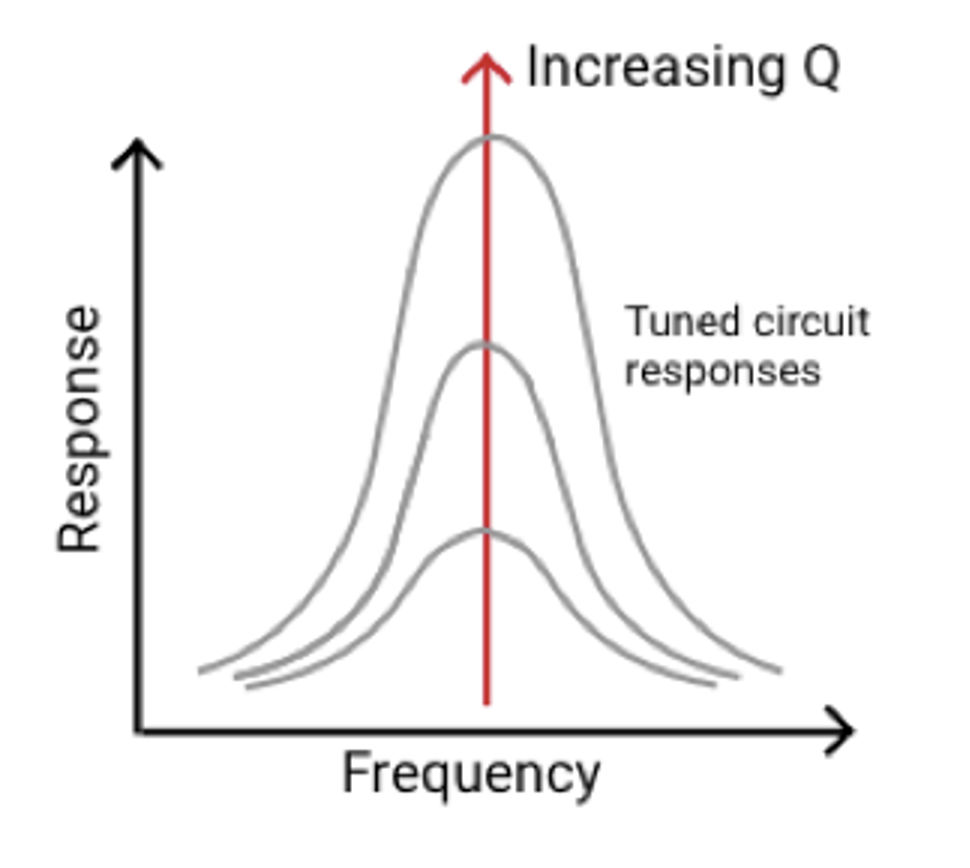
- The Self Resonant Frequency (SRF) occurs when an inductor fails to work properly. In radio-frequency (RF) circuits, choosing an SRF higher than the frequency at which the circuit operates is critical. This is because at the SRF, both the inductance and Q Factor become zero. So, the inductor will not help the circuit at its self-resonant frequency. Ideally, avoid using it at this frequency.
- Saturation Current is the maximum amount of steady electrical current an inductor can handle before losing effectiveness. An inductor’s core can only hold a certain amount of magnetic force. When it exceeds this limit, the inductor will cease working correctly. Whereas the Rated Current is the maximum amount of current that can safely be sent through an inductor without causing damage, the Saturation Current is the limit. At this point, the inductor will fail.
- DC Resistance (DCR) is like the natural resistance found in the inductor wire. Think of it as a tiny, built-in resistor in the inductor’s wire. This resistance is essential to consider when designing dc-dc converters because it causes the electrical energy to turn into heat, so power is lost. The higher the DCR, the less efficient the inductor is at transferring electrical energy, and more heat (power) is wasted.
- Tolerance measures how much an inductor’s “inductance” can deviate or differ from the datasheet. When there’s a tolerance, it means that the inductor might not perform exactly as expected. This difference could lead to an unintended change in the frequency the inductor is expected to work at. This is particularly important for RF filters, which must be extremely precise. So, tolerance is critical because it can affect how well a circuit operates.
What are converters?
Dc-to-dc converters are like magic transformers for electricity. They can change one level of electrical power to another. Electronic devices, like computer chips and transistors, need specific amounts of electricity to work properly. Sometimes, they require more voltage, and other times less.
Think of a buck converter as a power downsizer, whereas a boost converter is like a power booster. Converters make electronic circuits work better by using electricity more efficiently, reducing any power gaps, and responding to electrical load changes.
Choosing the ideal components based on the circuit’s requirements is important for an effective and efficient device. Often, this means adjusting the standard circuit to match the specific requirements of each component.
The working principles of a dc-dc converter
The operation of a dc-to-dc converter is straightforward. When a switch is turned on, the inductor (found at the circuit’s input) allows energy in and stores it as magnetic energy. When the switch is turned off, the inductor releases this stored energy.

The working principles of a dc-dc converter.
Selecting an inductor for vehicle dc-dc converters
Aim: to demonstrate how to choose an inductor for a dc-to-dc converter in a real-life scenario.
The dc-to-dc converter in vehicles has a significant role. It takes the high-voltage power from the vehicle’s battery and changes it into lower-voltage power. This lower-voltage power operates features like the vehicle’s lights, windshield wipers, and window controls. This applies to fully electric and hybrid cars.
It can be important to keep the high-voltage and low-voltage parts of the vehicle separate, especially if they’re used independently. The converter used may differ depending on the requirements.
- To increase or decrease voltage, a buck-boost converter is used.
- If the voltage must be flipped, a charge-pump converter is used.
These converters help the vehicle’s electrical system work smoothly and safely.
In automotive applications, a standard electrical voltage is 48 volts, which must be converted or reduced for various purposes. To illustrate, let’s consider the LM5007 Integrated Circuit (IC), which operates as a dc-to-dc buck converter.
The LM5007 regulator is like a simple tool that can change high voltages from nine to 75 volts into lower voltages. It works well with power sources that are 12, 24, or 48 volts, whether those sources are well-controlled or unstable.

A typical application schematic.
Design requirements: the parameters are below, from which we can derive the others.
Input Voltage = 48V
Output Voltage = 12V
Maximum Output Current = 500mA
Nominal Switching Frequency = 380 kHz
Let’s set the switching frequency via the resistor RON:
RON = Vout / 1.42 × 10⁻¹⁰ Fsw
RON = 12V / 1.42 × 10-10 × 380 × 103
RON = 222 kΩ
Selecting FSW = 380 kHz results in RON = 222 kΩ. Choose a standard value of 200 kΩ for this design.
To calculate the buck inductor (L1), the inductor current ripple is:
∆IL = (VIN – VOUT) VOUT /L0 Fsw VIN
The peak-to-peak inductor ripple current ΔIL is 50% x IOUT(max)
L0 = (VIN – VOUT) VOUT /∆IL Fsw VIN
L0 = 103µH
L0 is 103 µH, so we can select a standard inductor value of 100 µH.
Let’s calculate the value of series resistor Rc:
Rc = 25mV × VOUT / ∆IL(min) × VREF
Typical value of VREF is 2.5V and ∆IL (min) is 88mA according to the datasheet, So…
Rc = 1.36Ω
Based on the calculated value of Rc is 1.36Ω, select a standard value of 1 Ω.
Next, let’s select the output capacitor to minimize the capacitive ripple:
COUT = ∆IL / 8× FSW × ∆VCOUT
ΔVCOUT is the voltage ripple across the capacitor which is 10mV.
COUT = 7.5 µF
COUT = 7.5 µF so, select a standard 15-µF value for COUT with X5R or X7R dielectric and a voltage rating of 16 V or higher.
Now, let’s calculate the feedback resistors, RFB1 and RFB2:
VOUT = VFB x (RFB2/RFB1 + 1), and since VFB = 2.5 V(as per data sheet) in regulation, the ratio of RFB2 to RFB1 is 3 : 1. Select standard values of RFB1 = 1 kΩ and RFB2 = 3.01 kΩ. Other values can be chosen as long as the 3 : 1 ratio is maintained.
RFB1 = 1 kΩ
RFB2 = 3.01 kΩ
Note: These calculations are specifically tailored to this IC and are applicable exclusively to this converter. Separate calculations will be required for other converter models.

Circuit schematic: Selecting an inductor for vehicle dc-dc converters.
Applications
Renewable energy: when using dc-to-dc converters for renewable systems, the power must remain smooth without sudden variations. The converters ensure the power is steady. They also must be flexible and work with different kinds of power sources, like solar panels or wind turbines.
Medical devices: isolated dc-to-dc converters are essential when safety is a concern. They help keep the output power separate from dangerous electricity on the input side.
However, depending on the device, sometimes non-isolated converters are preferred. This is true for powering X-ray machines, where safety is managed differently. These converters are acceptable when there’s no risk of mixing electricity with the output power.
Smart lighting: often uses special devices to control the power efficiently, such as with LEDs. These devices must manage the flow of electricity, protect against voltage, and allow for easy control using PWM (Pulse Width Modulation). They also must have a straightforward design.
For this to occur, linear regulators, charge pumps, and regular switch-based converters are typically used. These converters act as controllers for the LED lights, ensuring they work and are easily managed.
Choosing the ideal converter is like using the correct tool for the job.
Conclusion
When considering inductors used in dc-to-dc converters, it’s possible to refer to general numbers to describe how they work. However, it’s essential to keep in mind that these numbers are like pictures taken under specific conditions. They might not show the whole story of how an inductor will perform in every situation. So, it’s vital to account for each specific inductor’s behavior changes in different situations.
You may also like:



Filed Under: Circuit Design
Questions related to this article?
👉Ask and discuss on Electro-Tech-Online.com and EDAboard.com forums.
Tell Us What You Think!!
You must be logged in to post a comment.