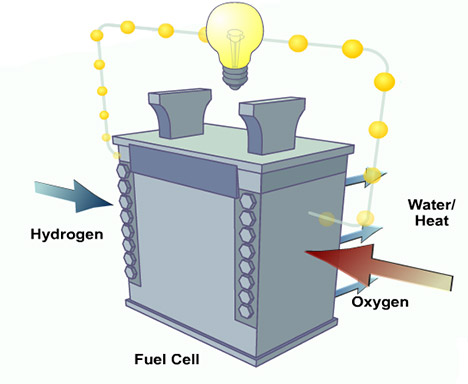
Fig. 1: Simple Labelled Diagram Showing a Fuel Cell
The first law of thermodynamics states, “Energy can neither be created nor destroyed, but can be converted from one form to another”. The first part of this law tells us that there is a fixed amount of energy in the universe whereas, the second part gives a sneak peak into how we can utilize the available energy to alter it into a form which is useful to us. The ideal case would be that the entire portion of the source energy be converted to the form of our choice. For example, a perfect gasoline car would produce the energy which is exactly equal to the energy released by breaking the bonds of the hydrocarbon fuel through combustion, which would mean a 100% efficient machine. Unfortunately, we don’t live in such a perfect universe and such a machine (called a perpetual motion machine of the first kind – PMM 1) doesn’t exist.
There are always losses when energy conversion is concerned, either through friction, heat or vibration. Which means that the source energy isn’t exactly converted to just one form of energy. Therefore, engineers don’t try to eliminate losses when designing machines instead try to minimize the losses to the greatest extent by utilizing the second law of thermodynamics which deals with the concept of “Entropy”. Basically this law explains the directionality of energy transfer by dividing energy into two categories, high grade energy and low grade energy. A high grade energy can be easily converted to a great extent into a low grade energy but the reverse is more inefficient. Considering the example of a gasoline engine in a car, chemical energy from the gasoline is first converted to thermal energy (lower grade energy) by combustion and then into mechanical energy (higher grade energy) leading to low efficiencies (about 25% to 30%). If we could eliminate the process of conversion to a lower grade energy, we could create a more efficient power device. This is exactly the purpose behind a “Fuel Cell” which directly converts chemical energy to electrical energy. In this article we will understand how a fuel cell works, its various types and its applications.
The Fuel Cell – Working
The fuel cell is basically an electrochemical energy conversion device working on a principle which is reverse to “Electrolysis”. In electrolysis, water is broken down by applying electricity into hydrogen and oxygen whereas, in a fuel cell hydrogen gives its electrons to oxygen and forms water. The path taken by the electrons is directed through a circuit which produces electricity. Unlike batteries, which are also electrochemical power devices, fuel cells can constantly keep producing electrical energy as long as the fuel is supplied.
The two components Hydrogen and oxygen are separated by a membrane which doesn’t allow the passage of electrons. The hydrogen is passed through this membrane separating the positive hydrogen ion from the electron and goes through an electrolytic solution towards the cathode section. The electrons which cannot pass though the membrane, pass through the conductor into the cathode section and form a negative oxygen ion. The positive hydrogen ion and the negative oxygen ion combine to form water which is let out as a byproduct. The basic fuel hydrogen is supplied through pressurized gas containers and oxygen from air. The pressurized hydrogen container is quite a heavy installment and therefore there are certain fuel cells which are designed to operate from hydrogen containing gases like clean natural gas or renewable biogas.
Types of Fuel Cells
Types of Fuel Cells
The electrolyte used is different for different applications and they operate on different temperatures. Based on this fuel cells are classified into different types.
-
Polymer Exchange Membrane Fuel Cells (PEMFCs): These are probably the most commonly used fuel cells since it uses a polymeric membrane which contains the electrolyte solution between the electrodes and also operates at a relatively low temperature of about 60 to 80 degrees on the Celsius scale. A commonly used membrane material is the Nafion which is a hydrocarbon based polymer. The hydrogen gas is forced through a platinum coated catalyst which splits up the electrons and positive ions. The sandwiched fuel cells are generally stacked together to provide the necessary output. These can be used for the smaller and more portable applications as well.
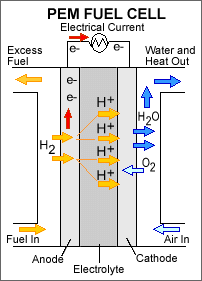
Fig. 2: Polymer Exchange Membrane Fuel Cell
-
Solid Oxide Fuel Cells (SOFCs): These are more suited for stationary power generation plants as they operate on a higher temperature of about 700 to 1000 degrees Celsius. It uses a solid electrolyte made of a ceramic material called Yttria Stabilized Zirconia. These are unique from the other types since they have the negative oxygen ions travelling through the electrolyte towards the hydrogen ions. The high temperatures associated with this can be used in a co-generation power plant where the waste heat from this cycle can be used to produce steam to power a turbine-run generation plant.
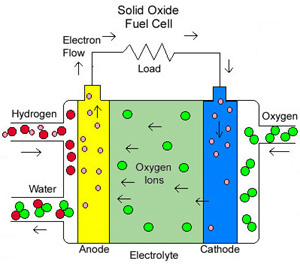
Fig. 3: Solid Oxide Fuel Cell
-
Alkaline Fuel Cells (AFCs): This type of fuel cell is one of the oldest design which was made for the Apollo space programs to generate electricity as well as water for the astronauts in space. It utilizes pure hydrogen and oxygen and is therefore very expensive. Alkaline solutions like Potassium Hydroxide (KOH) or Sodium Hydroxide (NaOH) are used as the electrolyte through which the pure hydrogen and oxygen are bubbled into. It operates at a temperature range of 70 to 140 degrees Celsius.
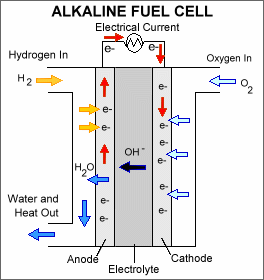
Fig. 4: Alkaline Fuel Cell
-
Molten Carbon Fuel Cells (MCFCs): Like the SOFCs, this type of fuel cell also operate at a high temperature of about 650 degrees Celsius. It uses Lithium Potassium Carbonate salt as the electrolyte in the molten form. The advantage of this fuel cell is that it can extract hydrogen from the general fossil fuels instead of using pure hydrogen gas. While keeping carbon emissions at a minimum.
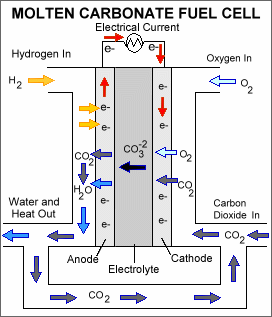
Fig. 5: Molten Carbon Fuel Cell
-
Phosphoric Acid Fuel Cells (PAFCs): These types of fuel cells use phosphoric acid as an electrolyte to pass the hydrogen ions but at the same time being a non-conductive electrolyte. Operating temperatures are about 150 to 200 degrees. Although these temperatures are not optimal for a power plant, they are suited to power Air Conditioning plants. Although the higher temperatures leads to a longer warm up time making it unsuitable for automobiles.
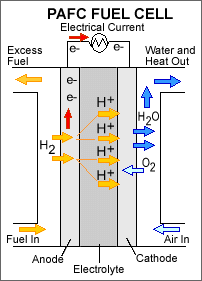
Fig. 6: Phosphoric Acid Fuel Cell
-
Phosphoric Acid Fuel Cells (PAFCs): These types of fuel cells use phosphoric acid as an electrolyte to pass the hydrogen ions but at the same time being a non-conductive electrolyte. Operating temperatures are about 150 to 200 degrees. Although these temperatures are not optimal for a power plant, they are suited to power Air Conditioning plants. Although the higher temperatures leads to a longer warm up time making it unsuitable for automobiles.
Fig. 7: Phosphoric Acid Fuel Cell
Direct Methanol Fuel Cells (DMFCs): This is a type of a proton exchange fuel cell which uses methanol as the fuel source to provide hydrogen. Its operating temperature is similar to the PEMFCs but has a lower efficiency. It can be used in portable devices which require a good power density rather than efficiency.
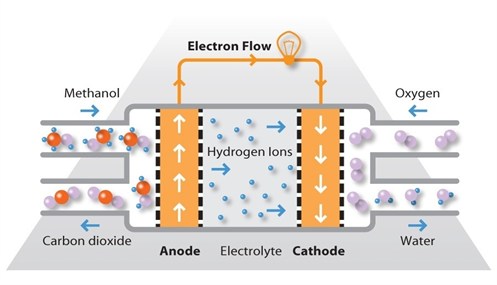
Fig. 8: Direct Methanol Fuel Cell
Enzymatic and Microbial Biofuel Cells (EFCs and MFCs): The enzymatic and microbial bio fuel cells fall under the special category of bio fuel cells which use biological media as catalysts to release the electrons. EFCs specifically use enzymes for this purpose which are produced by living cells which are easy and cheap to mass produce whereas the MFCs use actual living organisms (microbes). These replace the use of expensive materials like platinum and nickel. Enzymes and microbes are capable of breaking down simple organic molecules like sugars, human waste, biofuels etc. Biofuel cells have still not found a way to go out of the research labs but hold a lot of promise if they are commercialized taking into considerations its strong pros from an economic standpoint. They are aimed at finding application in powering bio implants, spacecraft life support systems etc.
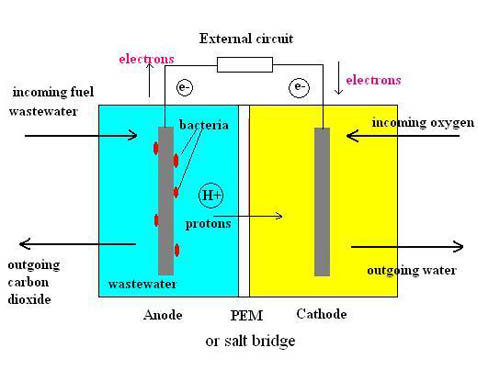
Fig. 9: Enzymatic and Microbial Biofuel Cell
Application
Application Highlight – Fuel Cell Vehicles
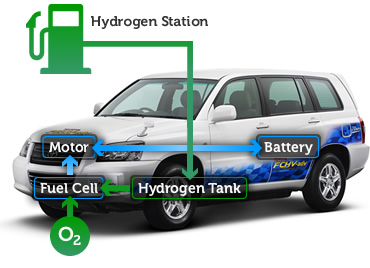
Fig. 10: Fuel Cell Implementation in a Four-Wheeler
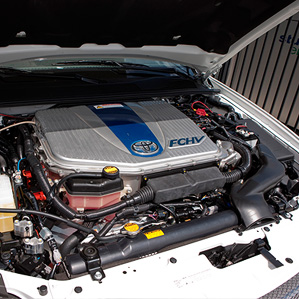
Fig. 11: Image Showing Fuel Cell in a Car’s Bonnet
The automobile sector has been the most impacted industry by the technology of fuel cells. The Fuel Cell Vehicles are a common research interest among the big names of the automobile industry. The electricity obtained by the fuel cell is used to power a motor which is used to provide torque to provide rpm to the transmission system.
The electrical energy to mechanical energy by the motor carries an efficiency of 80%, which leads to an overall efficiency (80% of fuel cell + 80% of motor) of about 64% (although there are certain transmission losses) which when compared to the 30% efficiency of gasoline engines is a massive increase. These numbers are for a fuel cell using pure hydrogen.
As of 2015, there are two models which are available commercially, Hyundai IX35 FCEV and the Toyota Mirai although they were released in a limited quantity. There are many more concept cars released by automobile companies like Honda (FCX clarity and FCV concept), Audi (A7 h-tron Quattro), Mercedes Benz (F-Cell and F800), Volkswagen (Golf Hymotion) and Nissan (TeRRA FCV SUV). The most efficient models include the use of pure hydrogen which may add to the weight and therefore sometimes hydrogen containing compounds are used which add an additional device called the “Reformer” to extract hydrogen.
A doubt may still arise as to why battery powered cars are not good enough to do the job? Although batteries are more efficient than fuel cells (about 90%), they cannot produce their own power. The electricity used to recharge the batteries has to be obtained from somewhere and that energy may not be produced in an eco-friendly or an efficient manner.
Why Fuel Cells?
The main reason why fuel cells hold promise in power generation is that they are environment friendly. The major byproduct of fuel cells is water which is another major advantage. Since the transition into a lower grade energy like thermal energy is being left out, they are highly efficient, up to 80% and even 90% i.e. 80% of the energy released from the chemical reaction is converted into electricity.
Fossil fuel dependency has to end in order for life to sustain comfortably on earth and this is the reason why scientists and engineers are working towards finding better ways to produce energy. The Fuel cell technology may be the answer but currently this technology is not strong enough to replace the conventional energy production. They have issues regarding cost, durability, storage and other considerations. Countries are also working to produce hydrogen in an environmentally friendly way and have formed the “International Partnership for the Hydrogen Economy” between 17 countries. Hydrogen is the most abundant element present in the universe and powers the stars. When we use the gifts of nature, we must follow the rules of nature.
Filed Under: ARM, Articles, Tech Articles
Questions related to this article?
👉Ask and discuss on EDAboard.com and Electro-Tech-Online.com forums.
Tell Us What You Think!!
You must be logged in to post a comment.