Global Positioning System (GPS) trackers are widely used devices that provide real-time or periodic location updates. Their applications range from navigation, logistics, fleet management, and personal safety to outdoor activities, theft prevention, and even pet monitoring. Available in various sizes and with diverse features, GPS trackers are adaptable to different needs.
Whether for personal use or business, creating a reliable GPS tracking system can be a worthy challenge. In this article, we’ll discuss how a GPS tracker is built and cover the hardware and software aspects of a GPS tracking device. We’ll also discuss the Internet-of-Thing (IoT) architecture required to properly implement a GPS tracking solution.

What is a GPS tracker?
A GPS tracker uses the Global Positioning System (GPS) to pinpoint the exact location of an object, with typical accuracy ranging from 20 meters to as precise as five meters. These portable devices can be attached to vehicles, people, pets, or assets. Depending on its purpose and design, the GPS may provide real-time location updates or store location data for later analysis.
This device is comprised of a GPS receiver module, which communicates with a network of satellites orbiting Earth. These satellites are a part of the GPS — currently, the most widely used Global Navigation Satellite System (GNSS) — and continuously broadcast signals that include their position information. A GPS receiver picks up these signals, measuring the time it takes to reach it. Knowing the speed of light allows the device to calculate its distance from each satellite.
A GPS receiver determines its exact position on Earth through triangulation by using data from at least three satellites. By drawing imaginary spheres around each one, using the calculated distance as the radius, the receiver finds its location at the intersection point of these spheres.
This triangulation technique enables a GPS tracker to locate objects, reliably enhancing security, navigation, and asset management. The GPS’ internal controller decodes this data into a digital format suitable for transmission over the Internet. The devices typically include a connectivity solution, such as a cellular or Wi-Fi module. Once connected to a cellular network or Wi-Fi hotspot, the location data is transmitted to a server or Cloud platform, where it’s processed and sent to the authorized user’s device. The user can then view the location on a map or receive updates in other formats.
GPS trackers that offer real-time location tracking rely on cellular networks for connectivity, enabling live updates. In contrast, trackers designed only to store location data for later review typically use Wi-Fi. Without cellular connectivity, real-time tracking isn’t possible with a GPS tracker.
Applications of GPS tracking
GPS tracking systems are widely used in the automotive and logistics sectors, integrated within IoT networks to enable real-time management of vehicles and transportation. One of the most prominent applications is fleet management. GPS tracking allows businesses to monitor vehicles in real-time, optimize routes for fuel efficiency, prevent theft and misuse, and receive alerts for route deviations or unexpected stops. This functionality ensures timely deliveries, enhances productivity and contributes to efficient logistics.
A GPS device is also valuable for drivers, offering real-time navigation and traffic updates to plan optimal routes. Industries like healthcare and e-commerce rely on GPS for delivery tracking, especially when using drones to quickly deliver urgent supplies to precise locations.
Additionally, GPS trackers are used across various industries to monitor heavy machinery and valuable equipment, such as video production gear, industrial machines, and farming equipment. Many individuals also use GPS devices or smartphone GPS services for navigation or to monitor children, pets, elderly family members, and patients, providing peace of mind and added security.
Types of GPS systems
There are three main types of GPS tracking systems:
- Cellular-based GPS trackers use mobile networks (GSM, GPRS, 3G, 4G, or 5G) to transmit location data to a server or Cloud platform. These trackers provide real-time location updates at intervals, typically every five to ten minutes. They offer comprehensive coverage and can integrate with other cellular services. While setup costs are generally low, they require a monthly subscription for continued operation. However, cellular GPS trackers may experience coverage gaps in remote areas due to limited network availability and can sometimes struggle to acquire a GPS signal.
- Satellite-based GPS trackers connect directly with a satellite network to transmit location data. Known for their reliability, these devices provide extensive, nationwide coverage, and are well-suited for remote or rural areas where cellular networks may be unavailable. They’re typically more costly than cellular trackers and often have subscription fees, which vary based on features and tracking requirements.
- Passive GPS trackers collect and store location data internally and upload it to a server or Cloud platform when they connect to a cellular network or Wi-Fi hotspot. Typically, these systems gather GPS data as vehicles return to a base or depot, relying on Wi-Fi for data transfer. These devices are cost-effective, with a one-time setup cost and no subscription fees. They support longer battery life but offer limited or no real-time tracking capabilities. Despite this, passive trackers are valuable for tracking and diagnostic purposes.
GPS tracker hardware
Building a GPS tracking system involves integrating a GPS with a web application that’s hosted on a dedicated server or Cloud platform. The tracker’s design depends on the specific features and tracking requirements.
A GPS tracker consists of several components, as follows:
The GPS receiver is critical in building a GPS tracker. Typically designed as a system-on-chip (SoC) with an integrated processor and antenna, the receiver decodes satellite signals to provide location data. Communication with a computer, controller, or microcontroller is achieved through UART or I2C interfaces. Many commercial GPS trackers use modems that combine GPS and cellular functionality in one unit.
Well-known standalone GPS modem providers include Quectel, U-blox, and Telit:
- Quectel modems offer integrated cellular support for GSM, GPRS, 3G, 4G, and 5G networks and are valued for their reliability and performance.
- U-blox modems are popular for their low power consumption and high accuracy. They also offer a range of development tools for easier GPS solution design.
- Telit focuses on IoT applications, providing rugged, reliable modems for harsh environments.
Choosing a suitable GPS modem depends on factors such as network compatibility, accuracy, power consumption, size, weight, and budget. Modems with 4G or 5G connectivity offer higher speeds but are more expensive than those with GSM or 3G.
The microcontroller decodes the GPS data and relays it to a server via cellular or Wi-Fi connectivity. GPS trackers can be built using either 8-bit or 32-bit microcontrollers, each with distinct advantages:
- 8-bit microcontrollers have low power consumption, extend battery life, and are cost-effective. They’re adequate for simple GPS tracking tasks — such as calculating location, processing GPS data, and managing basic network connectivity.
- 32-bit microcontrollers have more processing power, so they can handle more complex applications that require real-time processing, advanced algorithms, or additional sensor integration. They also provide versatile connectivity options like Wi-Fi and Bluetooth, making them suitable for scalable, sophisticated GPS applications.
Common microcontroller options for GPS tracking include Atmel AVR, PIC, ARM Cortex-M series, MSP430, ESP32, and STM32. The selection depends on the complexity and specific requirements of the GPS tracking solution.
The cellular modem may be necessary if the GPS receiver lacks integrated cellular functionality. While these receivers are typically less costly, separate GPS and GSM modems can increase the tracker’s size and power consumption.
A Wi-Fi modem is sometimes needed, although a GPS design with built-in Wi-Fi and Bluetooth is worth considering. Additional Wi-Fi or Bluetooth modules may be required if the chosen microcontroller lacks these functions.
The power supply for GPS trackers in vehicles typically uses the car’s adapter. However, some devices can be powered by batteries or solar panels.
An external antenna can enhance the satellite signal reception, though many GPS receivers perform adequately without one.
A display screen is often part of advanced GPS devices with navigation capabilities. It shows the GPS location on a digital map, diagnostics, and sensor information. The screen can also access certain cellular services through the tracker.
A plastic enclosure protects the circuit and internal components of the tracker.
Sensors like an accelerometer, temperature sensor, or magnetometer can enhance the tracker’s functionality. Accelerometers help monitor vehicle movement, detect accidents, and provide driving diagnostics, while temperature sensors adjust power consumption based on operating conditions.
A SIM card is essential for cellular communication and is typically inserted in the GPS receiver or cellular modem slot.
GPS tracker software
The software for a GPS tracker consists of two main components: embedded software within the tracking device and application software hosted on a server or Cloud platform. Although many ready-made GPS software solutions are available, they may not fully align with specific requirements or offer the flexibility for necessary customizations.
Custom-developed software is often ideal for meeting unique tracking needs. The embedded software, residing on the tracker’s microcontroller, processes data from the GPS receiver to calculate location, time, and other relevant details. It handles the connection to the cellular network, transmitting GPS data to the server or Cloud, and manages the tracker’s power consumption.
The embedded software is also responsible for filtering, formatting, and packaging location data for transmission.
The application software collects data from tracking devices, stores, processes, and analyzes it on either a server or a Cloud platform. Users access this information through a web application or mobile app, where they can view real-time locations on digital maps, receive alerts, and access diagnostic data. Fleet managers and users can monitor activity, set up geofences, and optimize routes. A database is often used to store GPS data and generate valuable insights.
The embedded software within the device is typically developed in C, while higher-level functions like geofencing and map visualization are implemented using different languages. Android apps are commonly built in Java or Kotlin, iOS apps in Swift or Objective-C, and web applications with HTML, CSS, JavaScript, and a backend framework like Node.js, Django, or Ruby.
The GPS tracking system
A GPS tracking system is essentially an IoT solution. The GPS trackers act as IoT edge devices, gathering real-time location data and sending it to the server. The application on the server or Cloud processes this data for visualization, analysis, and diagnostics — providing an integrated system for location-based insights.
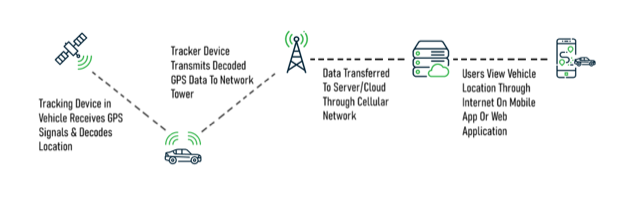
The software in a GPS solution can be complex and sophisticated on the embedded and Cloud sides, depending on the system’s features and functionality. Many advanced GPS solutions use a serverless IoT architecture, often integrating multiple sensors on the tracker hardware and IoT APIs for seamless integration with the application software.
You may also like:


Filed Under: Tech Articles
Questions related to this article?
👉Ask and discuss on Electro-Tech-Online.com and EDAboard.com forums.
Tell Us What You Think!!
You must be logged in to post a comment.