Engineers Garage

  • Electronic Projects & Tutorials
    • Electronic Projects
      • Arduino Projects
      • AVR
      • Raspberry pi
      • ESP8266
      • BeagleBone
      • 8051 Microcontroller
      • ARM
      • PIC Microcontroller
      • STM32
    • Tutorials
      • Audio Electronics
      • Battery Management
      • Brainwave
      • Electric Vehicles
      • EMI/EMC/RFI
      • Hardware Filters
      • IoT tutorials
      • Power Tutorials
      • Python
      • Sensors
      • USB
      • VHDL
    • Circuit Design
    • Project Videos
    • Components
  • Articles
    • Tech Articles
    • Insight
    • Invention Stories
    • How to
    • What Is
  • News
    • Electronic Product News
    • Business News
    • Company/Start-up News
    • DIY Reviews
    • Guest Post
  • Forums
    • EDABoard.com
    • Electro-Tech-Online
    • EG Forum Archive
  • DigiKey Store
    • Cables, Wires
    • Connectors, Interconnect
    • Discrete
    • Electromechanical
    • Embedded Computers
    • Enclosures, Hardware, Office
    • Integrated Circuits (ICs)
    • Isolators
    • LED/Optoelectronics
    • Passive
    • Power, Circuit Protection
    • Programmers
    • RF, Wireless
    • Semiconductors
    • Sensors, Transducers
    • Test Products
    • Tools
  • Learn
    • eBooks/Tech Tips
    • Design Guides
    • Learning Center
    • Tech Toolboxes
    • Webinars & Digital Events
  • Resources
    • Digital Issues
    • EE Training Days
    • LEAP Awards
    • Podcasts
    • Webinars / Digital Events
    • White Papers
    • Engineering Diversity & Inclusion
    • DesignFast
  • Guest Post Guidelines
  • Advertise
  • Subscribe

Insight – Learn the Workings of a Gas Sensor

By Ashutosh Bhatt March 1, 2025

In today’s technological landscape, monitoring gas emissions is critical. From household appliances like air conditioners and electric chimneys to industrial safety systems, gas monitoring plays a vital role. Gas sensors are an essential component of these systems. Small yet highly responsive gas sensors detect and react to the presence of gases, ensuring real-time updates on any changes in concentration levels.

Gas sensors come in a wide range of specifications, varying in sensitivity, the type of gas detected, physical dimensions, and other factors. This Insight focuses on a methane gas sensor, which can also detect gases such as ammonia that may be produced from methane. When a gas interacts with the sensor, it first undergoes ionization and is then adsorbed by the sensing element. This adsorption generates a potential difference, which is transmitted to the processor unit through output pins in the form of an electrical current.

But what exactly is this sensing element? Is it enclosed in a chamber or exposed? How does it receive power, and how is the output extracted? Let’s explore these questions below.
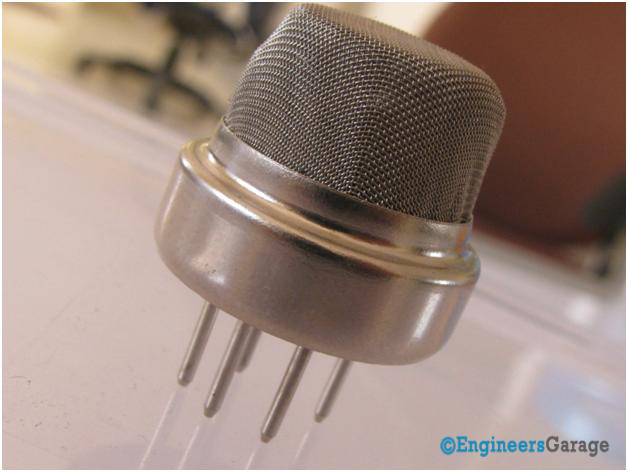
Figure 1. A typical gas sensor.

The gas sensor module consists of a steel exoskeleton that houses the sensing element (Figure 1). This sensing element is supplied with current through connecting leads, known as the heating current. As gases approach the sensing element, they become ionized and are absorbed by it. This process alters the resistance of the sensing element, which in turn affects the output current, allowing the sensor to detect changes in gas concentration.
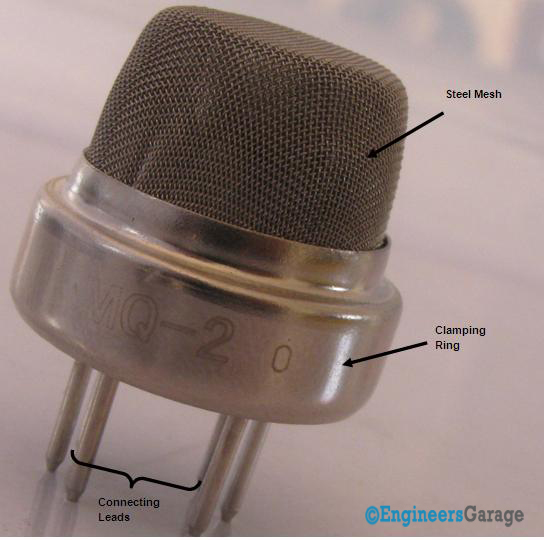
Figure 2. The various parts of a gas sensor.

Figure 2 shows the external components of a standard gas sensor module, including a steel mesh, copper clamping ring, and connecting leads. The top section consists of a stainless steel mesh, which serves multiple functions:

  1. Filtering out suspended particles, allowing only gaseous elements to enter the sensor.
  2. Protecting the internal components of the sensor.
  3. Providing an anti-explosion barrier, ensuring the sensor remains intact under high temperatures and gas pressures.

To efficiently perform these functions, the steel mesh is designed with two layers. It’s securely fastened to the rest of the sensor body using a copper-plated clamping ring (Figure 3).
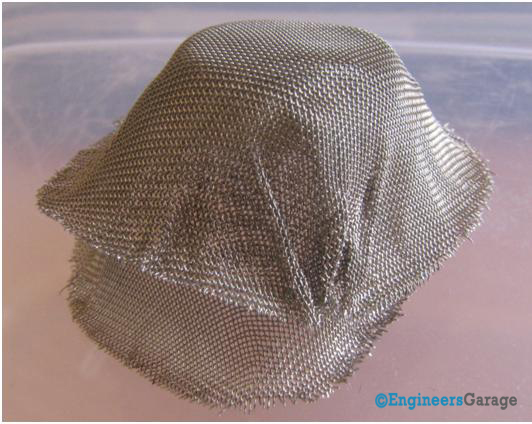
Figure 3. Steel mesh used In a gas sensor.

The connecting leads of the sensor are designed to be thick, ensuring a firm connection to the circuit while also conducting sufficient heat to the internal components. These leads are made of copper with a tin plating for enhanced conductivity and durability.

  • Four of the six leads (A, B, C, D) are used for signal retrieval, transmitting data from the sensing element.
  • Two leads (1, 2) are dedicated to heating the sensing element, ensuring optimal functionality.

The pins are mounted on a Bakelite base, which acts as a good insulator and provides a secure grip for the sensor’s connecting leads.

Internal features
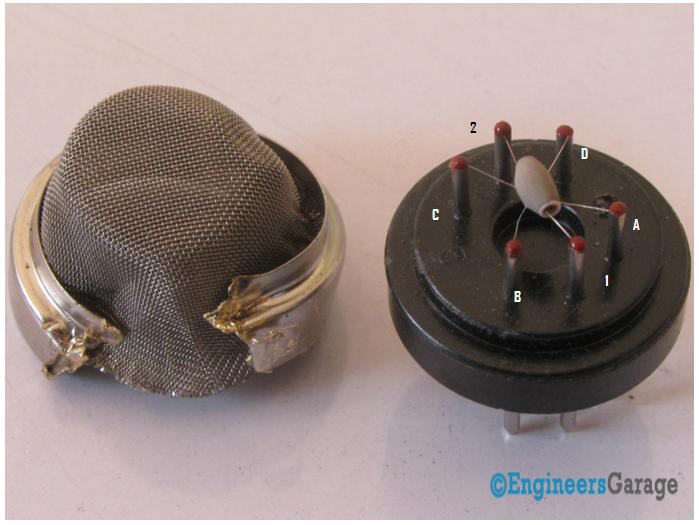
Figure 4. The inside view of a gas sensor after the steel mesh is removed.

The top cover of the gas sensor has been removed to reveal its internal components, including the sensing element and connection wiring.

  • The sensing element is positioned at the center of the structure, playing a crucial role in detecting gases.
  • The hexapod structure consists of the sensing element and six connecting legs, which extend beyond the Bakelite base to facilitate electrical connections.
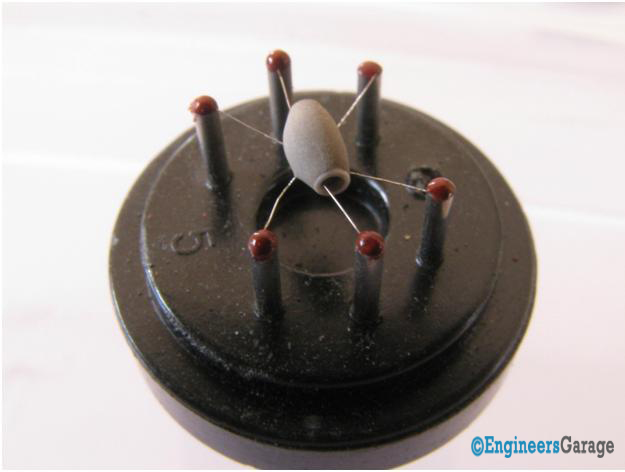
Figure 5. The hexapod structure inside a gas sensor.

Figure 4 illustrates the hollow sensing element, which is constructed from an aluminum oxide-based ceramic and coated with tin oxide.

  • The ceramic substrate enhances heating efficiency, ensuring stable operation.
  • The tin oxide coating is sensitive to methane and its byproducts, making it ideal for gas detection.

The heating leads are connected via nickel-chromium wires, a well-known conductive alloy, while the output signal leads use platinum wires to detect minor current variations.

  • Platinum wires are attached to the body of the sensing element to measure resistance changes.
  • Nickel-chromium wires pass through the hollow core, providing controlled heating for gas ionization and adsorption.

Ceramic sensing element
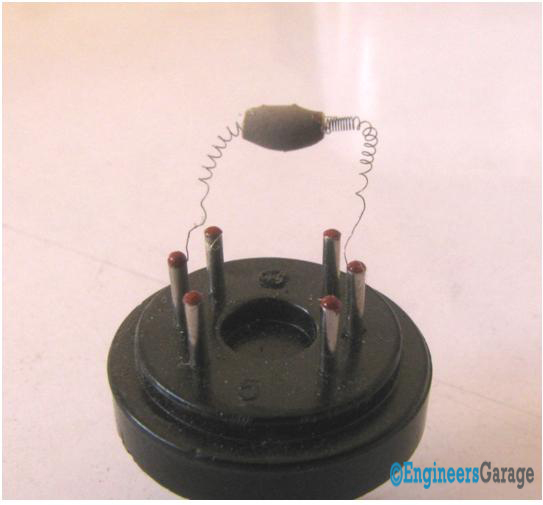
Figure 6. The ceramic sensing element that’s inside a gas sensor.

While other wires are attached to the outer body of the sensing element, the nickel-chromium wires are positioned inside the element in a spring-like shape.

Figure 5 illustrates the coiled section of the nickel-chromium wire, which is carefully placed within the hollow ceramic structure. This design ensures efficient and uniform heating of the sensing element, allowing for consistent ionization and adsorption of target gases. By maintaining an optimal operating temperature, the sensor enhances its sensitivity and ensures accurate detection of methane and its byproducts.
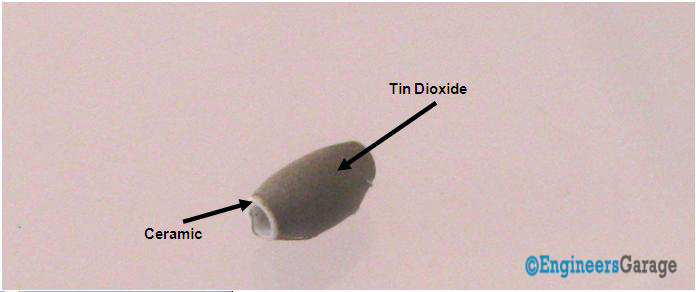
 Figure 7. A closer look at the ceramic element.

Figure 6 shows the ceramic structure coated with tin dioxide with strong adsorption properties. Each gas to be monitored has a specific ionization temperature, and the sensor’s role is to maintain the optimal temperature for ionization to occur.

The nickel-chromium wire supplies a heating current to the ceramic region of the sensing element, ensuring it reaches the required temperature. The heat radiates into the surrounding area, allowing gas molecules to interact with the element and become ionized. Once ionized, the gas molecules are adsorbed by the tin dioxide layer (Figure 7).

This adsorption alters the resistance of the tin dioxide, leading to a change in the current passing through the sensing element. The resulting variation in current is transmitted through the output, which leads to the control unit, which processes the sensor’s readings.


Filed Under: Insight
Tagged With: ceramic sensing element, gas sensor, sensing element, sensor
 

Next Article

← Previous Article
Next Article →

Questions related to this article?
👉Ask and discuss on Electro-Tech-Online.com and EDAboard.com forums.


Tell Us What You Think!! Cancel reply

You must be logged in to post a comment.

EE TECH TOOLBOX

“ee
Tech Toolbox: Internet of Things
Explore practical strategies for minimizing attack surfaces, managing memory efficiently, and securing firmware. Download now to ensure your IoT implementations remain secure, efficient, and future-ready.

EE Learning Center

EE Learning Center
“engineers
EXPAND YOUR KNOWLEDGE AND STAY CONNECTED
Get the latest info on technologies, tools and strategies for EE professionals.

HAVE A QUESTION?

Have a technical question about an article or other engineering questions? Check out our engineering forums EDABoard.com and Electro-Tech-Online.com where you can get those questions asked and answered by your peers!


RSS EDABOARD.com Discussions

  • Reducing "shoot-through" in offline Full Bridge SMPS?
  • High Side current sensing
  • How to simulate power electronics converter in PSpice?
  • Voltage mode pushpull is a nonsense SMPS?
  • Layout IRN reduction in Comparator

RSS Electro-Tech-Online.com Discussions

  • Back to the old BASIC days
  • Parts required for a personal project
  • PIC KIT 3 not able to program dsPIC
  • Failure of polypropylene motor-run capacitors
  • Siemens large industrial PLC parts

Featured – RPi Python Programming (27 Part)

  • RPi Python Programming 21: The SIM900A AT commands
  • RPi Python Programming 22: Calls & SMS using a SIM900A GSM-GPRS modem
  • RPi Python Programming 23: Interfacing a NEO-6MV2 GPS module with Raspberry Pi
  • RPi Python Programming 24: I2C explained
  • RPi Python Programming 25 – Synchronous serial communication in Raspberry Pi using I2C protocol
  • RPi Python Programming 26 – Interfacing ADXL345 accelerometer sensor with Raspberry Pi

Recent Articles

  • What is AWS IoT Core and when should you use it?
  • AC-DC power supply extends voltage range to 800 V DC
  • Infineon’s inductive sensor integrates coil system driver, signal conditioning circuits and DSP
  • Arm Cortex-M23 MCU delivers 87.5 µA/MHz active mode
  • STMicroelectronics releases automotive amplifiers with in-play open-load detection

EE ENGINEERING TRAINING DAYS

engineering

Submit a Guest Post

submit a guest post
Engineers Garage
  • Analog IC TIps
  • Connector Tips
  • Battery Power Tips
  • DesignFast
  • EDABoard Forums
  • EE World Online
  • Electro-Tech-Online Forums
  • EV Engineering
  • Microcontroller Tips
  • Power Electronic Tips
  • Sensor Tips
  • Test and Measurement Tips
  • 5G Technology World
  • Subscribe to our newsletter
  • About Us
  • Contact Us
  • Advertise

Copyright © 2025 WTWH Media LLC. All Rights Reserved. The material on this site may not be reproduced, distributed, transmitted, cached or otherwise used, except with the prior written permission of WTWH Media
Privacy Policy

Search Engineers Garage

  • Electronic Projects & Tutorials
    • Electronic Projects
      • Arduino Projects
      • AVR
      • Raspberry pi
      • ESP8266
      • BeagleBone
      • 8051 Microcontroller
      • ARM
      • PIC Microcontroller
      • STM32
    • Tutorials
      • Audio Electronics
      • Battery Management
      • Brainwave
      • Electric Vehicles
      • EMI/EMC/RFI
      • Hardware Filters
      • IoT tutorials
      • Power Tutorials
      • Python
      • Sensors
      • USB
      • VHDL
    • Circuit Design
    • Project Videos
    • Components
  • Articles
    • Tech Articles
    • Insight
    • Invention Stories
    • How to
    • What Is
  • News
    • Electronic Product News
    • Business News
    • Company/Start-up News
    • DIY Reviews
    • Guest Post
  • Forums
    • EDABoard.com
    • Electro-Tech-Online
    • EG Forum Archive
  • DigiKey Store
    • Cables, Wires
    • Connectors, Interconnect
    • Discrete
    • Electromechanical
    • Embedded Computers
    • Enclosures, Hardware, Office
    • Integrated Circuits (ICs)
    • Isolators
    • LED/Optoelectronics
    • Passive
    • Power, Circuit Protection
    • Programmers
    • RF, Wireless
    • Semiconductors
    • Sensors, Transducers
    • Test Products
    • Tools
  • Learn
    • eBooks/Tech Tips
    • Design Guides
    • Learning Center
    • Tech Toolboxes
    • Webinars & Digital Events
  • Resources
    • Digital Issues
    • EE Training Days
    • LEAP Awards
    • Podcasts
    • Webinars / Digital Events
    • White Papers
    • Engineering Diversity & Inclusion
    • DesignFast
  • Guest Post Guidelines
  • Advertise
  • Subscribe