Engineers Garage

  • Electronic Projects & Tutorials
    • Electronic Projects
      • Arduino Projects
      • AVR
      • Raspberry pi
      • ESP8266
      • BeagleBone
      • 8051 Microcontroller
      • ARM
      • PIC Microcontroller
      • STM32
    • Tutorials
      • Audio Electronics
      • Battery Management
      • Brainwave
      • Electric Vehicles
      • EMI/EMC/RFI
      • Hardware Filters
      • IoT tutorials
      • Power Tutorials
      • Python
      • Sensors
      • USB
      • VHDL
    • Circuit Design
    • Project Videos
    • Components
  • Articles
    • Tech Articles
    • Insight
    • Invention Stories
    • How to
    • What Is
  • News
    • Electronic Product News
    • Business News
    • Company/Start-up News
    • DIY Reviews
    • Guest Post
  • Forums
    • EDABoard.com
    • Electro-Tech-Online
    • EG Forum Archive
  • DigiKey Store
    • Cables, Wires
    • Connectors, Interconnect
    • Discrete
    • Electromechanical
    • Embedded Computers
    • Enclosures, Hardware, Office
    • Integrated Circuits (ICs)
    • Isolators
    • LED/Optoelectronics
    • Passive
    • Power, Circuit Protection
    • Programmers
    • RF, Wireless
    • Semiconductors
    • Sensors, Transducers
    • Test Products
    • Tools
  • Learn
    • eBooks/Tech Tips
    • Design Guides
    • Learning Center
    • Tech Toolboxes
    • Webinars & Digital Events
  • Resources
    • Digital Issues
    • EE Training Days
    • LEAP Awards
    • Podcasts
    • Webinars / Digital Events
    • White Papers
    • Engineering Diversity & Inclusion
    • DesignFast
  • Guest Post Guidelines
  • Advertise
  • Subscribe

Invention Story of ATM

By Samidha Verma July 16, 2011

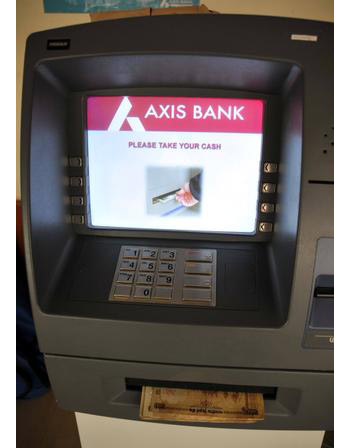
 Image Of Automated Teller Machine(ATM)

Fig. 1: Image Of Automated Teller Machine(ATM)

It is true that most inventions have happened due to sheer necessity and invention of ATM machine is one of them. Now the question that arises is what was the necessity, what called for the invention of a round the clock cash dispenser? Who invented it- a broke student or a shopaholic lady, a businessman or a banker, too tired of cashing the cheques? Also known as Cashpoint or Hole-in-the-Wall Machine (Britain), ABM or Automatic Banking Machine (USA), All-time Money (India), and Minibank (Norway) and so much more, the history of ATM is full of interesting facts, some we know, some we don’t.


Let’s tear through the pages of history to know more. An Armenian named Luther George Simjian was forced to move to USA in the year 1920, under the account of Armenian Genocide. He owned to his credit the invention of a portrait camera and then rolled out the formulated idea of ATM, the Automated Teller Machine.
 
Confident of his invention, he persuaded Citibank to run his product on a six month trial basis. Soon enough, he was disappointed with the performance and the lack of users and concluded that ATM was a wasteful addition to personal banking. And lack of demand for the ATM finally forced him to take a back seat. Clear enough; the time was not right for this concept to have been accepted generously. Simjian clearly lost out on the success and fame and the same was passed on to two other gentlemen, John Shepherd-Barron and Don Wetzel.
 
John Shepherd-Barron was a Scottish national born in India. Later he relocated to Britain and pursued his education from the University of Edinburgh, and at Trinity College, Cambridge. After returning empty handed from the bank, Shepherd-Barron was disappointed to have no other solution to wait till the bank would open next. And thus in a similar fashion like Archimedes, Shepherd-Barron claims to have hit his Eureka moment while taking a bath. A self-sufficient cash dispensing machine was what he was thinking about. And soon the ATM was invented in the early 1960s. The invention of a self-sufficient cash dispensing machine was his second and successful attempt at inventions. Earlier he had invented an instrument to scare away seals at his Scottish Salmon farms. Unfortunately, this device instead of deterring the seals attracted them, and was a failure.


The ATM machine gained Shepherd-Barron an ever-lasting recognition in the banking world and paved the way for hi-tech banking techniques, online bank accounts and PIN and chip security technology. The four-digit internationally accepted standard PIN was also invented by him. Earlier, he had a six-digit Army serial number in his mind but later his wife suggested for a shorter PIN as it would be easy to remember. Finally in 1967 that the first ATM that dispensed paper currency round the clock, was unveiled. The ATM machine installed outside a Barclay’s bank in North London started dispensing cash on a 24 hour basis.

 
As the plastic cards were still to have come into existence, this machine accepted and generated money through cheques impregnated with certain chemicals. Majorly a mild radioactive substance, Carbon 14 was used for detection by the machine. Once the PIN was given, the machine gave out the cash. This radioactive substance had no ill effects on the health of users and Shepherd-Barron claimed that a user would have to eat about 136,000 cheques to suffer any kind of ill-effects. Reg Varney, a famous TV sitcom popular became the first person to use the ATM in the year 1967 and withdrew about 10 dollars. The amount seems too less for us, but this money was enough for a complete night out spent on the tiles in London, inclusive of dinner, drinks, a show and a taxi-ride back to home, in short enough cash for a “Wild Weekend”.
While this prototype device originated by Shepherd-Barron had started functioning, various parallel developments were happening in different parts of the world. An American Engineer Donald Wetzel of Docutel engineered the Docuteller ATM which was declared as the first modern magstripe machine. It recognized magnetically encoded plastic (credit cards) and not the usual paper cheques.
 
And there have been a lot of efforts gone into final development of the ATM, the ones we see today, the ones we use so frequently, and the ones which have made our lives revolve around plastic money. The development of ATM ever since its baby steps in the late 1930s and then gearing up for longer runs in the 1960s, and finally a matured and stable stage that we see the ATMs in today. Undoubtedly, most of the ideas and patents contributed for makeover of the ATM from time to time form the backbone of what was initiated as “holes in the wall”.
 
Today, ATMs hold a strong foothold in the world, offering everyone a better access to their money, be it in any corner of the world. Let’s put figures to assumptions, there are about 1.8 million ATMs in use around the world with ATMs on cruise and navy ships, airports, newsagents and petrol stations. ATMs too have been categorized as on and off premise ATMs. On Premise ATMs are capable to connect the users to the bank with multi-function capabilities. Off premise, ATM machines on the other hand are the “white label ATMs” and are limited to cash dispense, no balance enquiries, no statement print-out.
 
The developments have not stopped; the contactless technology is on its rise. Shepherd-Barron continued to take inimitable and lively interest in technology well even in his old age and had foreseen a future where plastic cards too would be numbered. For his excellent and unforgettable contributions to financial technologies, he was also offered the OBE in the year 2005. And in the year 2010, he took his last breath and left behind his legacy of technological advancements which would refuses to end. Many more inventions are in process and many will be successful too. The time is just right to bring in the glorious inventions rolling in.

Filed Under: Invention Stories


Next Article

← Previous Article
Next Article →

Questions related to this article?
👉Ask and discuss on Electro-Tech-Online.com and EDAboard.com forums.


Tell Us What You Think!! Cancel reply

You must be logged in to post a comment.

EE TECH TOOLBOX

“ee
Tech Toolbox: Internet of Things
Explore practical strategies for minimizing attack surfaces, managing memory efficiently, and securing firmware. Download now to ensure your IoT implementations remain secure, efficient, and future-ready.

EE Learning Center

EE Learning Center
“engineers
EXPAND YOUR KNOWLEDGE AND STAY CONNECTED
Get the latest info on technologies, tools and strategies for EE professionals.

HAVE A QUESTION?

Have a technical question about an article or other engineering questions? Check out our engineering forums EDABoard.com and Electro-Tech-Online.com where you can get those questions asked and answered by your peers!


RSS EDABOARD.com Discussions

  • Reducing "shoot-through" in offline Full Bridge SMPS?
  • High Side current sensing
  • How to simulate power electronics converter in PSpice?
  • Voltage mode pushpull is a nonsense SMPS?
  • Layout IRN reduction in Comparator

RSS Electro-Tech-Online.com Discussions

  • Back to the old BASIC days
  • Parts required for a personal project
  • PIC KIT 3 not able to program dsPIC
  • Failure of polypropylene motor-run capacitors
  • Siemens large industrial PLC parts

Featured – RPi Python Programming (27 Part)

  • RPi Python Programming 21: The SIM900A AT commands
  • RPi Python Programming 22: Calls & SMS using a SIM900A GSM-GPRS modem
  • RPi Python Programming 23: Interfacing a NEO-6MV2 GPS module with Raspberry Pi
  • RPi Python Programming 24: I2C explained
  • RPi Python Programming 25 – Synchronous serial communication in Raspberry Pi using I2C protocol
  • RPi Python Programming 26 – Interfacing ADXL345 accelerometer sensor with Raspberry Pi

Recent Articles

  • What is AWS IoT Core and when should you use it?
  • AC-DC power supply extends voltage range to 800 V DC
  • Infineon’s inductive sensor integrates coil system driver, signal conditioning circuits and DSP
  • Arm Cortex-M23 MCU delivers 87.5 µA/MHz active mode
  • STMicroelectronics releases automotive amplifiers with in-play open-load detection

EE ENGINEERING TRAINING DAYS

engineering

Submit a Guest Post

submit a guest post
Engineers Garage
  • Analog IC TIps
  • Connector Tips
  • Battery Power Tips
  • DesignFast
  • EDABoard Forums
  • EE World Online
  • Electro-Tech-Online Forums
  • EV Engineering
  • Microcontroller Tips
  • Power Electronic Tips
  • Sensor Tips
  • Test and Measurement Tips
  • 5G Technology World
  • Subscribe to our newsletter
  • About Us
  • Contact Us
  • Advertise

Copyright © 2025 WTWH Media LLC. All Rights Reserved. The material on this site may not be reproduced, distributed, transmitted, cached or otherwise used, except with the prior written permission of WTWH Media
Privacy Policy

Search Engineers Garage

  • Electronic Projects & Tutorials
    • Electronic Projects
      • Arduino Projects
      • AVR
      • Raspberry pi
      • ESP8266
      • BeagleBone
      • 8051 Microcontroller
      • ARM
      • PIC Microcontroller
      • STM32
    • Tutorials
      • Audio Electronics
      • Battery Management
      • Brainwave
      • Electric Vehicles
      • EMI/EMC/RFI
      • Hardware Filters
      • IoT tutorials
      • Power Tutorials
      • Python
      • Sensors
      • USB
      • VHDL
    • Circuit Design
    • Project Videos
    • Components
  • Articles
    • Tech Articles
    • Insight
    • Invention Stories
    • How to
    • What Is
  • News
    • Electronic Product News
    • Business News
    • Company/Start-up News
    • DIY Reviews
    • Guest Post
  • Forums
    • EDABoard.com
    • Electro-Tech-Online
    • EG Forum Archive
  • DigiKey Store
    • Cables, Wires
    • Connectors, Interconnect
    • Discrete
    • Electromechanical
    • Embedded Computers
    • Enclosures, Hardware, Office
    • Integrated Circuits (ICs)
    • Isolators
    • LED/Optoelectronics
    • Passive
    • Power, Circuit Protection
    • Programmers
    • RF, Wireless
    • Semiconductors
    • Sensors, Transducers
    • Test Products
    • Tools
  • Learn
    • eBooks/Tech Tips
    • Design Guides
    • Learning Center
    • Tech Toolboxes
    • Webinars & Digital Events
  • Resources
    • Digital Issues
    • EE Training Days
    • LEAP Awards
    • Podcasts
    • Webinars / Digital Events
    • White Papers
    • Engineering Diversity & Inclusion
    • DesignFast
  • Guest Post Guidelines
  • Advertise
  • Subscribe