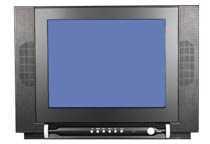
Image showing CRT Television with blue screen and stereo speakers
Fig. 1: Image showing CRT Television with blue screen and stereo speakers
One of the most popular inventions of 21st century has been surrounded by controversies. Television, which has become an indispensible part of our lives, is a result of several discoveries.
Early development stages of television witnessed various inventors employing combination of electronic, optical and mechanical technologies for capturing, transferring and broadcasting visual images. Towards the end of 1800s, images were transferred through fax machine for the first time. Soon after telephone came into being, electrically powered transmission of moving TV images, known as telephonoscope, was started. Science fiction writers were of the view that light would pass via wires like sound some day. And many people have worked hard to offer this exquisite instrument of entertainment.
Revolutionary works of Michael Faraday and Joseph Henry in 1831, launch of pantelegraph by Abbe Caselli and works by inventors and scientists Sheldon Bidwell, George Carey, Edison, Bell and Eugen Goldstein, all made way to Nipkow invention.
Paul Gottlieb Nipkow from Germany developed rotating disc technology known as Nipkow disc. In the year 1884, this young student patented electromagnetic TV system, employing scanning disk with various holes spiraling to center, for the purpose of rasterization. Holes on the disk were situated at equivalent angular intervals in way that the disc allowed light to pass through each hole in one rotation over light receptive selenium sensor that produced electrical pulses. But the design could only be used for transmission of halftone images.
Eventually, designs that used rotating mirror-drum scanner for capturing images and CRT as displaying device came into being. However, moving images were still not available due to bad sensitivity of selenium sensors. In year 1907, Boris, Russian scientist employed CRT in his experimental TV’s receiver. He made use of mirror drum scanner for transmitting geometric shapes to CRT.
After some decades, in 1920s, a Scots inventor named John Baird patented the technology that used various transparent rods for broadcasting images to be viewed and delivered on TV sets. The back lit figures were replaced by 30-line resolution. John clarified that his patented technology was based on Nipkow’s invention. He transmitted first ever televised images of moving objects, human faces and real time moving entities in the years 1924, 1925 and 1926 respectively. Baird was the first person to invent Phonovision, video recording mechanism. By using traditional audio recording mechanism, he modulated output signals of TV camera, down to audio range while capturing signals on wax audio discs. Some of his recordings stayed alive and were decoded to viewable pictures in 1990s with signal processing technologies.
In the year 1926, Hungarian engineer named Kalman Tihanyi also designed Television that showcased fully electronic display and scanning elements. This instrument used principle of the charge storage in scanning tube. And the invention was soon followed by mirror drum based TV by a Russian Inventor named Leon Theremin in 1927. Herbert Ives from the Bell Labs transferred moving images from 50 apeture disk.
Philo Farnsworth, the electronic inventor discovered earliest electronic television. He made a TV system that offered electronic scanning of display and pickup services. In year 1927, he achieved almost double resolution compared to Baird. Philo transmitted dollar sign image that comprised of around 60 horizontal lines. He displayed his invention in front of press in September 1928.
In 1938, Werner Flechsig, a German engineer disclosed his shadow mask color TV. He showcased ancestor of today’s analog signal television. And in year 1939, TV was first displayed at the World Fair at New York and International Exposition at San Francisco. David Sarnoff telecasted earliest Presidential speech at World Fair.
In year 1938, TV set manufacturing was initiated by DuMont Company and in no time these sets had become standard to which all other TVs were assessed. The DuMont labs started exploring and working cathode ray mechanism in year 1931. In year 1946, the company’s TV network became world’s first network. This network was basically established for selling television sets.
Under the guidance of Peter Goldmark, CBA scientists produced mechanical color TV based on Baird’s designs in 1940. Goldsmark showed his color TV system in 1946 to Federal Communications Commission. His set worked with the help of blue, green and red wheel spin in face of ray tube. In year 1948, around one million television sets were sold in United Stated.
Pennsylvanian mountains gave rise to cable TV that was known CATV in year 1940. Earliest color TV was commercially televised by FCC in 1953. First ever TV control known as Lazy Bones was introduced in 1950 by Zenith Corporation and it made entry in American homes in 1956.
Television has now become one of most important sources for entertainment for a lot of us. It works as a rejuvenator, companion and entertainer each day. Starting from black and whites, Television has transformed completely. 3D TV is latest edition to world of entertainment. It takes the viewer to a new world where landscapes seem realistic. This technology creates an illusion of viewing TV not just from a single angle but various angles. Equipped with infrared emitters, 3D technology TVs are offering exclusive experience to the users.
Not only in terms of viewing experience, TV has progressed in terms of looks and features too. A plethora of features are offered by latest LED TVs. Great audio and video clarity adds to the delight of viewers. The best part about these televisions is that they consume much less energy as compared to the conventional ones. Savings in electricity bills have persuaded people to invest in these televisions. Ultra thin and sleek look of this TV allows the users to adorn in any corner of the place.
Equipped with USB ports, one can easily watch movies or view other videos by connecting the device through TV. Whether it is LED or the 3D TV, TV viewing experience for the users have improved leaps and bounds. There has been remarkable improvement in the television since the time it was first launched. And the development has not stopped; there is a lot to come in near future too.
Filed Under: Invention Stories
Questions related to this article?
👉Ask and discuss on EDAboard.com and Electro-Tech-Online.com forums.
Tell Us What You Think!!
You must be logged in to post a comment.