Engineers Garage

  • Electronic Projects & Tutorials
    • Electronic Projects
      • Arduino Projects
      • AVR
      • Raspberry pi
      • ESP8266
      • BeagleBone
      • 8051 Microcontroller
      • ARM
      • PIC Microcontroller
      • STM32
    • Tutorials
      • Audio Electronics
      • Battery Management
      • Brainwave
      • Electric Vehicles
      • EMI/EMC/RFI
      • Hardware Filters
      • IoT tutorials
      • Power Tutorials
      • Python
      • Sensors
      • USB
      • VHDL
    • Circuit Design
    • Project Videos
    • Components
  • Articles
    • Tech Articles
    • Insight
    • Invention Stories
    • How to
    • What Is
  • News
    • Electronic Product News
    • Business News
    • Company/Start-up News
    • DIY Reviews
    • Guest Post
  • Forums
    • EDABoard.com
    • Electro-Tech-Online
    • EG Forum Archive
  • DigiKey Store
    • Cables, Wires
    • Connectors, Interconnect
    • Discrete
    • Electromechanical
    • Embedded Computers
    • Enclosures, Hardware, Office
    • Integrated Circuits (ICs)
    • Isolators
    • LED/Optoelectronics
    • Passive
    • Power, Circuit Protection
    • Programmers
    • RF, Wireless
    • Semiconductors
    • Sensors, Transducers
    • Test Products
    • Tools
  • Learn
    • eBooks/Tech Tips
    • Design Guides
    • Learning Center
    • Tech Toolboxes
    • Webinars & Digital Events
  • Resources
    • Digital Issues
    • EE Training Days
    • LEAP Awards
    • Podcasts
    • Webinars / Digital Events
    • White Papers
    • Engineering Diversity & Inclusion
    • DesignFast
  • Guest Post Guidelines
  • Advertise
  • Subscribe

How SMS are sent from internet/ websites to mobile phones

By Ashutosh Bhatt March 22, 2012

Since the invention of the Internet, a new era of convergence of technologies has ushered, bringing close distant technologies which could not have been thought to be related at all. Sure, we can send a mail from our GPRS activated cellular device, but is the reverse true? Can we send a text message from the Internet? The answer is yes and we all have used free online SMS sending websites either on a regular basis or just for testing if it works or is merely faking. The best and the most attractive part is the word ‘free’ and sometimes, ‘unlimited’ too. But have you ever wondered how this is made possible? We’re going to cruise along the path an online SMS would follow in the whole process in the next few pages.


The first and foremost requirement is a terminal with an internet browser and internet access.  We visit any website offering free SMS service, say www.xyz.com and register for a free account (Some websites allow sending SMS as guest users too). This would be sufficient on the end users part to get started. To send an online SMS, an interface is presented to the user which allows them to enter the destination mobile number and the Text Message. Usually, the service is offered on a national basis through an Aggregator Gateway adopting Local Termination model, i.e. we are allowed to send messages on numbers from the same country only, but a few premium sites may offer international messaging too.
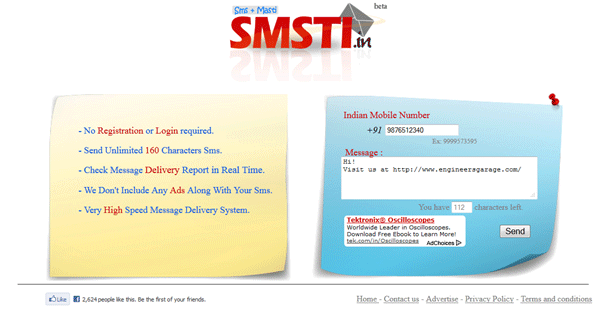
How Online SMS are sent
The life of an online SMS commences in the network jungle the moment you click on the send button. And that is where the user can cross fingers and hope it reaches the intended recipient while waiting for a delivery report. The internet is a quagmire of various protocols which help us to navigate through the World Wide Web. One of the most common formats adopted is the HTTP (Hyper Text Transfer Protocol), which does an effective cross-linking and navigation of various nodes of the webspace. The message entered by the user may travel the web in various protocols like HTTP, HTTPS (HTTP + SSL encryption), XML over HTTP / HTTPS, SMTP (email to SMS), and FTP. A simple HTTP request can be like:
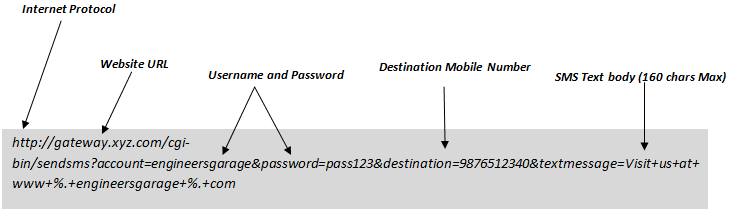
How websites send SMS to mobile phones
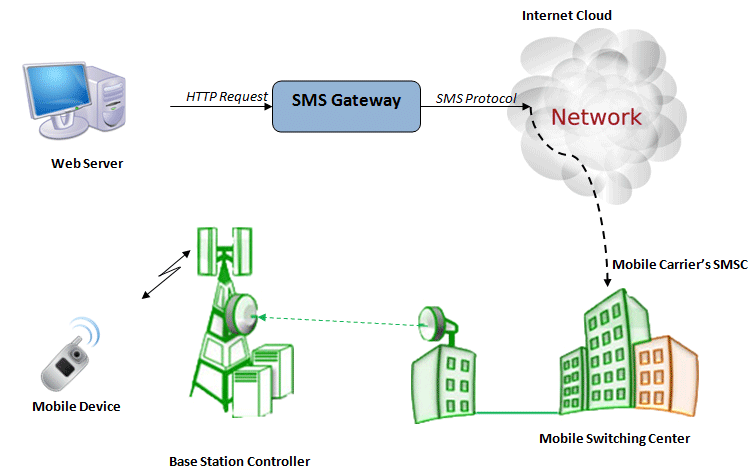
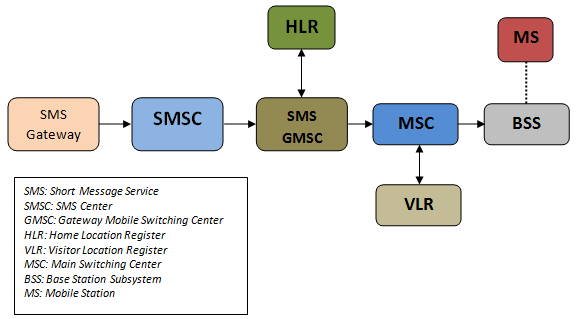
The block diagram of the message flow is shown above.
 
1.      The website server makes an entry of all the SMS details in its database record before it injects the message into the network. This may include the IP address of the user, user details, the time of login, message sent, destination number, time of sending message etc.
 
2.      For a message to be accepted as a valid SMS in the mobile networks, it must have a few necessary parameters. These are Header (this identifies the type of message to be sent), Service Centre Timestamp, phone number of the sender, protocol identifier, data coding scheme, length of the message and the message itself. The message is input to a SMS gateway which handles the necessary protocol conversion. This protocol conversion is necessary because the internet request coming from a web server is generally in the form of an http request(Hyper Text Transfer Protocol), while the mobile networks make use of the SS7 signalling protocols. Thus, an SMS gateway acts as a bridge between the two network formats. For illustration, the message sent above as an http request may look like this in the CIMD protocol after conversion:
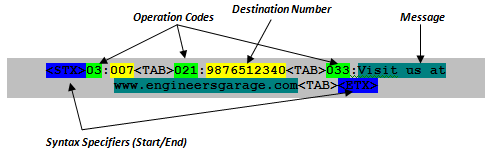
 

How SMS are sent by Websites

 
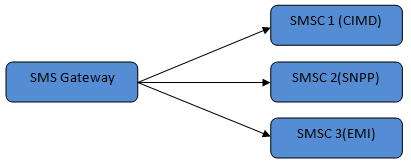
A SMS Gateway can be an application API written in programming languages like C/C++, Java etc. implemented in the server backend, or it can be a readymade solution provided by the software companies in the form of SaaS (Software as a Service). Websites usually employ Direct-to-SMSC gateway type of gateways to achieve this kind of conversion. Such Gateways are directly connected to the Mobile Operators SMS Centers (SMSC) through internet or via leased lines. It is the SMS centers which store the messages sent by a user and deliver it to the intended recipient when they are available.
 

SMS Gateway

 
3.      All the SMS transactions on the mobile network are handled by SMS Centers (SMSCs) which can work on various protocols. It is necessary to convert the requests into the suitable protocols for successful communication as they do not understand the internet protocols. For example, Nokia uses CIMD protocol, CMG uses EMI while many others use SNPP protocol.
 

SMS centers

 
After going through a succession of steps of internal processing, the local GMSC sends an appeal to the HLR (Home Location Register) and gets the information required to route the message to the receiver. This includes the network information of the recipient so that it can be sent to Main Switching Center of the respective provider via the home MSC. The GMSC is the window of any network to the rest of the mobile networks.
 
4.      The target MSC checks the receiver information using the VLR (Visitor Location Register) and does the necessary authentication and validation. The HLR and VLR are databases that keep entries of all the registered users in their specified coverage areas. The SMS uses a store and forward service. The MSC of the recipient forwards the message to the mobile server unit and stores the message there until received by the recipient or the maximum storage time expires, whichever comes first. If successful, the text is put on the internal memory of the SIM card until it is deleted by the user.
 
5.      The MSC of the recipient then provides a form of acknowledgement to the SMS centre which would be reported back to the original sender as a delivery report if such service has been provided by the website.
 
In this way, a website can be used to send SMS to a valid mobile number.


Filed Under: How to


Next Article

← Previous Article
Next Article →

Questions related to this article?
👉Ask and discuss on Electro-Tech-Online.com and EDAboard.com forums.


Tell Us What You Think!! Cancel reply

You must be logged in to post a comment.

EE TECH TOOLBOX

“ee
Tech Toolbox: Internet of Things
Explore practical strategies for minimizing attack surfaces, managing memory efficiently, and securing firmware. Download now to ensure your IoT implementations remain secure, efficient, and future-ready.

EE Learning Center

EE Learning Center
“engineers
EXPAND YOUR KNOWLEDGE AND STAY CONNECTED
Get the latest info on technologies, tools and strategies for EE professionals.

HAVE A QUESTION?

Have a technical question about an article or other engineering questions? Check out our engineering forums EDABoard.com and Electro-Tech-Online.com where you can get those questions asked and answered by your peers!


RSS EDABOARD.com Discussions

  • Reducing "shoot-through" in offline Full Bridge SMPS?
  • High Side current sensing
  • How to simulate power electronics converter in PSpice?
  • Voltage mode pushpull is a nonsense SMPS?
  • Layout IRN reduction in Comparator

RSS Electro-Tech-Online.com Discussions

  • Back to the old BASIC days
  • Parts required for a personal project
  • PIC KIT 3 not able to program dsPIC
  • Failure of polypropylene motor-run capacitors
  • Siemens large industrial PLC parts

Featured – RPi Python Programming (27 Part)

  • RPi Python Programming 21: The SIM900A AT commands
  • RPi Python Programming 22: Calls & SMS using a SIM900A GSM-GPRS modem
  • RPi Python Programming 23: Interfacing a NEO-6MV2 GPS module with Raspberry Pi
  • RPi Python Programming 24: I2C explained
  • RPi Python Programming 25 – Synchronous serial communication in Raspberry Pi using I2C protocol
  • RPi Python Programming 26 – Interfacing ADXL345 accelerometer sensor with Raspberry Pi

Recent Articles

  • What is AWS IoT Core and when should you use it?
  • AC-DC power supply extends voltage range to 800 V DC
  • Infineon’s inductive sensor integrates coil system driver, signal conditioning circuits and DSP
  • Arm Cortex-M23 MCU delivers 87.5 µA/MHz active mode
  • STMicroelectronics releases automotive amplifiers with in-play open-load detection

EE ENGINEERING TRAINING DAYS

engineering

Submit a Guest Post

submit a guest post
Engineers Garage
  • Analog IC TIps
  • Connector Tips
  • Battery Power Tips
  • DesignFast
  • EDABoard Forums
  • EE World Online
  • Electro-Tech-Online Forums
  • EV Engineering
  • Microcontroller Tips
  • Power Electronic Tips
  • Sensor Tips
  • Test and Measurement Tips
  • 5G Technology World
  • Subscribe to our newsletter
  • About Us
  • Contact Us
  • Advertise

Copyright © 2025 WTWH Media LLC. All Rights Reserved. The material on this site may not be reproduced, distributed, transmitted, cached or otherwise used, except with the prior written permission of WTWH Media
Privacy Policy

Search Engineers Garage

  • Electronic Projects & Tutorials
    • Electronic Projects
      • Arduino Projects
      • AVR
      • Raspberry pi
      • ESP8266
      • BeagleBone
      • 8051 Microcontroller
      • ARM
      • PIC Microcontroller
      • STM32
    • Tutorials
      • Audio Electronics
      • Battery Management
      • Brainwave
      • Electric Vehicles
      • EMI/EMC/RFI
      • Hardware Filters
      • IoT tutorials
      • Power Tutorials
      • Python
      • Sensors
      • USB
      • VHDL
    • Circuit Design
    • Project Videos
    • Components
  • Articles
    • Tech Articles
    • Insight
    • Invention Stories
    • How to
    • What Is
  • News
    • Electronic Product News
    • Business News
    • Company/Start-up News
    • DIY Reviews
    • Guest Post
  • Forums
    • EDABoard.com
    • Electro-Tech-Online
    • EG Forum Archive
  • DigiKey Store
    • Cables, Wires
    • Connectors, Interconnect
    • Discrete
    • Electromechanical
    • Embedded Computers
    • Enclosures, Hardware, Office
    • Integrated Circuits (ICs)
    • Isolators
    • LED/Optoelectronics
    • Passive
    • Power, Circuit Protection
    • Programmers
    • RF, Wireless
    • Semiconductors
    • Sensors, Transducers
    • Test Products
    • Tools
  • Learn
    • eBooks/Tech Tips
    • Design Guides
    • Learning Center
    • Tech Toolboxes
    • Webinars & Digital Events
  • Resources
    • Digital Issues
    • EE Training Days
    • LEAP Awards
    • Podcasts
    • Webinars / Digital Events
    • White Papers
    • Engineering Diversity & Inclusion
    • DesignFast
  • Guest Post Guidelines
  • Advertise
  • Subscribe