Engineers Garage

  • Electronic Projects & Tutorials
    • Electronic Projects
      • Arduino Projects
      • AVR
      • Raspberry pi
      • ESP8266
      • BeagleBone
      • 8051 Microcontroller
      • ARM
      • PIC Microcontroller
      • STM32
    • Tutorials
      • Audio Electronics
      • Battery Management
      • Brainwave
      • Electric Vehicles
      • EMI/EMC/RFI
      • Hardware Filters
      • IoT tutorials
      • Power Tutorials
      • Python
      • Sensors
      • USB
      • VHDL
    • Circuit Design
    • Project Videos
    • Components
  • Articles
    • Tech Articles
    • Insight
    • Invention Stories
    • How to
    • What Is
  • News
    • Electronic Product News
    • Business News
    • Company/Start-up News
    • DIY Reviews
    • Guest Post
  • Forums
    • EDABoard.com
    • Electro-Tech-Online
    • EG Forum Archive
  • DigiKey Store
    • Cables, Wires
    • Connectors, Interconnect
    • Discrete
    • Electromechanical
    • Embedded Computers
    • Enclosures, Hardware, Office
    • Integrated Circuits (ICs)
    • Isolators
    • LED/Optoelectronics
    • Passive
    • Power, Circuit Protection
    • Programmers
    • RF, Wireless
    • Semiconductors
    • Sensors, Transducers
    • Test Products
    • Tools
  • Learn
    • eBooks/Tech Tips
    • Design Guides
    • Learning Center
    • Tech Toolboxes
    • Webinars & Digital Events
  • Resources
    • Digital Issues
    • EE Training Days
    • LEAP Awards
    • Podcasts
    • Webinars / Digital Events
    • White Papers
    • Engineering Diversity & Inclusion
    • DesignFast
  • Guest Post Guidelines
  • Advertise
  • Subscribe

What is GPIB and is it obsolete?

By Rick Nelson October 15, 2023

The bus, codified as the IEEE 488 standard, continues to find use in legacy test-system upgrades and in calibration labs.

The General-Purpose Interface Bus (GPIB) began life as the Hewlett-Packard Interface Bus (HP-IB). Hewlett-Packard, whose electronic test-and-measurement business has evolved into today’s Keysight Technologies, created the interface in the 1960s to connect multiple instruments in automatic test equipment (ATE) systems. Hewlett-Packard licensed the technology to other companies, and the term GPIB began appearing. In 1978, the IEEE codified the interface as the IEEE 488 Standard Digital Interface for Programmable Instrumentation.

The 1960s and 1970s — so it must be obsolete, or close to it, right?
Not at all. GPIB is still widely used in legacy test systems, especially in military and aerospace applications.

What are the technical details?
GPIB is an 8-bit parallel interface employing 16 signal lines and eight ground lines. Figure 1 shows the connector as well as pin numbers, signal names, and signal descriptions. The GPIB interface includes eight bidirectional data lines (orange), five bus-management lines (blue), three handshake lines (red), and eight ground lines (gray).

Figure 1. The GPIB interface includes eight bidirectional data lines (orange), five bus-management lines (blue), three handshake lines (red), and eight ground lines (gray).

What are the drawbacks of GPIB?
GPIB has comparatively low data rates, limited data-transmission distances, and large, costly cables and connectors compared to alternatives. The basic interface has a data rate of 1 MB/s. An HS488 version developed by National Instruments (now NI) raises the data rate to 8 MB/s. The maximum data-transfer distance is about 20 m. In addition, parallel interfaces have fallen out of favor for several reasons, one being that the parallel bits in each byte can exhibit timing skew at high data rates.

What are the alternatives?
The Ethernet and USB serial interfaces are increasingly popular for interconnecting instruments. The LXI Consortium has defined LAN Extensions for Instrumentation (LXI), which enhances Ethernet with features specific for instrument control.

You mentioned that GPIB finds use in legacy systems. What benefits does it offer for legacy systems?
Say you have a GPIB-based legacy system consisting of several instruments of different types, and a signal generator fails. Your best approach would be to replace the failed unit with a new one of equivalent performance and identical interface connectors.

Is GPIB still readily available?
It rarely comes standard anymore, though some calibrators such as the Fluke 5522A still have GPIB as a standard feature. Many vendors offer it as an added-cost option. For example, AMETEK Programmable Power offers GPIB as an option on its Asterion AC programmable power source. The company also offers an emulation mode that enables the Asterion AC to substitute for one of its older sources with no or minimal changes to test programs.

What if one of my instruments fails and I cannot find a suitable replacement with GPIB?
At that point your best bet might be to migrate toward a hybrid system, such as the one shown in Figure 2, which incorporates GPIB and LXI. A hybrid system includes an Ethernet/GPIB gateway that lets you continue to use your GPIB instruments that still work. One such gateway is Keysight’s E5810B, which supports Ethernet and GPIB as well as USB and RS-232, the 1960s-era serial interface. The downside of evolving toward a hybrid architecture is that you will very likely have to make significant revisions to your test programs.
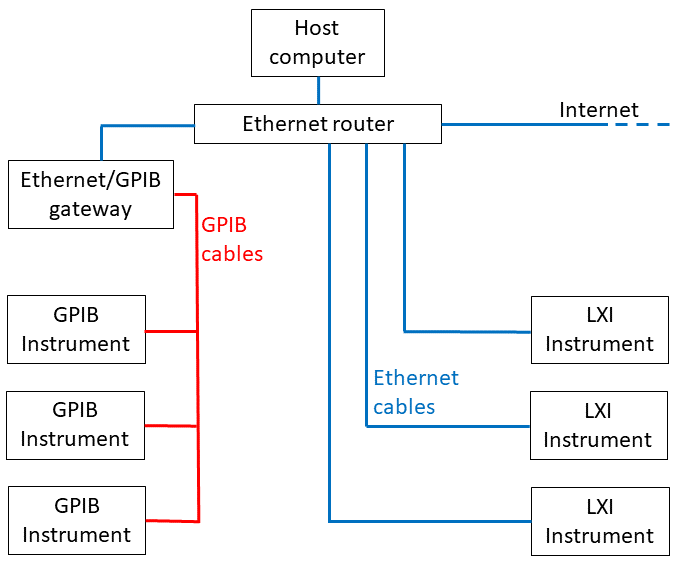
Figure 2. This hybrid instrument system includes GPIB and LXI instruments.

Where can I learn more?
NI has a paper titled “Eight Ways to Increase GPIB System Performance.” The LXI Consortium has more on hybrid systems here. CONTEC has the basics on GPIB, including information on daisy-chain and star connection topologies. Omega has an overview that discusses GPIB protocol, mechanical and electrical specifications, handshaking, addressing, and system controllers.


Filed Under: Tutorials, What Is


Next Article

← Previous Article
Next Article →

Questions related to this article?
👉Ask and discuss on Electro-Tech-Online.com and EDAboard.com forums.


Tell Us What You Think!! Cancel reply

You must be logged in to post a comment.

EE TECH TOOLBOX

“ee
Tech Toolbox: Internet of Things
Explore practical strategies for minimizing attack surfaces, managing memory efficiently, and securing firmware. Download now to ensure your IoT implementations remain secure, efficient, and future-ready.

EE Learning Center

EE Learning Center
“engineers
EXPAND YOUR KNOWLEDGE AND STAY CONNECTED
Get the latest info on technologies, tools and strategies for EE professionals.

HAVE A QUESTION?

Have a technical question about an article or other engineering questions? Check out our engineering forums EDABoard.com and Electro-Tech-Online.com where you can get those questions asked and answered by your peers!


RSS EDABOARD.com Discussions

  • Reducing "shoot-through" in offline Full Bridge SMPS?
  • High Side current sensing
  • How to simulate power electronics converter in PSpice?
  • Voltage mode pushpull is a nonsense SMPS?
  • Layout IRN reduction in Comparator

RSS Electro-Tech-Online.com Discussions

  • Back to the old BASIC days
  • Parts required for a personal project
  • PIC KIT 3 not able to program dsPIC
  • Failure of polypropylene motor-run capacitors
  • Siemens large industrial PLC parts

Featured – RPi Python Programming (27 Part)

  • RPi Python Programming 21: The SIM900A AT commands
  • RPi Python Programming 22: Calls & SMS using a SIM900A GSM-GPRS modem
  • RPi Python Programming 23: Interfacing a NEO-6MV2 GPS module with Raspberry Pi
  • RPi Python Programming 24: I2C explained
  • RPi Python Programming 25 – Synchronous serial communication in Raspberry Pi using I2C protocol
  • RPi Python Programming 26 – Interfacing ADXL345 accelerometer sensor with Raspberry Pi

Recent Articles

  • What is AWS IoT Core and when should you use it?
  • AC-DC power supply extends voltage range to 800 V DC
  • Infineon’s inductive sensor integrates coil system driver, signal conditioning circuits and DSP
  • Arm Cortex-M23 MCU delivers 87.5 µA/MHz active mode
  • STMicroelectronics releases automotive amplifiers with in-play open-load detection

EE ENGINEERING TRAINING DAYS

engineering

Submit a Guest Post

submit a guest post
Engineers Garage
  • Analog IC TIps
  • Connector Tips
  • Battery Power Tips
  • DesignFast
  • EDABoard Forums
  • EE World Online
  • Electro-Tech-Online Forums
  • EV Engineering
  • Microcontroller Tips
  • Power Electronic Tips
  • Sensor Tips
  • Test and Measurement Tips
  • 5G Technology World
  • Subscribe to our newsletter
  • About Us
  • Contact Us
  • Advertise

Copyright © 2025 WTWH Media LLC. All Rights Reserved. The material on this site may not be reproduced, distributed, transmitted, cached or otherwise used, except with the prior written permission of WTWH Media
Privacy Policy

Search Engineers Garage

  • Electronic Projects & Tutorials
    • Electronic Projects
      • Arduino Projects
      • AVR
      • Raspberry pi
      • ESP8266
      • BeagleBone
      • 8051 Microcontroller
      • ARM
      • PIC Microcontroller
      • STM32
    • Tutorials
      • Audio Electronics
      • Battery Management
      • Brainwave
      • Electric Vehicles
      • EMI/EMC/RFI
      • Hardware Filters
      • IoT tutorials
      • Power Tutorials
      • Python
      • Sensors
      • USB
      • VHDL
    • Circuit Design
    • Project Videos
    • Components
  • Articles
    • Tech Articles
    • Insight
    • Invention Stories
    • How to
    • What Is
  • News
    • Electronic Product News
    • Business News
    • Company/Start-up News
    • DIY Reviews
    • Guest Post
  • Forums
    • EDABoard.com
    • Electro-Tech-Online
    • EG Forum Archive
  • DigiKey Store
    • Cables, Wires
    • Connectors, Interconnect
    • Discrete
    • Electromechanical
    • Embedded Computers
    • Enclosures, Hardware, Office
    • Integrated Circuits (ICs)
    • Isolators
    • LED/Optoelectronics
    • Passive
    • Power, Circuit Protection
    • Programmers
    • RF, Wireless
    • Semiconductors
    • Sensors, Transducers
    • Test Products
    • Tools
  • Learn
    • eBooks/Tech Tips
    • Design Guides
    • Learning Center
    • Tech Toolboxes
    • Webinars & Digital Events
  • Resources
    • Digital Issues
    • EE Training Days
    • LEAP Awards
    • Podcasts
    • Webinars / Digital Events
    • White Papers
    • Engineering Diversity & Inclusion
    • DesignFast
  • Guest Post Guidelines
  • Advertise
  • Subscribe