Engineers Garage

  • Electronic Projects & Tutorials
    • Electronic Projects
      • Arduino Projects
      • AVR
      • Raspberry pi
      • ESP8266
      • BeagleBone
      • 8051 Microcontroller
      • ARM
      • PIC Microcontroller
      • STM32
    • Tutorials
      • Audio Electronics
      • Battery Management
      • Brainwave
      • Electric Vehicles
      • EMI/EMC/RFI
      • Hardware Filters
      • IoT tutorials
      • Power Tutorials
      • Python
      • Sensors
      • USB
      • VHDL
    • Circuit Design
    • Project Videos
    • Components
  • Articles
    • Tech Articles
    • Insight
    • Invention Stories
    • How to
    • What Is
  • News
    • Electronic Product News
    • Business News
    • Company/Start-up News
    • DIY Reviews
    • Guest Post
  • Forums
    • EDABoard.com
    • Electro-Tech-Online
    • EG Forum Archive
  • DigiKey Store
    • Cables, Wires
    • Connectors, Interconnect
    • Discrete
    • Electromechanical
    • Embedded Computers
    • Enclosures, Hardware, Office
    • Integrated Circuits (ICs)
    • Isolators
    • LED/Optoelectronics
    • Passive
    • Power, Circuit Protection
    • Programmers
    • RF, Wireless
    • Semiconductors
    • Sensors, Transducers
    • Test Products
    • Tools
  • Learn
    • eBooks/Tech Tips
    • Design Guides
    • Learning Center
    • Tech Toolboxes
    • Webinars & Digital Events
  • Resources
    • Digital Issues
    • EE Training Days
    • LEAP Awards
    • Podcasts
    • Webinars / Digital Events
    • White Papers
    • Engineering Diversity & Inclusion
    • DesignFast
  • Guest Post Guidelines
  • Advertise
  • Subscribe

How to create an RFID-based locker system using Arduino

By Ayush Jain January 17, 2025

Need somewhere to secure a few items? No problem! In this project, we’ll design an RFID-based locker system that offers a reliable and convenient solution for securing objects using radio frequency identification (RFID) technology.
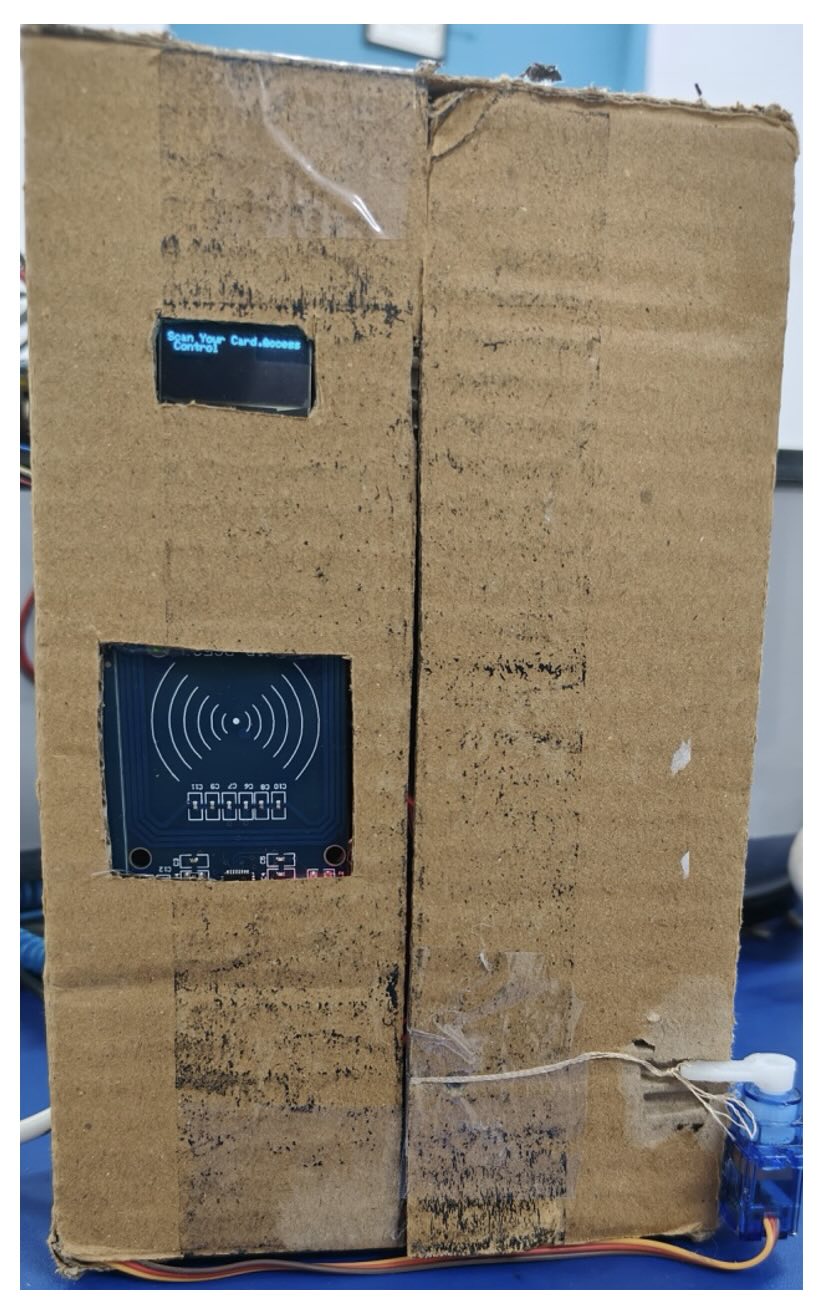
Figure 1. The protoype

Working operation: The RFID locker system

The RFID reader scans a unique tag, and if it matches a pre-registered one, the servo motor unlocks the door. However, the servo motor remains inactive if an unregistered tag is scanned. The servo’s shaft is mechanically connected to a door, allowing it to open and close within a predefined time frame.

Arduino manages the stored codes and controls the servo, activating it only when the RFID reader detects a valid tag. 

While this project demonstrates a small-scale model, it can be scaled up for larger applications with enhanced electronics. For example, the prototype uses a plastic-geared servo, but for bigger setups, a metal-geared servo could be employed for greater durability and efficiency.
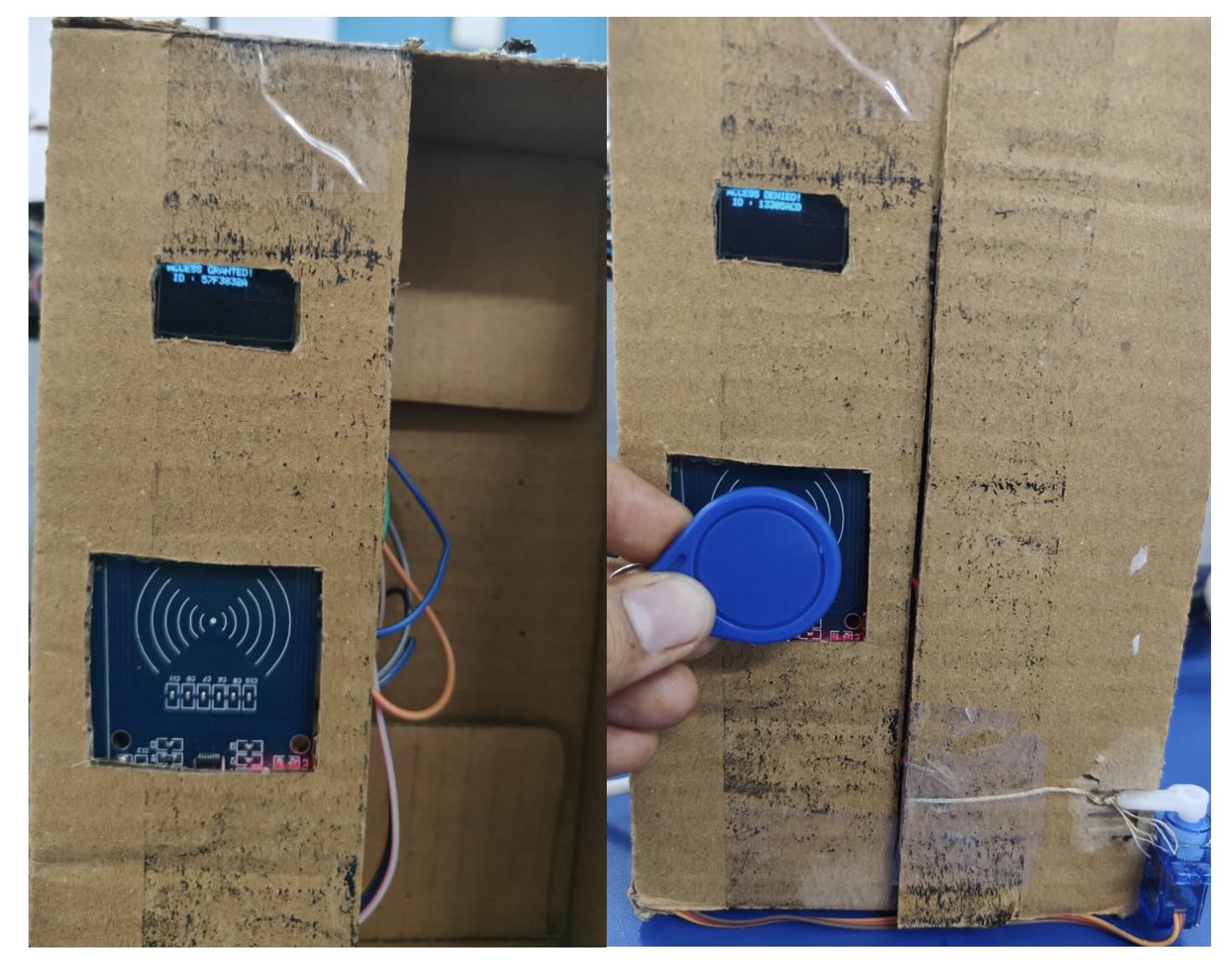
Figure 2. The RFID lock.

Materials

  1. Arduino UNO
  2. RFID reader module
  3. RFID tags
  4. Servo motor
  5. OLED display
  6. Jumper wires
  7. Breadboard or prototype board
  8. 5V power supply
  9. Lockable enclosure or cabinet for the locker

Instructions

Step 1. Hardware set-up
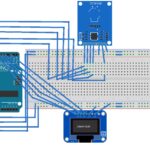
Begin by connecting the RFID reader module to Arduino UNO using the jumper wires. Ensure the breadboard’s power rails are connected to Arduino’s power and ground pins. The servo’s 5V must also connect with the OLED and RFID.

How to connect the RFID board to Arduino:

  1. SDA to D10
  2. SCK to D13
  3. MOSI to D11
  4. MISO to D12
  5. RST to D9

For the OLED display, connect:

  1. SCK to A5
  2. SDA to A4

Additionally, the servo’s signal pin must connect with Arduino’s D6. The servo acts as the locking mechanism for the locker. Once all of the components connected, you’re ready to add Arduino’s program to the board.
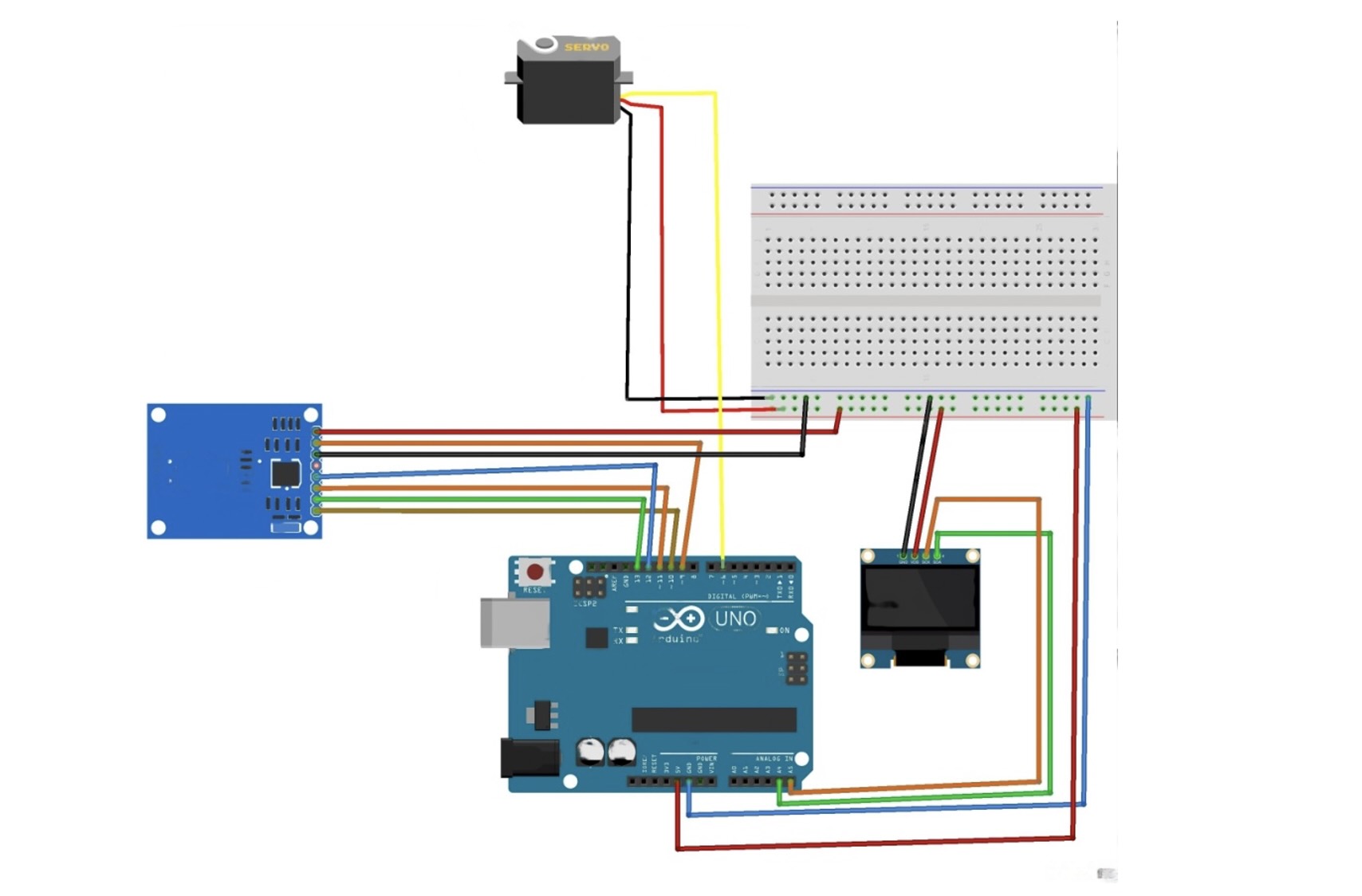
Figure 3. Circuit diagram

Mount the components securely on a breadboard or prototype board.

Step 2: Programming Arduino

  • Ensure Arduino IDE is installed on your computer.
  • Write the code to interface the RFID reader module. This code will read the unique IDs of the RFID tags and compare them with a list of authorized IDs.
  • Implement the logic to control the servo motor, based on the detected RFID tag. When an authorized tag is detected, the servo unlocks the locker, and when an unauthorized tag is detected, the servo remains locked.

The code


Step 3. The locker set-up

  • Design or procure a locker that can secure objects and provide access to the locker compartment.
  • Install the servo motor outside the locker in a way that it can actuate the locking mechanism.
  • One door should open and close the mechanism while another door will be equipped with the electronics like RFID board and OLED board.
  • Place RFID tags on items or cards that will serve as access keys for the locker. Assign each tag a unique ID and store these IDs within Arduino’s code.

Step 4. Test the system

  • Power up the system.
  • Test the system by presenting the RFID tag to the reader. Verify that the locker unlocks when the authorized tag is detected and remains locked for unauthorized ones.

Step 5. Final assembly

  • Once testing is successful, finalize the assembly of the components inside the locker enclosure.
  • Secure all connections and components to prevent damage or tampering.
  • Label the RFID tag.
  • Provide instructions for users on how to access the locker using their assigned tags.

Conclusion

By following the above steps, it’s possible to successfully build an RFID-based locker system that offers secure storage for valuables or sensitive items. This project demonstrates the adaptability of RFID technology in creating efficient and user-friendly security solutions.

Be sure to thoroughly test the system to verify that all components function properly and reliably before deploying it for practical use.

Video

https://www.engineersgarage.com/wp-content/uploads/2025/01/RFID_final-1.mp4


You may also like:


  • What are the most practical and useful modern spy gadgets?

  • How to build a GPS tracking device?

  • How to build your own smart home

  • Arduino compatible coding 02: Getting started with Arduino

  • What are the top open-source software systems for home automation?

  • Arduino-based RFID door lock

Filed Under: Arduino Projects, Electronic Projects, Video
Tagged With: Arduino, electronicproject, locker, rfid, storage, video
 

Next Article

← Previous Article
Next Article →

Questions related to this article?
👉Ask and discuss on EDAboard.com and Electro-Tech-Online.com forums.


Tell Us What You Think!! Cancel reply

You must be logged in to post a comment.

EE TECH TOOLBOX

“ee
Tech Toolbox: Internet of Things
Explore practical strategies for minimizing attack surfaces, managing memory efficiently, and securing firmware. Download now to ensure your IoT implementations remain secure, efficient, and future-ready.

EE Learning Center

EE Learning Center
“engineers
EXPAND YOUR KNOWLEDGE AND STAY CONNECTED
Get the latest info on technologies, tools and strategies for EE professionals.

HAVE A QUESTION?

Have a technical question about an article or other engineering questions? Check out our engineering forums EDABoard.com and Electro-Tech-Online.com where you can get those questions asked and answered by your peers!


RSS EDABOARD.com Discussions

  • Reducing "shoot-through" in offline Full Bridge SMPS?
  • High Side current sensing
  • How to simulate power electronics converter in PSpice?
  • Voltage mode pushpull is a nonsense SMPS?
  • Layout IRN reduction in Comparator

RSS Electro-Tech-Online.com Discussions

  • Back to the old BASIC days
  • Parts required for a personal project
  • PIC KIT 3 not able to program dsPIC
  • Failure of polypropylene motor-run capacitors
  • Siemens large industrial PLC parts

Featured – RPi Python Programming (27 Part)

  • RPi Python Programming 21: The SIM900A AT commands
  • RPi Python Programming 22: Calls & SMS using a SIM900A GSM-GPRS modem
  • RPi Python Programming 23: Interfacing a NEO-6MV2 GPS module with Raspberry Pi
  • RPi Python Programming 24: I2C explained
  • RPi Python Programming 25 – Synchronous serial communication in Raspberry Pi using I2C protocol
  • RPi Python Programming 26 – Interfacing ADXL345 accelerometer sensor with Raspberry Pi

Recent Articles

  • What is AWS IoT Core and when should you use it?
  • AC-DC power supply extends voltage range to 800 V DC
  • Infineon’s inductive sensor integrates coil system driver, signal conditioning circuits and DSP
  • Arm Cortex-M23 MCU delivers 87.5 µA/MHz active mode
  • STMicroelectronics releases automotive amplifiers with in-play open-load detection

EE ENGINEERING TRAINING DAYS

engineering

Submit a Guest Post

submit a guest post
Engineers Garage
  • Analog IC TIps
  • Connector Tips
  • Battery Power Tips
  • DesignFast
  • EDABoard Forums
  • EE World Online
  • Electro-Tech-Online Forums
  • EV Engineering
  • Microcontroller Tips
  • Power Electronic Tips
  • Sensor Tips
  • Test and Measurement Tips
  • 5G Technology World
  • Subscribe to our newsletter
  • About Us
  • Contact Us
  • Advertise

Copyright © 2025 WTWH Media LLC. All Rights Reserved. The material on this site may not be reproduced, distributed, transmitted, cached or otherwise used, except with the prior written permission of WTWH Media
Privacy Policy

Search Engineers Garage

  • Electronic Projects & Tutorials
    • Electronic Projects
      • Arduino Projects
      • AVR
      • Raspberry pi
      • ESP8266
      • BeagleBone
      • 8051 Microcontroller
      • ARM
      • PIC Microcontroller
      • STM32
    • Tutorials
      • Audio Electronics
      • Battery Management
      • Brainwave
      • Electric Vehicles
      • EMI/EMC/RFI
      • Hardware Filters
      • IoT tutorials
      • Power Tutorials
      • Python
      • Sensors
      • USB
      • VHDL
    • Circuit Design
    • Project Videos
    • Components
  • Articles
    • Tech Articles
    • Insight
    • Invention Stories
    • How to
    • What Is
  • News
    • Electronic Product News
    • Business News
    • Company/Start-up News
    • DIY Reviews
    • Guest Post
  • Forums
    • EDABoard.com
    • Electro-Tech-Online
    • EG Forum Archive
  • DigiKey Store
    • Cables, Wires
    • Connectors, Interconnect
    • Discrete
    • Electromechanical
    • Embedded Computers
    • Enclosures, Hardware, Office
    • Integrated Circuits (ICs)
    • Isolators
    • LED/Optoelectronics
    • Passive
    • Power, Circuit Protection
    • Programmers
    • RF, Wireless
    • Semiconductors
    • Sensors, Transducers
    • Test Products
    • Tools
  • Learn
    • eBooks/Tech Tips
    • Design Guides
    • Learning Center
    • Tech Toolboxes
    • Webinars & Digital Events
  • Resources
    • Digital Issues
    • EE Training Days
    • LEAP Awards
    • Podcasts
    • Webinars / Digital Events
    • White Papers
    • Engineering Diversity & Inclusion
    • DesignFast
  • Guest Post Guidelines
  • Advertise
  • Subscribe